The May 2026 Chemical Bulletin 
PDF of the Latest Bulletin
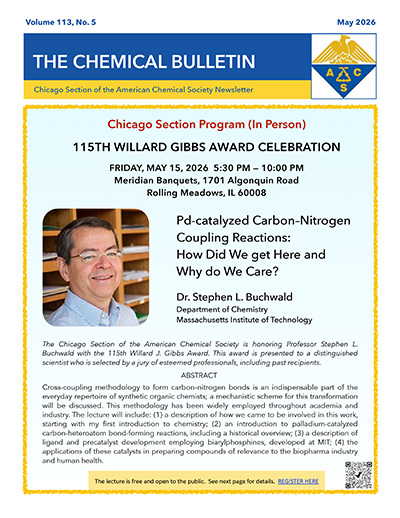
https://chicagoacs.org/images/downloads/Chemical_Bulletin/2026_05_chembulll.pdf
Next Meeting
115th Willard Gibbs Award Celebration
Friday, May 15
5:30 PM - 10:00 PM
Meridian Banquets
Rolling Meadows, IL
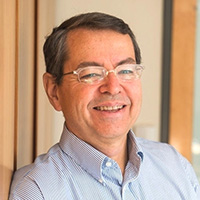
Dr. Stephen L. Buchwald
Department of Chemistry
Massachusetts Institute of Technology
"Palladium-catalyzed Carbon-Nitrogen Coupling Reactions:
How Did We get Here and Why do We Care?"
The Chicago Section of the American Chemical Society is honoring Professor Stephen L. Buchwald with the 115th Willard J. Gibbs Award. This award is presented to a distinguished scientist who is selected by a jury of esteemed professionals, including past recipients.
ABSTRACT
Cross-coupling methodology to form carbon–nitrogen bonds is an indispensable part of the everyday repertoire of synthetic organic chemists; a mechanistic scheme for this transformation will be discussed. This methodology has been widely employed throughout academia and industry. The lecture will include: (1) a description of how we came to be involved in this work, starting with my first introduction to chemistry; (2) an introduction to palladium-catalyzed carbon-heteroatom bond-forming reactions, including a historical overview; (3) a description of ligand and precatalyst development employing biarylphosphines, developed at MIT; (4) the applications of these catalysts in preparing compounds of relevance to the biopharma industry and human health.

Citation
• For the development of the Buchwald–Hartwig coupling reaction
•
Program:
- 5:30 PM Reception with hors d'oeuvres and two complimentary drinks
- 6:30 PM Dinner
- 8:00 PM Gibbs Award Ceremony
- "A History of the Willard Gibbs Award" by Amy Balija, Chicago Section Chair
- 8:15 PM Gibbs Award Lecture by Professor Buchwald
DINNER BANQUET
- Minestrone Soup & Meridian Salad
- Choice of entree:
- Roast Top Sirloin of Beef with rosemary merlot
- Fresh Broiled Norwegian Salmon with dill
- Portobello Mushroom with zucchini
- Hot Fudge Brownie à la mode
Coffee and assorted soda included.
Cash bar for alcoholic beverages.
Event VENUE, COST
Meridian Banquets
1701 Algonquin Road
Rolling Meadows, IL 60008
http://www.meridianbanquets.com
https://maps.app.goo.gl/aVxH4MHgZxvcJF1fA
$50 (All attendees)
No charge for lecture-only attendance.
Parking on site
Served by Pace Bus #208, #606
Assistive listening devices supported (incl. T-coil)
REGISTRATION
REGISTER NOW
Deadline To Register
12:00 noon, May 11
https://chicagoacs.starchapter.com/meet-reg1.php?id=243
Questions? Email us (info-at-chicagoacs.org) or contact us by phone (847-391-9091).
Meet the Speaker
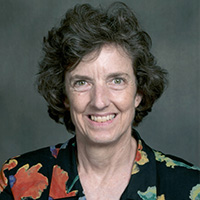
Stephen L. Buchwald was born in 1955 in Bloomington, Indiana. He received his Sc.B. from Brown University in 1977, where he worked with Kathlyn A. Parker and David E. Cane, as well as Professor Gilbert Stork at Columbia University. He entered Harvard University as a National Science Foundation Predoctoral Fellow in 1977 and received his Ph.D. in 1982 under the supervision of Jeremy R. Knowles. He was then a Myron A. Bantrell postdoctoral fellow at Caltech with Professor Robert H. Grubbs. In 1984, he joined the chemistry faculty at MIT as an assistant professor. He was promoted to associate professor (1989), then to professor (1993), and was named the Camille Dreyfus Professor in 1997. He served as Associate Head of MIT's Chemistry Department from July 2015 to August 2023. Buchwald has received numerous honors, including the ACS Award in Organometallic Chemistry (2000), the ACS Award for Creative Work in Synthetic Organic Chemistry (2006), and the Gustavus J. Esselen Award for Chemistry in the Public Interest (2010). He received the ACS Arthur C. Cope Award (2013), the Linus Pauling Medal (2014), and the Ulysses Medal (2014). In 2015, he received the BBVA Frontiers in Knowledge Award in Basic Sciences (2014 Award). He also received the William H. Nichols Award from the ACS New York Section (2016). In 2017, he received the Nagoya Gold Medal Lecture Award and the Carothers Award from the Delaware Section of the American Chemical Society. In 2018, he received the Tetrahedron Prize and the Dr. Karl Wamser Innovation Award (from the Technische Universität München). He was conferred the 2019 Roger Adams Award (ACS) and the 2019 Wolf Prize in Chemistry. In 2020, he was awarded the Yamada Koga Prize from the University of Tokyo (received in 2023). In 2021, he was honored with the Huang Yaozeng Award in Organometallic Chemistry of the Chinese Chemical Society, the Award for Creativity in Molecular Design and Synthesis from the ACS Northern New Jersey Organic Topical Group, and the inaugural Akira Suzuki Award from the Institute for Chemical Reaction Design and Discovery, Hokkaido University. In 2022, he received the Paul Karrar Gold Medal from the University of Zurich. He is a fellow of the American Academy of Arts and Sciences and a member of the National Academy of Sciences. Over the course of his career, Professor Buchwald has mentored more than 240 postdoctoral researchers, 100 graduate students, and numerous undergraduates and visiting scholars—many of whom have gone on to distinguished careers in academia and industry.
Letter from the Chair
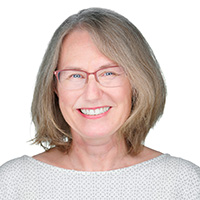
Chicago ACS Forging Ahead
with “Pardner”-ships
Do you remember old TV westerns? The parched bronco buster pushed his way through the saloon’s squeaky doors, ambled over to the poker table and sputtered through a mouthful of chewing tobacco: “Howdy pardner.”
— AMY BALIJA
Take the ACS Chicago Family Feud Survey!
Be part of history by participating in the ACS Chicago Family Feud Survey. The answers will be shared at the ACS Fall Meeting in Chicago August 23–27, 2026.
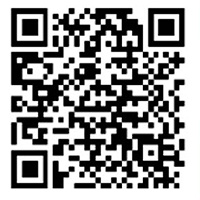
https://tinyurl.com/ChiACS-FamilyFeud2026
From the Archives
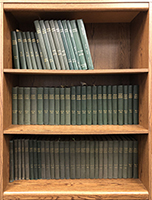
Why leave the poetical accomplishments of yesteryear to gather dust in the archives, when these (possibly humorous) verses can be reprinted in The Chemical Bulletin for the enjoyment of 21st-century terrestrians (now there’s a good word for a rhyme scheme). —Ed.
Origin of Avogadro’s Number?
Amadeo Giovanni Avogadro
- C. A. Eckroth
Analysis
It really takes a chemist of superior ability
The transfer of precipitate’s a touchy operation,
Much care is necessary for acceptable ignition,
The need for nimble finger tips is seen in gas analysis,
To operate a bomb implies considerable temerity,
Not everyone is qualified to run a distillation—
To be a proper analyst one must be super-human,
- The Chemical Bulletin, Vol. 24, January, 1937 (anon.)
Councilors' Report

Spring 2026 Council Meeting Report
The Spring National ACS Meeting was held in Atlanta, Georgia from March 22 to 26, 2026, both in person and online. As of March 24, there were 13,521 registrations (12,475 in-person and 1,046 online). The presider of the Council Meeting on the morning March 25 was Rigoberto Hernandez, current President of the ACS.
In person representing Chicago were: Amy Balija (Membership Affairs), Mark Cesa (Ethics), Russ Johnson (International Activities), Josh Kurutz (Chemists With Disabilities), Ana Clara Leal, Milt Levenberg (Senior Chemists), Tim Marin (Constitution and Bylaws), Anita Mehta, and Peggy Schott. Fran Kravitz (Women Chemists Committee) joined us online.
The Committee on Nominations and Elections (N&E) presented to the Council four nominees for selection as candidates for President-Elect for 2027: John Adams, Mary Virginia Orna, Laura Sremaniak, and Lisa McElwee-White. Council members voted for their first- and second-choice candidates in a ranked-choice voting scheme. The tallying of these ballots went through three rounds of elimination to narrow the field down to two candidates, namely, Lisa McElwee-White and Laura Sremaniak. These two names will be presented to the general membership as candidates for President-Elect for 2027.
The Committee on Nominations and Elections announced four candidates for Director-at-Large for the 2027-2029 term: Michael (Mick) Hurrey, Beth Lorsbach, William Provine, and Carolyn Ribes. The election of two Directors-at-Large from among these four candidates, along with any petition candidates, will be conducted in the fall, so no action was taken at this meeting. The Chicago Local Section is in District V, and we had no one up for election to serve on the Board of Directors in the coming term.
Oral reports were presented to Council by the Society President (Rigoberto Hernandez), President-Elect (Christina Bodurow), Immediate Past President (Dorothy Phillips), Chair of the Board (Wayne Jones), and Chief Executive Officer (Albert Horvath).
Here are some of the routine actions taken at the Council Meeting: On the recommendation of the Committee on Committees (ConC), and with concurrence of the Council Policy Committee (CPC), Council voted to continue the Committees on Analytical Reagents, Constitution and Bylaws, Divisional Activities, and Local Section Activities, and, subject to concurrence of the ACS Board of Directors, the Committees on Chemists with Disabilities, and Environment and Sustainability.
On the recommendation of ConC, and with concurrence of the CPC, Council voted to amend the name and duties of the Committee on Budget and Finance (B&F). The new name, subject to concurrence of the ACS Board of Directors, will be the Committee on Fiscal Affairs (CFA). This change reflects the growth and increased complexity of Society operations. A planned-for Board Finance Committee will assume fiduciary responsibility and enterprise-level focus.
On the recommendation of the Committee on International Activities (IAC), Council voted to approve the creation of a new International Chemical Sciences Chapter in Sri Lanka, subject to concurrence of the ACS Board of Directors.
On the recommendation of the Committee on Membership Affairs (MAC), Council voted to approve the 2027 Schedule of Dues and Benefits, subject to concurrence of the ACS Board of Directors. MAC proposed no changes from the 2026 Schedule of Dues and Benefits. The above actions were approved by over 95% of the Council members voting, and most by over 98%.
The Committee on Budget and Finance reported that in 2025, ACS had a net revenue of $50.7 million from operations and met all five of its financial guidelines. Over the past 25 years, revenue has more than doubled, with a fourfold increase in unrestricted net assets. ACS currently receives 58% of revenue from outside of North America and is active in 56 different jurisdictions.
Since the U.S. government has not funded or paid TSA workers for several weeks, everyone was warned to allow four hours to get through airport security. Since many councilors were planning to fly out on Wednesday afternoon, shortly after Council ended, this concern was high, resulting in a laser-like focus on completing Council business as expeditiously as possible. Much to our delight, we finished Council business and adjourned by 10:30 AM, certainly a record in this author’s experience!
• Respectfully submitted by Milt Levenberg, April 3, 2026
From the Editor's Desk
Good Reading (and Viewing) Ahead
Dear Readers,
Each year in the spring the Chicago Section serves as host to a long-running tradition, namely, the Willard Gibbs Medal banquet and lecture. All are encouraged to attend. Digital bulletin editor Josh Kurutz maintains a Wikipedia page called “Willard Gibbs Award”, complete with references to its 115-year history.
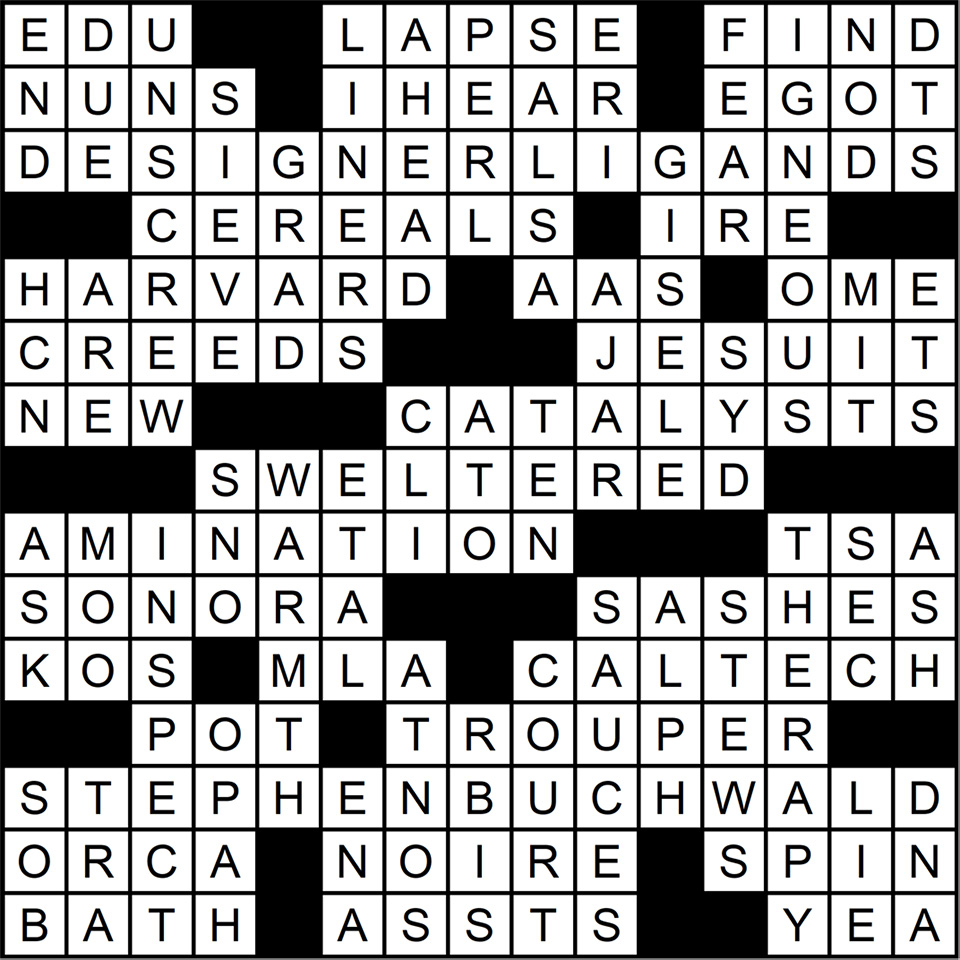
A brand new crossword puzzle featuring clues to this year’s Gibbs medalist, Steven Buchwald, has been created by Section member Irene Cesa and puzzle-meister George Barany (University of Minnesota, retired). The puzzle is challenging (yet solvable!) and is available online for digital solvers.
I would also call attention to the recorded keynote lectures (see page 11) presented at the recent ACS National Meeting in Atlanta. The talk given by Dr. Jennifer Doudna is a must-view for a number of reasons. Doudna showed only a handful of slides but described them fully. She emphasized repeatedly the reality that young chemists are fully capable of realizing their dreams, as she has done, by moving from strength to strength. Doudna’s Priestley Lecture is a masterclass in scientific communication.
Another “product” of the national meeting is the Council Report prepared by Milt Levenberg for this issue. The ACS Council, which meets twice a year to conduct the business of the society, is attended by the Councilors of the Chicago Section, many of whom perform volunteer service as members of national committees, as noted in the report.
Chicago Section Chair Amy Balija has written another marvelous installment commemorating the 150th anniversary of the American Chemical Society (1876–1926 and counting). Please take a minute also to review the thoughtful and imaginative illustrated poems by students at Chicago-area schools. The three local winners have demonstrated a good understanding of the benefits of trees in our lives.
If you have an idea for an article, column, short entry, advertisement, or humorous science poem, you may contact me at editor-at-chicagoacs.org. Thanks for reading this issue!
— MARGARET E. SCHOTT
FALL ACS NATIONAL MEETING IN CHICAGO
AUGUST 23–27, 2026
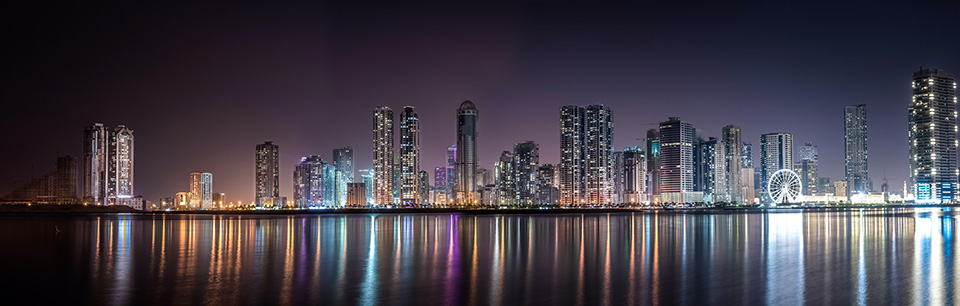
Image credit: pexels-amar-saleem-311012.jpg
We need volunteers for the ACS National Meeting!
Please contact chair-at-chicagoacs.org
Chemists Celebrate Earth Week

Illustrated Poem Contest Winners
In the spring and fall of each year, the American Chemical Society holds an Illustrated Poem Contest for K–12 students. Entries, which are submitted to Local ACS Sections, must feature a given theme and adhere to a specific set of guidelines; for example, poems are limited 40 words. First-place winners on the local level advance to the national contest. Thanks to the efforts of Chicago Section Outreach coordinator Sherri Rukes, we can share the winning local entries on the topic of “Into the Woods with Chemistry."
In this, its sesquicentennial (150th) year, ACS is celebrating the theme Chemistry is Everything by highlighting the essential role of trees and forests in building a sustainable world. The Illustrated Poem Contest serves to promote the positive role that chemistry plays in the world while giving students an opportunity to express their own ideas.
Congratulations to Emily, Allison, and Hassan!
Grades 3–5: Emily Fischer, Spring Brook Elementary, Naperville:
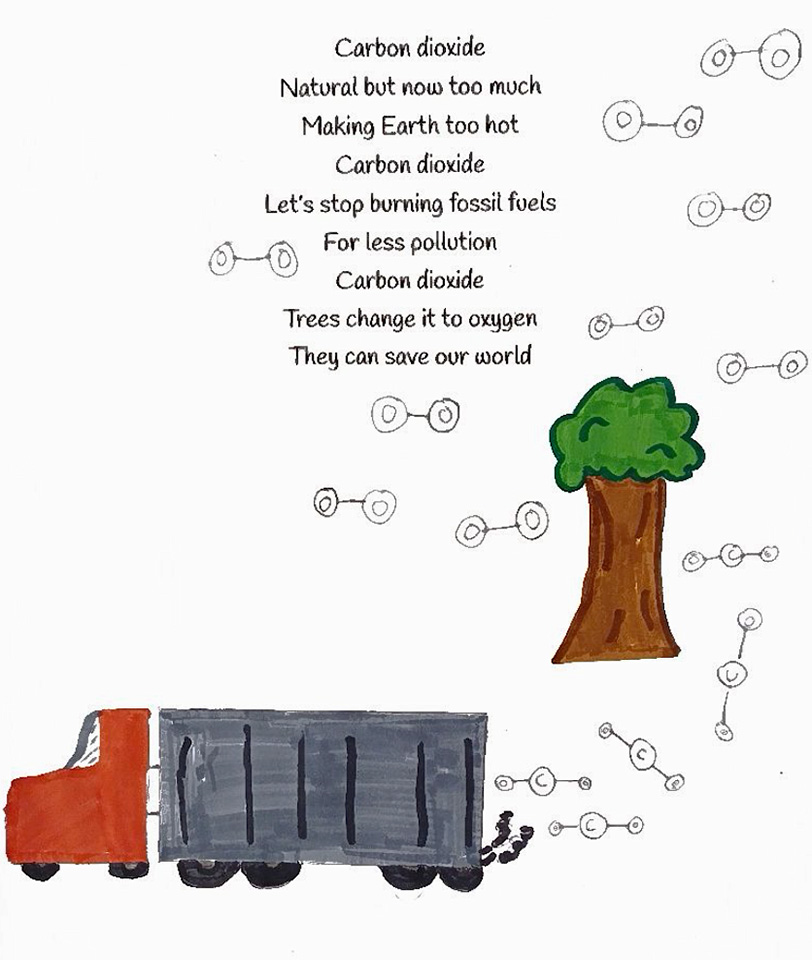
Carbon dioxide
Natural but now too much
Making Earth too hot
Carbon dioxide
Let's stop burning fossil fuels
For less pollution
Carbon dioxide
Trees change it to oxygen
They can save our world
•
Grades 6–8: Allison Fischer, Gregory Middle School, Naperville
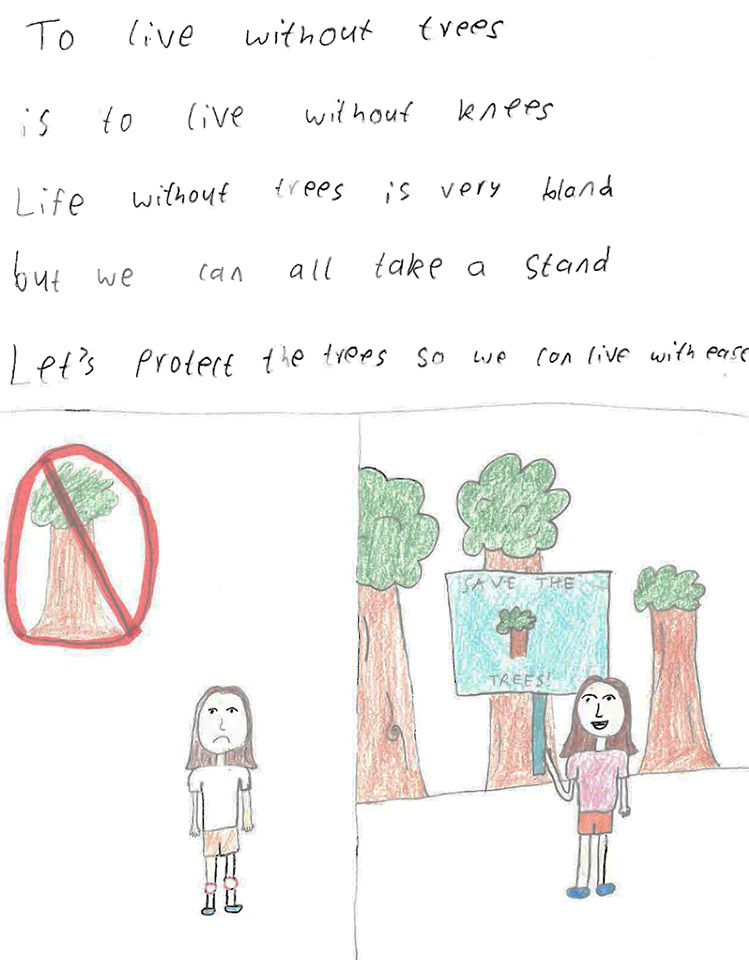
To live without trees
•
Grades 9–12: Hassan Rizwan,
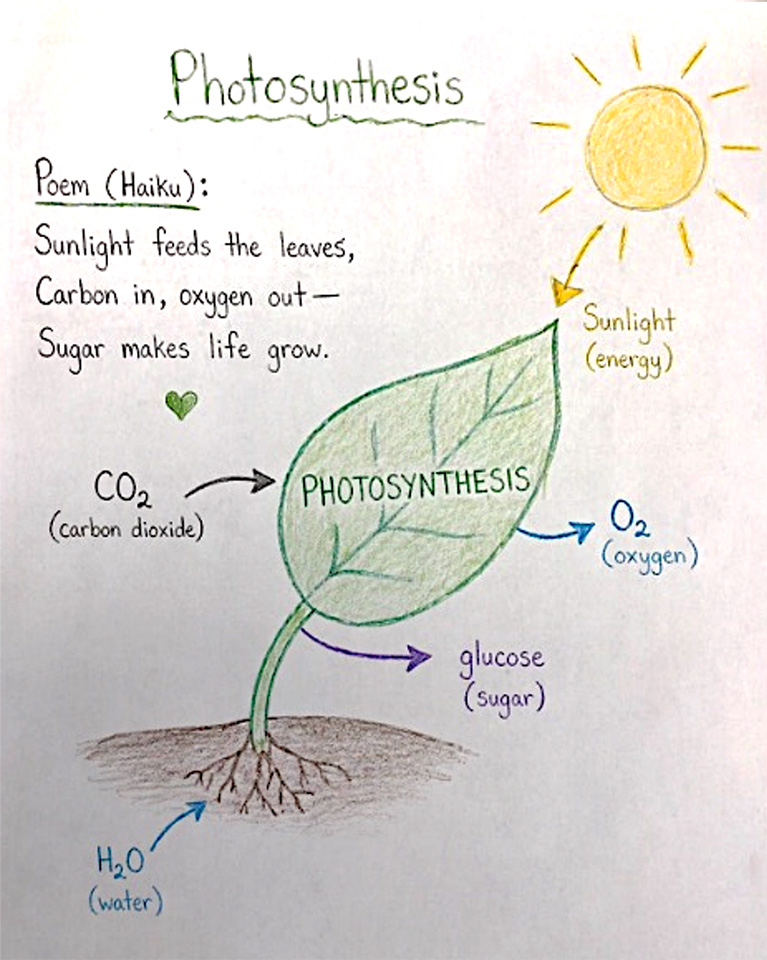
Sunlight feeds the leaves,
Carbon in, oxygen out -
Sugar makes life grow
Haiku is a traditional Japanese poetic form consisting of three phrases with a 5, 7, 5 syllable structure (17 total), focusing on nature, a specific moment in time, or human experience. It often features a seasonal reference and avoids rhyme, aiming for concise, vivid imagery. Modern haiku often adopt looser structures, focusing on capturing a poignant, instant insight.
—SHERRI RUKES, Education and Outreach Chair
Puzzle

Gibbs Tribute Puzzle
“Cross(word) Coupling,” a tribute puzzle in honor of the 2026 Gibbs Medalist, was created by George Barany, Professor Emeritus at the University of Minnesota, and Irene Cesa, a retired chemist from Wheaton, Illinois, and a member of the ACS Chicago Section. Answers to the clues celebrate the chemistry achievements recognized by the award, highlighting contributions that “enable everyone to live more comfortably and to understand the world better.” The authors thank Dave Cesa, Mark Cesa, Noam Elkies, Jed Fisher, Vivian London, and Paul Rossi for test-solving and editorial suggestions. See next page for the puzzle, and last page of this issue for the solution. Click here to test your puzzle-solving skills online.
Cross(word) Coupling
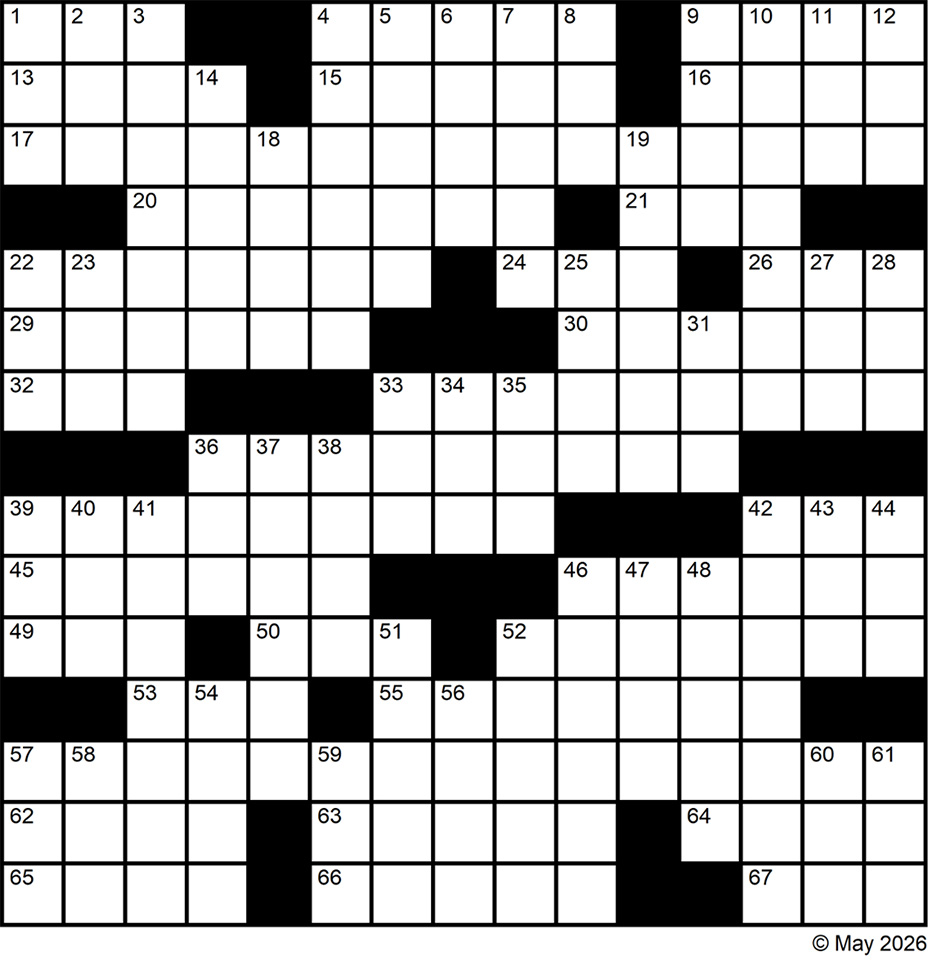
Across
1. Part of a college address
Down
1. Terminus, perhaps
ChemShorts for Kids
2-Ingredient Slime!
Introduction:
Who doesn’t love playing with slime? This experiment involves just 2 simple ingredients that are most likely in your household already! By just mixing these 2 simple ingredients, we can easily make slime through the beauty of chemistry.
Materials:
- Mixing bowl
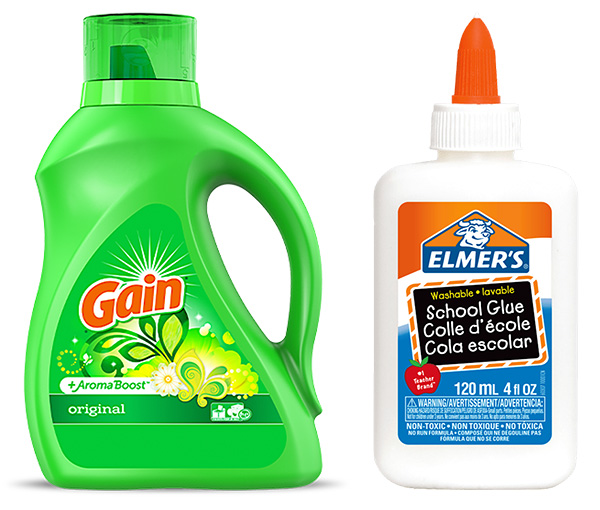
- 4-oz bottle of white Elmer’s glue
Experiment:
Using a mixing bowl, add in an entire 4-oz bottle of white Elmer's glue, along with 2 tablespoons of Gain laundry detergent. You can use a different detergent; however, measurements may differ depending on brand and formulation. After this, begin mixing both ingredients (this will take time, do not give up!). After a few minutes of mixing, the slime should have formed to the point where it is not leaving residue on the bowl. Once you have reached this point, you can then remove the slime from the mixing bowl and begin kneading it by hand until you’ve reached your ideal slime texture.
What’s Happening?
How does mixing glue and detergent create slime? The white glue contains polyvinyl alcohol and polyvinyl acetate, both of which consist of long polymer fibers that slide past one another and thus will pour easily. Borax, an ingredient found in Gain detergent, contains borate ions to which the polymer strands are attracted. Once the glue is mixed with an activator like Borax, these fibers “link” together through a chemical process called cross-linking.
Because the polymer strands are all linked together, they cannot easily slide past each other and the material becomes stiffer. This process transforms the glue into a slime-like texture that acts as both a liquid when no force is applied to it, but acts like a solid when stretched or poked. We call this a non-Newtonian fluid!
Extension/Final Notes:
What ingredients do different detergents have, and do they affect the slime? What other household ingredients could you use as activators for the slime? Could you add items—such as air-dry clay, beads, glitter, or sand—to transform the slime into a whole new texture,? Can you dye the slime different colors using food coloring or foods like ketchup/mustard? What ratio of glue to detergent makes the best slime? Does water help?
Resources:
https://www.youtube.com/watch?v=3kWA96S7EvA
To view past “ChemShorts for Kids” activities, go to:
https://chicagoacs.org/ChemShorts.
— PAUL BRANDT
Recent National Meeting
Recorded Presentations from Atlanta
YouTube links to the Priestley Medal Address and three keynote presentations from the Spring 2026 ACS National Meeting are listed below for handy reference. They can also be found at https://www.acs.org/events/spring.html. If advertisements pop up, skip past them and keep going.
Priestley Medalist Address
Presented by Dr. Jennifer Doudna (UC Berkeley)
“The Chemistry of Genome Editing — Transforming Human and Planet Health with Crispr”
(The lecture begins at 40 minutes, following the ACS Spring 2026 Board Open Session.) Dr. Doudna, 2020 recipient of the Nobel Prize in Chemistry, shares the remarkable discovery and development of gene-editing technology, along with personal insights and encouragement for younger chemists embarking on their careers.
•
Kavli Foundation Emerging Leader in Chemistry
Keynote Lecture
presented by Dr. Rachel Carter
(U.S. Naval Research Laboratory)
“Understanding Interactions Between Temperature And Battery Phenomena”
Dr. Carter, now an Associate Professor at the University of Kansas, explores groundbreaking insights at the inter-section of energy storage, electrochemistry, and materials science.
•
150th Anniversary Keynote Address
presented by Dr. Omar Yaghi (UC Berkeley)
“Organic Chemistry and AI for Our Planet”
Dr. Yaghi, recipient of the 2025 Nobel Prize in Chemistry, explores how the convergence of organic chemistry, materials science, and artificial intelligence can accelerate solutions to some of the world’s most pressing global challenges. This keynote reflects ACS’s legacy while charting a bold path forward for science in service of humanity.
•
The Fred Kavli Innovations in Chemistry Keynote Lecture
presented by Dr. Moungi Bawendi (MIT)
“Quantum Dots: From Curiosity to Technology”
Dr. Bawendi, recipient of the 2023 Nobel Prize in Chemistry, explores the journey of quantum dots—from their discovery and fundamental research origins to their revolutionary impact on technologies including displays, biomedical imaging, and next‑generation materials.
Upcoming Events

ChemHIST Talks
ChemHIST Talks is a WebSeries featuring two talks from each National ACS meeting. HIST is the Division of the History of Chemistry. We will have two presentations from the Spring 2026 National ACS Meeting in Atlanta, GA. Register here for the ChemHIST Talks. On May 13, 2026 at 2:00 PM CST we are pleased to host:
Mark Chalmers
Oesper Library Collections
University of Cincinnati in Ohio
“Chemical symbolism through the ages:
A Rookwood fountain's visual journey”
•
Kristine L. Konkol
Department of Natural Sciences
Albany State University in Georgia
“Toward Consensus in Standardization:
The 1892 Geneva Congress on Organic Nomenclature.”
Please forward to your classes or other colleagues who might be interested. Only those who register can watch live. Anyone will be able to watch after the talks are posted to the HIST website.
CHICAGO SECTION BOARD MEETINGS
Open to all Section members. For Zoom link, contact: office-at-chicagoacs.org
2026: May 14, June 11, August 7, Sep 13, October 8, Nov 12, Dec 3
•
Deadlines for Bulletin Submissions
Deadline for bulletin submissions is the 16th of each month. Content can include photos, reports, past event summaries, flyers and information for upcoming events, original articles, current chemistry, etc. Contact editor-at-chicagoacs.org. Thank you!
May 16th for June issue,
Aug 16th for Aug/Sept (special issue for the Fall National ACS Meeting in Chicago)
Chicago ACS Section Programs
https://chicagoacs.org/meetinginfo.php
|
Friday, May 15, 2026 Meridian Banquets, |
Gibbs Medal Lecture & Banquet, celebrating medalist Prof. Stephen L. Buchwald of MIT |
|
Jun / Jul |
(TBD Family-friendly event) |
|
Aug 23 - 27, 2026 McCormick Place, |
Chicago Section to host Fall ACS National Meeting of the American Chemical Society Can we count on your volunteer help? |
| Sept 17 |
(TBD) Monthly Program - Education night |
| Oct |
(TBD) Monthly Program |
|
Nov 6 Northwestern University |
Basolo Medal Lecture at Northwestern University, with dinner to follow, celebrating medalist Prof. Kimoon Kim |
|
Dec 11 |
(TBD) Holiday Party |
Please also refer to the Section’s website chicagoacs.org/meetinginfo.php and social media accounts
FALL ACS NATIONAL MEETING IN CHICAGO
AUGUST 23–27, 2026
Solution to puzzle found on page 9:
Board & Committee Members

2026 Chicago ACS Section Officials
|
Chair Chair-Elect Past Chair Vice Chair Secretary Treasurer |
Amy Balija Inessa Miller Anita Mehta Sunshine Silver Michael Koehler Russ Johnson |
|
|
Directors |
2025-2026 Daniela Andrei 2026-2027 Ken Fivizzani |
directors-at-chicagoacs.org |
|
Councilors |
2024-2026 Paul Brandt 2025-2027 Josh Kurutz 2026-2028 Amy Balija |
councilors-at-chicagoacs.org |
|
Alternate |
2024-2026 Avrom Litin 2025-2027 Katie Leach 2026-2028 Nicolas Gerst |
altcouncilors-at-chicagoacs.org |
* One vacancy to be filled by the Board
Masthead
Bulletin Information
May 2026, Vol. 113, No. 5
Published monthly (10 issues, Sept – Jun) by the Chicago Section of the American Chemical Society
https://chicagoacs.org
Editor: Margaret E. Schott
editor-at-chicagoacs.org
Digital Editor: Josh Kurutz
historian-at-chicagoacs.org
Proofreaders: Nicolas Gerst, Amy Balija
How to reach us
office-at-chicagoacs.org (847) 391-9091
ACS Chicago Section Office
Krasa 035B and C
5700 College Road
Lisle, IL 60532
Website: https://chicagoacs.org
Social links
Follow ChicagoACS on social media!
Bluesky (new!): https://bsky.app/profile/chicagoacs.bsky.social
Instagram: https://www.instagram.com/ChicagoACS/
Facebook: https://www.facebook.com/ChicagoACS
LinkedIn: https://www.linkedin.com/groups/1854603/


