The January 2026 Chemical Bulletin 
PDF of the Latest Bulletin
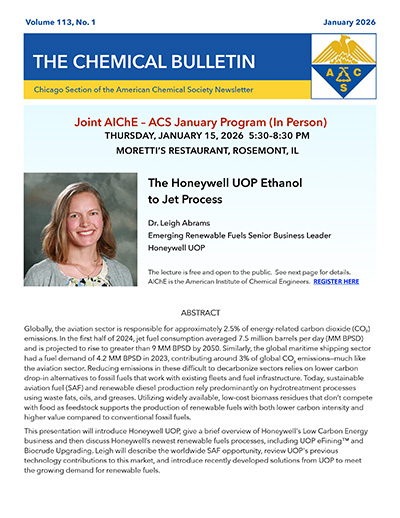
https://chicagoacs.org/images/downloads/Chemical_Bulletin/2026_01_chembull.pdf

Next Meeting
Joint AIChE – ACS
January Program (In Person)
Thursday, January 15
5:30 - 8:30 PM
Moretti's Restaurant
Rosemont, IL
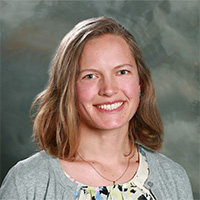
Dr. Leigh Abrams
Emerging Renewable Fuels Senior Business Leader
Honeywell UOP
“The Honeywell UOP Ethanol to Jet Process”
ABSTRACT
Globally, the aviation sector is responsible for approximately 2.5% of energy-related carbon dioxide (CO2) emissions. In the first half of 2024, jet fuel consumption averaged 7.5 million barrels per day (MM BPSD) and is projected to rise to greater than 9 MM BPSD by 2050. Similarly, the global maritime shipping sector had a fuel demand of 4.2 MM BPSD in 2023, contributing around 3% of global CO2 emissions—much like the aviation sector. Reducing emissions in these difficult to decarbonize sectors relies on lower carbon drop-in alternatives to fossil fuels that work with existing fleets and fuel infrastructure. Today, sustainable aviation fuel (SAF) and renewable diesel production rely predominantly on hydrotreatment processes using waste fats, oils, and greases. Utilizing widely available, low-cost biomass residues that don’t compete with food as feedstock supports the production of renewable fuels with both lower carbon intensity and higher value compared to conventional fossil fuels.
This presentation will introduce Honeywell UOP, give a brief overview of Honeywell's Low Carbon Energy business and then discuss Honeywell’s newest renewable fuels processes, including UOP eFining™ and Biocrude Upgrading. Leigh will describe the worldwide SAF opportunity, review UOP's previous technology contributions to this market, and introduce recently developed solutions from UOP to meet the growing demand for renewable fuels.
Program:
• 5:30 – 6:00 PM Check-In, networking
• 6:00 – 7:00 PM Buffet Dinner
• 7:00 – 7:15 PM Announcements
• 7:15 – 8:15 PM Technical Presentation
• 8:15 – 8:30 PM Q&A, Closing
Buffet Dinner - Menu TBA
Event VENUE, COST, and Parking
Moretti’s Restaurant & Pizzeria
9519 West Higgins Road; Rosemont, IL 60018
Website and Directions
$45 ACS members, $55 guests & non-ACS members
$10 students & postdocs (members or non-members)
No charge to attend lecture only.
Parking is available at the restaurant.
REGISTRATION
REGISTER NOW
Deadline To Register
11:00 PM, Wednesday, January 14
https://chicagoacs.starchapter.com/meet-reg1.php?id=237
Questions? Email us (info-at-chicagoacs.org)
or contact us by phone (847-391-9091).
Meet the Speaker
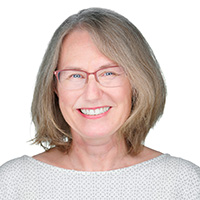
Dr. Leigh Abrams is the Emerging Renewable Fuels Senior Business Leader at Honeywell UOP. She is responsible for UOP’s technologies to produce renewable liquid fuels from next-generation feedstocks. The UOP renewable fuels portfolio includes Ecofining™ and the ETJ process, as well as technology for biomass and CO2 conversion into liquid fuels. She earned her Ph.D. in Chemistry from the University of Wisconsin - Madison and has been with Honeywell for over 11 years. Leigh worked 7 of those years in catalyst R&D at Honeywell UOP, where she received four US patents and was an inventor on multiple trade secrets. She has experience in the characterization of microporous materials as well as decarbonization and sustainable processes. Her projects outside of R&D include work on sustainability, circular plastics policy, ESG ratings (for environmental, social and governance risks), and socioeconomic modeling of energy transitions.
Letter from the Chair
2026: Year of the Chicago Chemist
Anyone who has driven the Kennedy Expressway into Chicago will have encountered the Morton Salt Shed. Now a state-of-the-art entertainment venue, the building continues to stand as a reminder of the company which added magnesium carbonate to salt to prevent clumping and premiered the little girl with her umbrella who declared that when it rains, it pours. While this innovation and charming brand proved invaluable to the settlers of the Gold Rush, Morton Salt manufactured and championed the benefits of iodized salt during the goiter epidemic in the Midwest and Pacific Northwest. The campaign led to the reduction in goiters and enlarged thyroids, as well as an increase in IQ scores.
Chicago’s history chronicles many fascinating examples of chemistry at work. As the ACS celebrates its 150th anniversary and as I assume leadership of the Chicago Section, I hope to highlight the scientific advancements and innovations of our great city’s chemical community. One possibility is to create a collaboration of national and regional local committees to highlight Chicago’s chemical history. To encourage members to come to Chicago, our section will sponsor a table at the ACS Spring National Meeting in Atlanta. We also will host a welcome table at the ACS Fall National Meeting in Chicago to make our fellow scientists welcome. As a Chicago chemist, you are invited to be a part of our celebration.
Thank you for all you do to educate, protect, and serve Chicagoland through chemistry. If you have any suggestions or want to volunteer contact me at: chair-at-chicagoacs.org. The opportunities are countless. For example, besides chemical enterprises, our scientists also give back. When our ACS visitors come to Chicago, they can enjoy the legacy of our town left by the Morton family in the Art Institute’s Morton Room and the Morton Arboretum in Lisle. Want to lead a tour to one of the venues?
In the coming year, I look forward to meeting you and personally thanking you for your membership.
— AMY BALIJA
150 Years Strong. Ready for What’s Next.
ACS celebrates a historic milestone in 2026: 150 years of advancing science and delivering value to the global scientific community! Learn more about the exciting anniversary celebration, goals, rebranding, and monthly themes planned for carrying out this incredible accomplishment. Presentation slides from the December 2025 webinar are also available.
Click here to learn more about the Celebration.
Recent Meeting
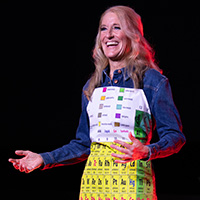
Holiday Party at Elmhurst Wows
The last program event of the calendar year took place the evening of Friday, December 12th in the Frick Center at Elmhurst University. The overarching topic presented by Dr. Colleen Kelley was molecular literacy, as she calls the learned appreciation of foundational chemistry — a universal language — that underpins so many aspects of our day-to-day lives. Her mission is to bring awareness and foster creative thinking in individuals of any age (from 8 to 108!). The in-person program was titled “Chemistry isn’t just about science. It’s the shared story of everything!”
Kelley’s program was exceptionally well attended, with over 60 persons having registered ahead of time. Thank you to Elmhurst faculty member Sunshine Silver for assisting with plans for the on-campus event, and to Ilana Lemberger and Tanya Hunter together for coordinating program and arrangements. Josie Alexander, Daniela Andrei and Madelyn Smith did a great job with social media.
“Chemistry is the story of connection—between atoms, ideas, and all of us.”
- Dr. Colleen Kelley
Chair Anita Mehta served as emcee for the evening and carried out the ritual transfer of the gavel to the incoming Chair, Amy Balija. In turn, Balija presented a Past-Chair pin to Mehta. Amy Balija was also the recipient of a special plaque marking her selection as winner of the 2025 Emerging Star Award. A round of applause all around indicated the heartfelt appreciation for the leadership provided by these two outstanding Section Members.
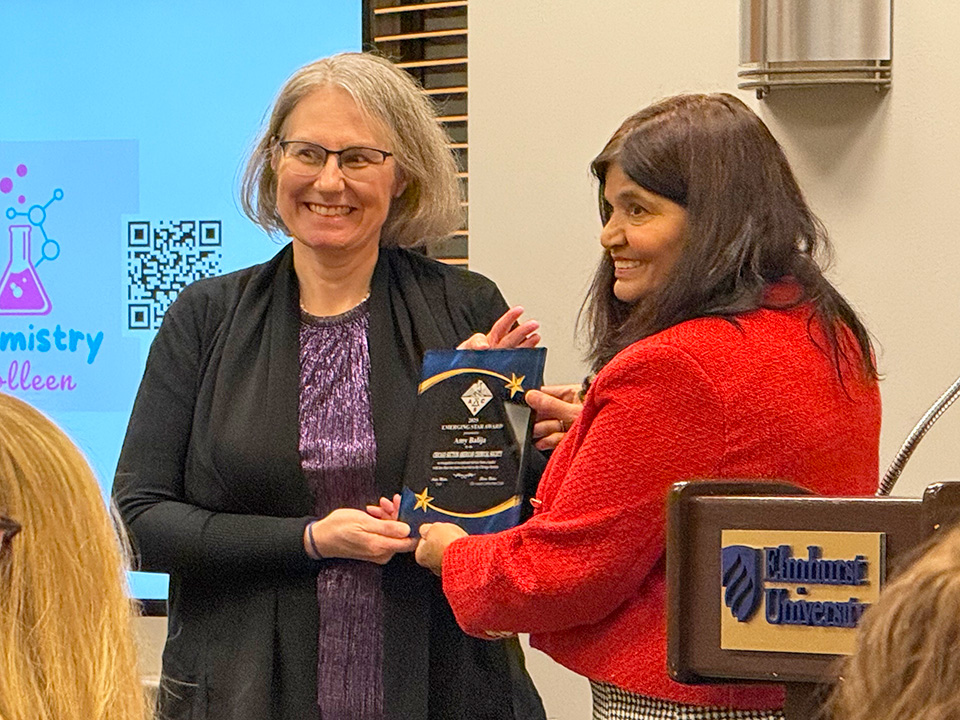
Anita Mehta (right) presents the Emerging Star Award plaque to Amy Balija.
Josh Kurutz won a beautiful handmade afghan, and other lucky winners went home with gift cards. Our speaker handed out many items for guests to take home including chemistry comic books and playing cards.
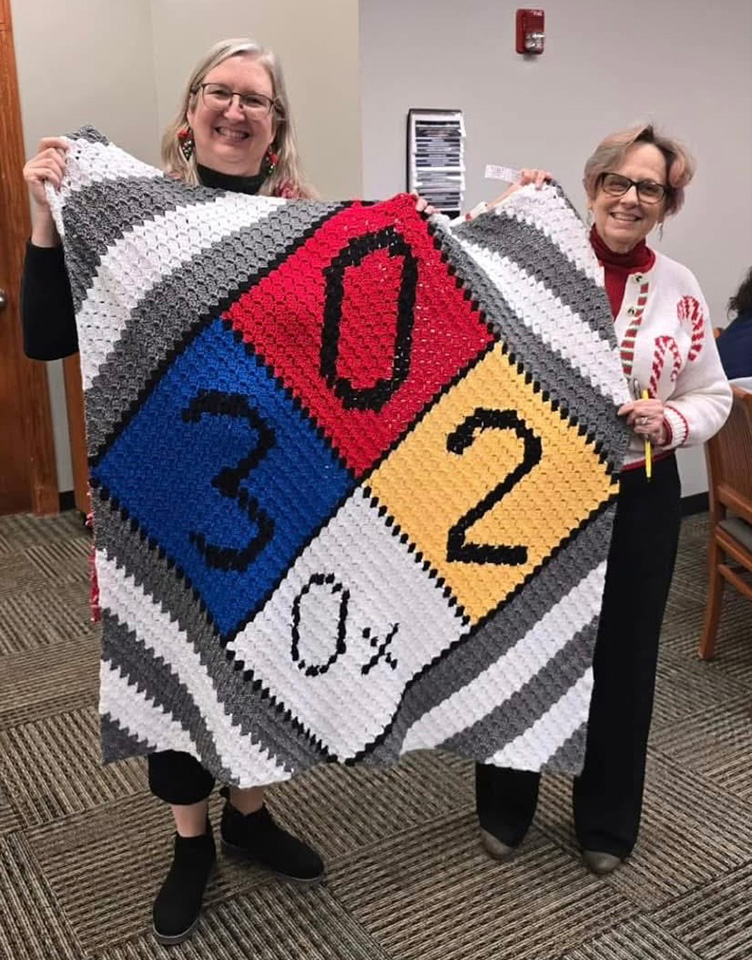
Vivian Sullivan (left) and Janet Ferroni display a handmade hazard-diamond afghan made by Vivian and donated by the Aurum Iodide Chapter of Iota Sigma Pi, the National Honor Society for Women in Chemistry. The chapter has a tradition of participating in the holiday party each year.
Photos by Ilana Lemberger
One enthusiastic participant posted these comments on the social media site LinkedIn:
I was so happy to meet Colleen Kelley, Ph.D. at the end-of-year event organized by American Chemical Society - Chicago Section. She strongly believes that if kids can read English, they can also read chemistry. She shared how chemistry is often introduced quite late, sometimes not until 11th grade, which can make it feel overwhelming at the university level because [many topics are] completely new for students. To address this, she has created an amazing collection of games, comics, and audiobooks that introduce chemistry concepts in a fun and accessible way for young learners.
I read one of her comics, and I have to say that even adults can enjoy it. It introduces the ideas of cations and anions through a creative story where the main character has to save Lady Xenon, a Noble [element] family member. The pirate holding her hostage demands a million electrons, only to realize that gold can provide just two electrons.
I loved how clever and playful the chemistry storytelling was … this would make a wonderful holiday gift for kids, or for anyone looking for a fun way to introduce a friend to chemistry.
From the Editor's Desk
FROM THE EDITOR’S DESK
Dear Readers,
Recently I had an opportunity to attend the 2025 Nobel Prize Lectures in Chemistry, which took place on December 8th at the University of Stockholm (the lectures are free and open to the public). Each of the laureates – Richard Robson, Susumu Kitagawa and Omar Yaghi – gave a 40-minute presentation on their contribution to the development of metal-organic frameworks (MOFs), a fascinating field that had its origins in the desire to construct beautiful molecules. I would encourage anyone who is interested to view the recorded lectures, download the PowerPoint slides, or read summaries of the work by visiting https://www.nobelprize.org/prizes/chemistry/2025/summary/. In addition, Yaghi, a Jordanian-American, gave a short Banquet Speech following the invitation-only prize-giving ceremony on December 10th, a date commemorating the death of Alfred Nobel. The text of the speech is included below. The Nobel Prize website hosts a wealth of information about current and past laureates in all categories since Nobel founded the prize in 1901.
Yaghi, together with Sir Fraser Stoddart of the Chicago ACS Section, co-founded a startup company called H2MOF, which aims to use atomic precision in solid-state materials to enable the hydrogen economy. Next month’s issue will include a remembrance of Sir Fraser – if you have memories or comments to contribute, please contact me at editor-at-chicagoacs.org.
Another Chicago Section member, Professor Mercouri Kanatzidis of Northwestern University, was recognized recently with the World Cultural Council’s 2025 Albert Einstein World Award of Science “for his groundbreaking contributions as a pioneer in shaping the field solar photovoltaic materials through his seminal work on halide perovskite semiconductors.” Kanatzidis presented a talk on this topic at our joint Chicago Section ACS-AIChE program in January 2023.
I hope you enjoy this issue, made possible by many contributors.
— MARGARET E. SCHOTT
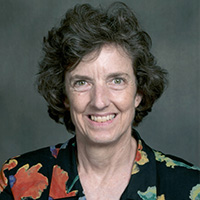
Omar M. Yaghi’s speech at
the Nobel Prize banquet,
December 10, 2025
Your Majesties, Your Royal Highnesses, Excellences, Dear laureates, Ladies and gentlemen —
On behalf of my co-laureates Susumu Kitagawa, Richard Robson, and myself, I thank the Royal Swedish Academy of Sciences and the Nobel Foundation for this extraordinary honor.
Tonight, we celebrate not only achievement but possibility—the power of human curiosity to reshape the world. Our development of metal–organic frameworks, or MOFs, began with a simple but bold idea: that we could design materials with atomic precision, forming strong purposeful bonds that unlock remarkable functions.
From this idea came new possibilities: the power of pulling pure water from desert air, capturing carbon dioxide directly from the sky. These are only early chapters. With countless structures and applications, MOFs are rapidly moving from promise to practical tools that are changing countless lives.
My journey began far from any laboratory. I grew up in Amman, Jordan, in a refugee family of ten children, in a home with no running water and no electricity, sharing our space with livestock, our family’s livelihood. Hardship was everywhere. My chances for success were slim—except for the surprising ways nature reveals itself and helps us overcome.
My turning point came at the age of ten, when I discovered drawings of molecules in my school library. Their beauty and mystery captivated me, and when I learned that they are the building blocks of everything, living and non-living, they ignited my passion for chemistry, and I was hooked forever. It became my escape and my direction.
Another childhood experience shaped me just as deeply. In the desert, water arrived from the government once every week or two. I remember the whisper through our neighborhood, “the water is coming,” and the urgency as I rushed to fill every container I can find before the flow stopped.
Many years later, while studying how MOFs take and release water, I recognized something revolutionary in what seemed like an ordinary behavior. I saw how this MOF could pull water from desert air and turn it into clean drinking water. It echoed the rhythm of my childhood—yet now offered a solution to the very hardship we had once endured. I often wonder whether I would have recognized that pattern of data had I not lived it first.
But MOF’s deeper lesson lies in their metaphor: a MOF’s strength comes from the bonds between its molecules—just as our future depends on the bonds we build across nations and generations. MOF science is now practiced in more than 100 countries, inspiring young people everywhere, especially in the developing world.
And here lies our greatest hope: a science capable of reimagining matter, and a generation eager to move it forward. I urge our leaders to act. Scientists are not asking for privilege, but for possibility. Support their curiosity. Remove barriers. Protect academic freedom. Welcome global talent.
And on climate, the hour for collective action has already arrived. The science is here. What we need now is courage—courage scaled to the enormity of the task—so we may gift the next generation not only carbon capture, but a planet worthy of their hopes.
I imagine a future where practicing chemistry does not require being a chemist, where discovery is accessible to all. Advances in AI may make this possible—a future where chemistry becomes not only a science of progress but a science of hope. A future where no child faces the limitations I once knew, but grows into a world more stable, more abundant, and more just.
Thank you.
Citation: Omar M. Yaghi – Banquet speech. NobelPrize.org. Nobel Prize Outreach 2026. Thu. 1 Jan 2026. <https://www.nobelprize.org/prizes/chemistry/2025/yaghi/speech/>
Board & Committee Members

2026 Chicago ACS Section Officials
|
Chair Chair-Elect Past Chair Vice Chair Secretary Treasurer |
Amy Balija Inessa Miller Anita Mehta Sunshine Silver Michael Koehler Russ Johnson |
|
|
Directors |
2025-2026 Daniela Andrei 2026-2027 Ken Fivizzani |
directors-at-chicagoacs.org |
|
Councilors |
2024-2026 Paul Brandt 2025-2027 Josh Kurutz 2026-2028 Amy Balija |
councilors-at-chicagoacs.org |
|
Alternate |
2024-2026* Michael Morello 2025-2027 Katie Leach 2026-2028 Nicolas Gerst |
altcouncilors-at-chicagoacs.org |
* One vacancy to be filled by the Board
Project SEED
Summer Mentors Needed
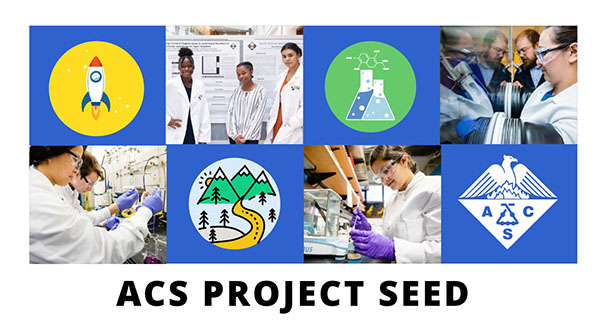
Happy New Year! Let’s celebrate 2026 with the goal of inspiring the next generation of scientists! Coach ambitious high school students as they work in your laboratory over the summer.
Mentors are key to the success of Project SEED! Are you working on a project that can be partitioned into segments suitable for high students to work on? Any individual involved in scientific work can be a mentor — including scientists from academia, industry, and nonprofit or government organizations.
Project proposals from mentors must be submitted
by February 5, 2026
“The students are highly motivated and very willing to learn …”
— Loyola University Mentor
Project SEED is a highly successful program of the American Chemical Society that matches enthusiastic high school students interested in chemistry with mentors from academia, industry and other careers. Student eligibility includes low-income background with at least one high school chemistry class completed. Project SEED students work on their projects for eight weeks, 40 hours/week, over the summer, and are eligible for up to two summers of support.
Please visit the program website at www.acs.org/projectseed or contact Raelynn Miller at raelynn.miller-at-Honeywell.com for more details.
Save the Date
Chinese American Chemical Society Party
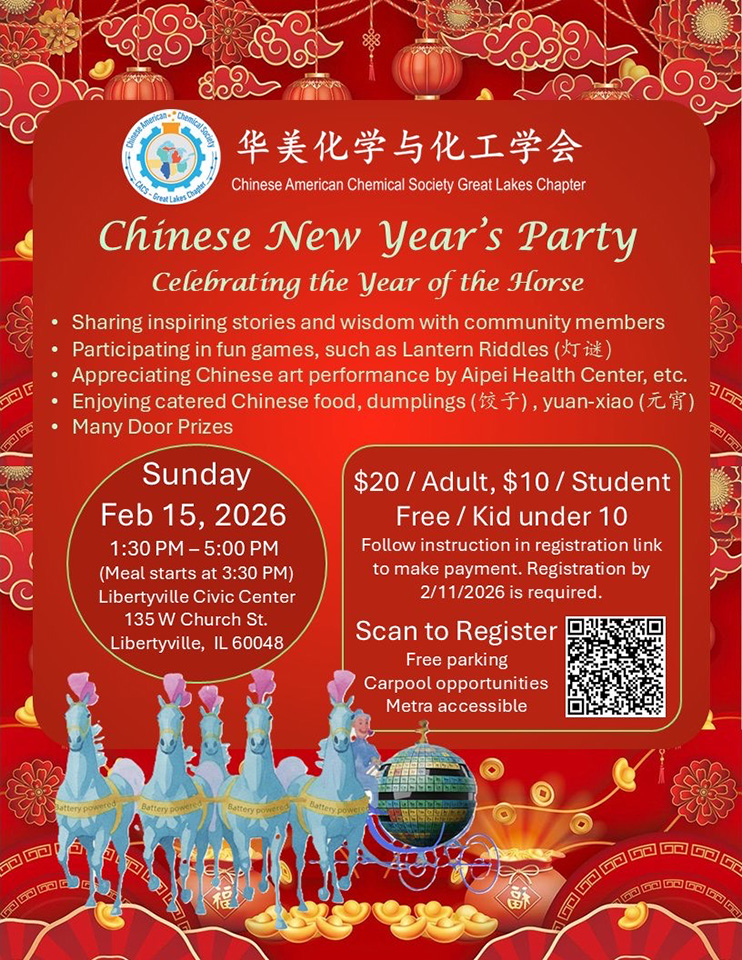
To celebrate the coming Year of the Horse, the Great Lakes Chapter of the Chinese American Chemical Society (GLCACS) invites you to join us for a joyful Chinese New Year Celebration Party to be held on February 15, 2026, at Libertyville Civic Center. This special gathering will be an opportunity to gather with friends, enjoy festive games, and savor delicious Chinese food. The party is being co-sponsored by the ACS Chicago Section and all ACS members are invited. Please register by February 11, 2026 using this link or the QR code below. We look forward to celebrating together with you!
ChemShorts for Kids
Why does rust form?
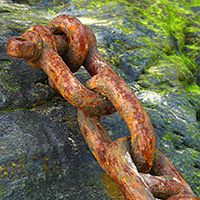
America was built with cement and steel. Maybe not as much today, but this is the time of year when we would see our steel cars rusted through from snow and salt on the roads. Let’s investigate this process a little more closely.
Materials:
Steel wool (any fineness)
Clear glasses
Cold tap water
3% Hydrogen peroxide
Salt
Baking soda
Measuring cup (½ cup – 100 mL)
Teaspoon
Scissors
Safety: Hydrogen peroxide may cause burns – especially on open wounds. Have an adult help when using this substance. The solid waste generated can go into the garbage can, while the liquid waste can go down the drain.
Experiment:
Cut the steel wool into at least 5 equal-sized pieces. Spread out the wool pieces a bit and add one to each of 5 glasses. Add ½ cup of water to each of the 1st and 2nd glasses. Add ½ cup of hydrogen peroxide to each of the 3rd, 4th, and 5th glasses. Add a teaspoon of salt to the 2nd and 4th glasses, and add a teaspoon of baking soda to the 5th glass. (See planning grid below.)
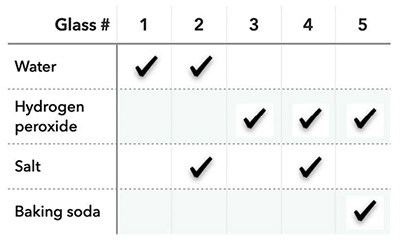
Stir the contents in each of the glasses and allow them to sit. After a couple of minutes, you will begin to see some changes. Swirl the solutions occasionally and observe.
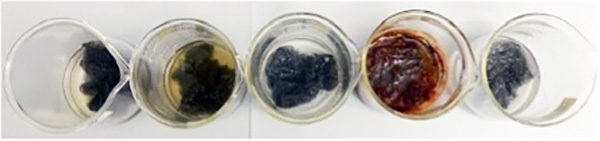
What’s happening?
Steel wool is an alloy (a combination of metal and another element) of iron and carbon. Iron, or Fe, will easily corrode (rust) when exposed to oxygen and an electrolyte (water, salt, acid, etc.). Hydrogen peroxide (H2O2) is an excellent source of oxygen because it breaks down into water (H2O) and oxygen gas (O2). Given this, it seems easy to predict that the 4th glass should corrode the fastest because it has both the oxygen (from the hydrogen peroxide) and the salt. However, sodium bicarbonate is also a salt (it has positive and negative ions), and although we see that it will also rust the steel wool, it isn’t nearly as good at doing so. We find that the chloride (Cl– ion) will also enhance the rusting process as it will cause the surface of the steel to pit, giving an active surface on the iron for the reaction with oxygen to occur.
Extension:
One of the electrolytes mentioned was an acid. How will vinegar (a solution of acetic acid) compare? Muriatic acid (hydrochloric acid) is used by masons, and this has acid and chloride ion components. Will dry salt produce rust in the presence of atmospheric oxygen? What happens if you use deionized water instead of tap water, which has ions in it?
References:
To view past “ChemShorts for Kids” activities, go to:
https://chicagoacs.org/ChemShorts.
- PAUL BRANDT
Rusty chain image: pexels-mikebirdy-282004.jpg
Upcoming Events

ACS Webinars
REGISTER HERE for these and other upcoming and archived ACS webinars:
https://www.acs.org/acs-webinars.html
Organic Origins: Asteroid Chemistry
January 22
1:00 PM CST | 2:00 PM EST
•
View past webinars PLUS slide decks on these and other topics:
Speaking to Your Congressional Representatives
(Dec 2025)
Citations and the Power of Publishing Safety Research
(Nov 2025)
The Nano Frontier: From Atomic Antennas to Photocatalysis
(Oct 2025)
Check out other past webinar topics:
ACS NATIONAL MEETINGS
https://www.acs.org/meetings/acs-meetings.html
ACS Spring National Meeting & Expo in Atlanta
March 22–26, 2026
Celebration of ACS150 begins
Unveiling of new ACS brand
•
ACS Fall National Meeting & Expo in Chicago
August 23–27, 2026
Celebration of ACS150 continues
Chicago Section hosts welcome booth
Volunteer alert!
We need volunteers to help with various aspects of the ACS Fall National Meeting in Chicago. Meet other young chemists while making use of your talents! Contact chair-at-chicagoacs.org
CHICAGO-AREA SEMINARS,
COLLOQUIA & SCIENCE CAFES
American Institute of Chemical Engineers (AIChE)
Refer to the AIChE newsletter for a listing of future local, regional, and national events
https://www.aiche.org/community/sites/local-sections/chicago
•
NORTHERN ILLINOIS UNIVERSITY (NIU) –
STEAM CAFES
Event venue is Fatty’s Pub and Grille in DeKalb.
Wednesday, February 4, 6:30 PM
“Unlocking the Science Behind Olympic Glory”
-
Wednesday, March 4, 6:30 PM
“Turning Sewage into Energy"
https://niusteam.niu.edu/programs-events/
•
NORTHWESTERN UNIVERSITY (NU), EVANSTON -
CHEMISTRY, SUSTAINABILITY, NANO, & MORE
https://chemistry.northwestern.edu/about/events/department-calendar.html
•
University of Chicago (UChicago) –
Chemistry Seminars
Mondays and Fridays at 3:45 pM,
Room 120, Kent Chemical Laboratory
https://events.uchicago.edu/all/groups/Chemistry
•
University of Illinois at Chicago (UIC) -
Chemistry Seminars
Tuesdays at 4:00 pM
at SES 238 (Science & Engineering South)
845 West Taylor Street, Chicago
https://chem.uic.edu/events-2/?event_month=1&event_day=1&event_year=2026
PAST CHICAGO SECTION PROGRAMS ON VIDEO
Videos of several past presentations can be accessed at the Chicago ACS Section website [chicagoacs.org / Events / Videos of Past Meetings] or by going directly to https://www.chicagoacs.net/videos/index.html.
CHICAGO SECTION BOARD MEETINGS
Open to all Section members. For Zoom link, contact: office-at-chicagoacs.org
2026: January 8, February 12, March 12, April 16, May 14, June 11
•
Deadlines for Bulletin Submissions
Deadline for bulletin submissions is the 16th of each month. Content can include photos, reports, past event summaries, flyers and information for upcoming events, original articles, current chemistry, etc. Contact editor-at-chicagoacs.org. Thank you!
January 16th for February issue
February 16th for March issue
Chicago ACS Section Programs
https://chicagoacs.org/meetinginfo.php
|
Thursday, January 15, 2026 Moretti's Restaurant, Rosemont, IL |
Joint program with Chicago AIChE: Dr. Leigh Abrams (Senior Business Leader at Honeywell UOP) “The Honeywell UOP Alcohol to Jet Process” |
|
Tuesday, Febuary 10, 2026 (local location TBA) |
IUPAC - Global Women’s Breakfast. Theme is "“Many Voices, One Science”. https://iupac.org/gwb/ |
|
Wednesday, February 25, 2026 |
New program date and format to be confirmed |
|
Saturday, March 14, 2026 virtual program |
Senior Chemists daytime webinar / Public Affairs |
|
March 22-26, 2026 Atlanta, GA |
ACS Spring National Meeting |
|
Saturday, April 18, 2026 |
Younger Chemists (YCC) event |
|
Friday, May 15, 2026 |
Gibbs Medal Lecture and Banquet |
|
Sunday, June 21 |
Family-friendly event |
|
Aug 23 - 27, 2026 McCormick Place, |
Chicago Section to host Fall ACS National Meeting of the American Chemical Society |
Please also refer to the Section’s website chicagoacs.org/meetinginfo.php and social media accounts.
Masthead
Bulletin Information
January 2026, Vol. 113, No. 1
Published monthly (10 issues, Sept – Jun) by the Chicago Section of the American Chemical Society
https://chicagoacs.org
Editor: Margaret E. Schott
editor-at-chicagoacs.org
Digital Editor: Josh Kurutz
historian-at-chicagoacs.org
Proofreaders: Kshitish Patankar, Bethel Shekour
How to reach us
office-at-chicagoacs.org (847) 391-9091
ACS Chicago Section Office
Krasa 035B and C
5700 College Road
Lisle, IL 60532
Website: https://chicagoacs.org
Social links
Follow ChicagoACS on social media!
Bluesky (new!): https://bsky.app/profile/chicagoacs.bsky.social
Instagram: https://www.instagram.com/ChicagoACS/
Facebook: https://www.facebook.com/ChicagoACS
LinkedIn: https://www.linkedin.com/groups/1854603/


