
Introduction:
This fun and colorful experiment shows how capillary action works using simple household materials. We will be utilizing science to allow water to walk and blend the primary colors!
Materials:
• Clear cups, 7 (glass or plastic)
• Red, blue, and yellow food coloring
• Paper towels
• Water
Experiment:
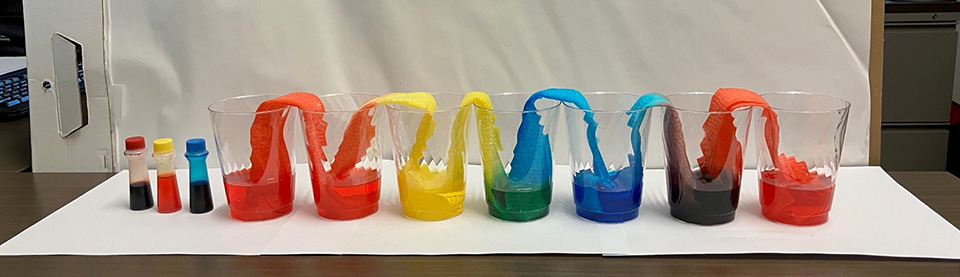
Line up 7 clear plastic cups and fill the 1st, 3rd, 5th, and 7th cups full of water. In the 1st and 7th cups add 5 drops of red food coloring; in the 3rd cup add 5 drops of yellow food coloring, and in the 5th cup add 5 drops of blue food coloring. Mix the solutions in each of those cups. Leave the 2nd, 4th, and 6th cups empty. Fold 6 half-sheets of paper towels twice, hot dog style, into long, thin strips and then fold them in half lengthwise. Cut the ends of the paper towels so that their length is about the height of the cups. Place one end of the first strip into the 1st cup and the other end into the 2nd cup. Repeat with all cups until you have created a bridge of paper towels. Watch what happens over the course of the day. Did you see the full rainbow of colors appear in the seven cups?
What’s Happening?:
So, how is the water moving against gravity? Adhesive forces occur with the paper towel and water molecules, allowing the water to “stick” to the towel, traveling upwards! As the primary colors in the 1st, 3rd, 5th, and 7th cups travel up the paper towel and into the 2nd, 4th, and 6th cups, the even-numbered cups will fill with the mixture of colored water. The primary colors (yellow, red, and blue) will mix to form the secondary colors (orange, green, and purple). In the end, all the cups have the same volume of water. This occurs because once the water finds its way into the empty cup, it can begin to climb in the reverse direction and back to the original cup. It will only do that, however, if the once-empty cup were to get higher in volume than the original cup. We call this equilibrium. Next month, we will see this action occur in Nature!
Extension/Final Notes:
Could you experiment with different colors? Can you get tertiary colors to appear if you start with the secondary colors? Could you use just one color and attempt an ombre effect? What will happen if the originally empty cups are filled with only tap water? Could you align the cups in a circle to create a flower-like rainbow?
Resources:
https://www.youtube.com/watch?v=1PWVSt5zYaI
To view past “ChemShorts for Kids” activities, go to:
https://chicagoacs.org/ChemShorts.


