The December 2021 Chemical Bulletin 
PDF of the Latest Bulletin
 https://chicagoacs.org/images/downloads/Chemical_Bulletin/2021_12_chembull.pdf
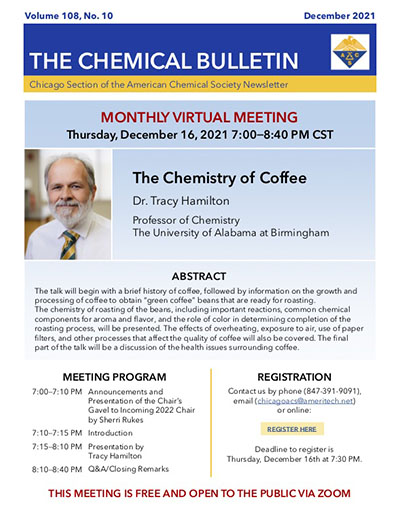
Next Meeting
December Meeting
7:00 - 8:40 PM, Thursday, December 16
Virtual MeetinG
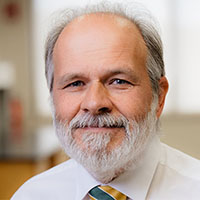
Dr. Tracy Hamilton
Professor of Chemistry
The University of Alabama at Birmingham
"The Chemistry of Coffee"
ABSTRACT:
The talk will begin with a brief history of coffee, followed by information on the growth and processing of coffee to obtain “green coffee” beans that are ready for roasting. The chemistry of roasting of the beans, including important reactions, common chemical components for aroma and flavor, and the role of color in determining completion of the roasting process, will be presented. The effects of overheating, exposure to air, use of paper filters, and other processes that affect the quality of coffee will also be covered. The final part of the talk will be a discussion of the health issues surrounding coffee.
PROGRAM
REGISTRATION
THIS MEETING IS FREE AND OPEN TO THE PUBLIC VIA ZOOM
Deadline to register is Thursday, December 16 at 7:30 PM.
Meet The Speaker
Tracy Hamilton received his Ph.D. in theoretical chemistry from the University of Arkansas under the mentorship of Peter Pulay, and did postdoctoral work with Fritz Schaefer at the University of Georgia. His postdoctoral research was on various organic systems, such as carbenes, nitrenes, and phosphorus clusters. While at Georgia he also obtained a working knowledge of all aspects of quantum software through writing code in nearly every module. Since 1991, Hamilton has been at the University of Alabama at Birmingham, where he is currently Associate Professor of Chemistry with research interests in the quantum mechanical properties of reactive oxygen species. Hamilton started consumption of coffee late in life when he was forty years old. Through the influence of a fellow brewmaster, he started roasting coffee in 2006 and has been doing so ever since.

From the Editor's Desk
It Takes a Village
As 2021 draws to a close, we would like to reflect on the collective work and cooperation involved in producing The Chemical Bulletin. The newsletter is built on a strong sense of community and collaboration. Our team worked together to communicate a year’s worth of news and information to the Chicago Section.
Just as it takes a village to raise a child, it also takes a village to produce the Bulletin. In 2021 alone, the newsletter involved the work of more than twenty contributors, two proofreaders, and four editors. Each issue required hard work and dedication. We extend our heartfelt thanks to all the volunteers who devoted their time and energy to making each issue shine.
Our newsletter team found joy in working together and focusing on a common goal. We built relationships based on trust and respect. The camaraderie improved our efforts and made the long hours worthwhile.
As 2022 approaches, we would like to again extend a warm welcome to new contributors. Join our team and share your knowledge and expertise with the Chicago Section!
- AMBER ARZADON and IRENE CESA

ACKNOWLEDGEMENTS
Contributors*
Paul Brandt, Raychelle Burks, Irene Cesa, Mark Cesa, Ken Fivizzani, Herb Golinkin, W.S. Gilbert, Russ Johnson, Michael Koehler, Russ Kohnken, Fran Kravitz, Josh Kurutz, Tom Lehrer, Margy Levenberg, Milt Levenberg, Richard Rateick, Jr., Jason Romero, Sherri Rukes, Susan Shih, Margaret Schott, Arthur Sullivan, J. J. Thomson, and Andrea Twiss-Brooks
Proofreaders
Helen Dickinson and Ken Fivizzani
Past Editor
Margaret Schott
Digital Editor
Josh Kurutz
*Includes contributions from our archives.
Election Results
The general election for the 2022 Chicago ACS Officers concluded on November 9th. A special election for Councilors concluded on November 29th.
It was brought to the attention of the Board that there was a mistake in the instructions for the Councilor election. The mistake was corrected very quickly, however some of our membership had already voted, and it would not be fair to them if they were not able to vote properly for those positions. At the November Board meeting, it was decided to allow the general election for officers and directors to continue until November 9th as planned, and to hold a subsequent special election for Councilors from November 15 - 29.
Every member who was able to vote was asked to participate in the special election for Councilors. The section wanted to be transparent and let our membership know that an error was made. As a volunteer organization, we try to do everything to the best of our abilities and not make mistakes. Mistakes do happen.
Thank you to the members who voted in our elections and to all the candidates who ran for various positions; we appreciate your participation and patience. Congratulations to the newly elected officers!
- SHERRI RUKES
2022 CHICAGO ACS OFFICERS*
Chair-Elect:
Margaret Schott
Vice Chair:
Amber Arzadon
Secretary:
Josh Kurutz
Treasurer:
Michael Morello
Directors:
Amy Balija, Tanya Hunter, Lauren Jackson
Kathryn Leach, Anita Mehta, Jason Romero
Sunshine Silver, Vivian Sullivan
Councilors**:
Mark Cesa, David Crumrine, Josh Kurutz
Margaret Levenberg, Timothy Marin
Alternate Councilors:
Kathryn Leach, Jana Markley, Oluseye (Kenny) Onajole
*325 completed ballots were counted for the general election.
**206 completed ballots were counted for the special Councilor election.
Letter from the Chair

Season’s Greetings!
Season’s greetings to you all! Last month we had the privilege of welcoming Mary Virginia Orna, Chair-Elect for the New York Section, for a presentation about some of the remarkable women in science who have not received a Nobel Prize. Our virtual meeting meant that Mary was able to deliver her talk all the way from Poland. She told many interesting stories about highly accomplished women scientists. Even as the world becomes more inclusive, progress is still needed. If you missed the presentation, please go to our website to get the link to the meeting. It is a very good talk, especially for K - 12 educators.
At the November meeting, we honored our newly elected officers, the Scholarship Exam winners, and the Teacher of the Year for the Chicago Section. It was great to see familiar and new faces among the elected officers. I am inspired by our Teacher of the Year, Chris Cassidy, with all he does in and outside of the classroom. He has embraced the ideas of the Next Generation Science Standards (NGSS) to transform the way he teaches and is a role model to his students, coworkers, and all teachers.
As the year comes to an end and we reflect on the past year, our thoughts naturally turn to the future. I hope you will be able to find time to relax with your family, your chemistry family, and friends. As I reflect upon my time as Chair, I am filled with many feelings, including hope, anxiety, and gratitude.
We have all been changed by the pandemic, and many of us had to pivot and alter the way we do things. Many organizations and businesses had to either limit their activity or close down. Despite these changes, the Chicago Section made its presence known and emerged stronger than ever. We promoted a variety of chemistry opportunities while many organizations struggled. It is my sincere HOPE that the section will continue to collaborate with its area partners, hold meetings that appeal to all, and organize events that convey the passion of the section to the public.
The pandemic caused many of us to self-isolate, leaving us with heightened feelings of ANXIETY and stress. We maintained our sense of family by continuing to hold virtual monthly meetings. Being able to see members and talk to them before or after a meeting was one way we stayed connected. Many of you used this time to learn new skills, learn more about yourselves, and discover where your passions lie. You found creative ways to stay connected with the section through Zoom and YouTube. Virtual platforms allowed us to continue our committee work and attend webinars and meetings. As a group we found ways to supplement children’s science education by providing them activities, magazines, and kits.
As the year went on, the section was able to provide both in-person and virtual events. Our members participated in the Illinois State Fair, Science Works at the Museum of Science and Industry, as well as two events at Navy Pier to celebrate National Chemistry Week. We also held many virtual networking events. I hope we will continue this great work as the pandemic slowly wanes and our lives return to normal. We reached a remarkable number of members and the community at large through section events in 2021. This is a tremendous accomplishment!
Finally, I leave with a sincere sense of GRATITUDE. I am grateful for the leadership of our seasoned Board members, our Past Chairs, the National Office, and our office manager, Gail Wilkening. Without their support and direction, I would have been lost. All of these entities worked hard throughout 2021 to ensure that we were able to continue the mission of the Chicago Section. Most importantly, they helped spread a feeling of solidarity among all of our members.
I extend my note of gratitude to you, the entire membership of the Chicago Section. Throughout this time it was YOU, the membership, who supported us. You showed up for our programs, commented on our surveys, clicked on our webpages and social media, and freely volunteered your time, talent, and expertise. Because of your generosity, the organization is as strong as ever and we are able to continue to inform, engage, and inspire. I hope we will continue to earn your trust and lead in our community.
As we move towards 2022, your support will be needed more than ever before. Not only are we grappling with how to move forward, but 2022 will be a milestone year for us as the ACS Fall National Meeting comes to Chicago. The meeting has not been held in Chicago for 15 years. It is an exciting venture and will require all members working together to make it the best national meeting possible. Plans are already underway; there will be many opportunities to celebrate together both in person and virtually.
We always welcome new ideas and volunteers. My goal has been to help the Chicago Section improve and innovate. If you have ideas for future meeting themes or comments and suggestions, please fill out this short survey. You can also reach out to me on the Board at [email protected].
I look forward to the section advancing under the leadership of Mark Cesa. He has been Chair of the Cleveland Section and has served as the President of IUPAC. Mark has a plethora of experience to draw from and our section will continue to grow with him at the helm. The section is in good hands!
Serving as Chair has been a tremendous honor. I was in awe that a section with so many highly educated professionals devoted to chemistry, my love and passion, elected me, a high school teacher, to be their leader. I will never forget the trust you placed in me. I always tried my best to build bridges between our members and the community. Our proven record of resilience and collaboration will help us continue to prosper in the future. I hope one day soon I will be able to meet more of the membership in person. Take care, and always look forward to what comes next! As I said to my students when our school went remote during the pandemic: think like a proton and stay positive!
- SHERRI RUKES
Food and Toy Drive
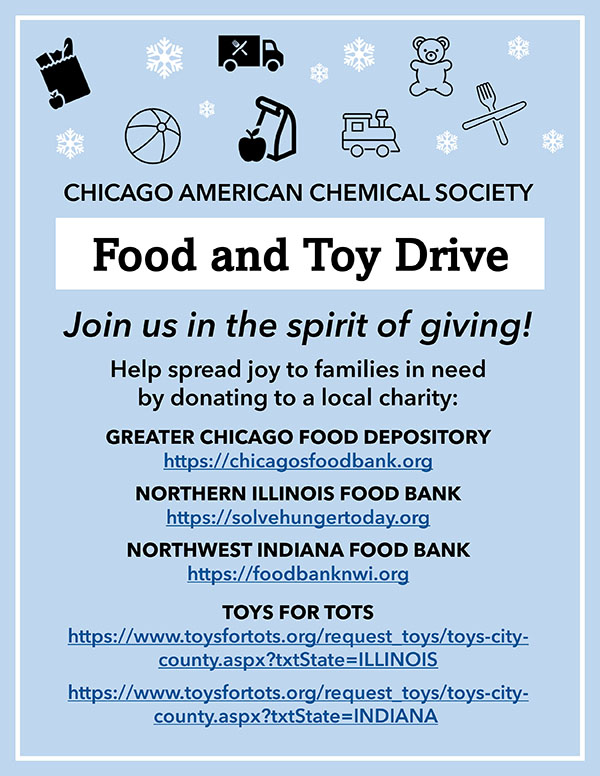
GREATER CHICAGO FOOD DEPOSITORY
https://chicagosfoodbank.org
NORTHERN ILLINOIS FOOD BANK
https://solvehungertoday.org
NORTHWEST INDIANA FOOD BANK
https://foodbanknwi.org
TOYS FOR TOTS
https://www.toysfortots.org/request_toys/toys-city-county.aspx?txtState=ILLINOIS
https://www.toysfortots.org/request_toys/toys-city-county.aspx?txtState=INDIANA
The Year in Review
Thank you for all the great events and meetings we hosted in 2021. The success of these activities is due to all of us (members, speakers, and volunteers) working together toward a common goal. THANK YOU! The highlights listed below provide just a glimpse of the many experiences we shared during 2021. I hope that 2022 will bring us even greater success and fulfillment as we emerge from the pandemic and things return to normal. I am truly looking forward to the ACS Fall 2022 National Meeting being held in Chicago.
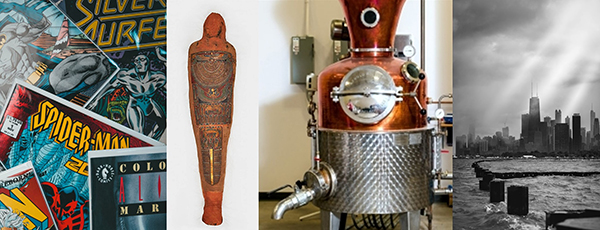
2021 Monthly Meeting topics included the science related to pop culture, art, distilled spirits, and the Great Lakes.
January
Our 2021 schedule started off with the traditional joint meeting with AIChE (American Institute of Chemical Engineers). Richard Rateick, Jr. spoke about the history of steel. The talk connected chemistry to chemical engineering and materials science, and showed how they all rely on similar principles.
February
Clara Granzotto, a conservation scientist at the Art Institute of Chicago, gave a fascinating talk about art and chemistry. The presentation showed how chemistry is connected to other sciences as well as to art.
The College Education Committee held a virtual poster session featuring research talks by two young and aspiring chemists. The Community Activities Committee created a video for the DuPage Area STEM Expo to look at ways to help the environment.
March
Sustainability was the theme for our March meeting. We discussed how to advocate for STEM, chemistry education, and the environment. Members learned about the leadership role of Loyola University from Nancy Tuchman, Dean of Loyola’s interdisciplinary School of Environmental Sustainability.
The K - 12 Education Committee held the local Chemistry Olympiad Exam for area students. It was a challenging endeavor as not all schools were meeting in person yet. Of 91 students who took the local test, 19 qualified to take Part I of the National Exam.
April
Our monthly meeting was all about beer! Derek Kassebaum, founder of North Shore Distillery, spoke about the chemistry of beer-making and distillation separation techniques.
The Younger Chemists Committee (YCC), along with the Women Chemists and Minority Affairs Committees, hosted a cross-committee career panel. Four area scientists discussed their experiences establishing successful careers in STEM-related fields. (See the YCC Spotlight on page 10.)
To celebrate Earth Day, the Community Activities Committee created a pledge for members, posted family activities on our website, and handed out ACS Earth Day magazines and kits to underserved families. The K - 12 committee helped administer Part II of the National Chemistry Olympiad Exam. Ten students from the Chicago Section qualified to take the exam.
May
The May meeting honored educators. After a tumultuous year of remote, hybrid, and in-person teaching, we saluted all educators for their hard work. Raychelle Burks gave a light-hearted talk about pop culture for fans of both chemistry and Marvel.
The K - 12 Education Committee administered scholarship exams for area high school students to qualify for college scholarships.
June
We welcomed meteorologist Cheryl Scott from ABC Channel 7, who spoke about the effects of climate change on the Great Lakes. We also celebrated our 50-, 60-, and 70-year members; you are truly inspiring! The Awards Committee announced the recipients of the section’s Distinguished Service Award, Paul Brandt, and the Emerging Star Award, Jason Romero.
We initiated a campaign called “Why Chicago ACS?” YCC and Senior Chemists Committee held a virtual networking event, and we also co-hosted a social event with the New York Section via Zoom.
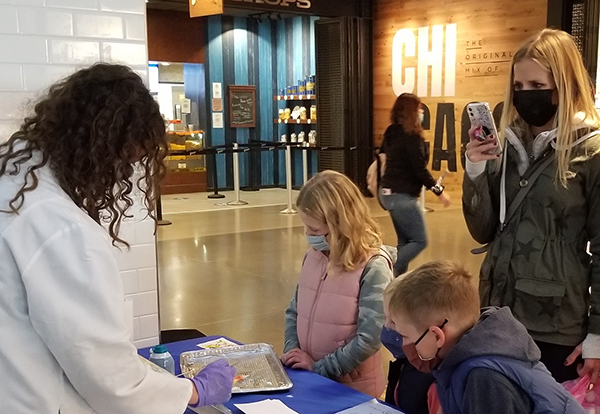
NCW community event at Navy Pier
July
Many members were hard at work during the Board’s traditional summer break planning future events. The Nominations Committee met to finalize the slate of candidates for the annual election. Thank you to everyone who agreed to run for the Board. Without you, our section could not continue its mission.
August
The section hosted a Science Tent at the Illinois State Fair with four other sections. Despite ongoing concerns about the pandemic, a group of dedicated volunteers participated in the 15-day event. With safety protocols in place, the tent received more than 4,000 visitors and put on numerous entertaining demo shows.
Four section members became ACS Fellows: Mark C. Hersam, the Walter P. Murphy Professor of Materials Science and Engineering at Northwestern University; Xavier Pillai, Principal Patent Attorney at Leydig, Voit & Mayer; Susan M. Shih, Professor Emeritus at the College of DuPage; and Andrea Twiss-Brooks, Director of Humanities and Area Studies for the University of Chicago Libraries.
September
The 2021 Gibbs Medal was presented to Dr. Sharon Hammes-Schiffer at the September meeting. We were delighted that ACS President H. N. Cheng and other leaders from National were able to join us virtually. In her award address, Sharon described how proton-coupled electron transfer (PCET) reactions can help chemists address fundamental issues in biochemistry, materials science, and solar energy.
The YCC hosted the first in a series of career virtual events, welcoming Tabbetha Bohac to share her career journey. The Awards Committee announced the winner of the High School Teacher Excellence Award, Chris Cassidy.
October
Our virtual dinner meeting featured an informative presentation about the gender gap in STEM, especially chemistry, by our Chair-Elect, Mark Cesa. In the second installment of YCC career events, Matthew Katcher and Jana Markley talked about medicinal chemistry and the importance of networking.
The Community Activities Committee organized multiple events to celebrate National Chemistry Week (NCW) and selected the winners of the NCW Poetry Contest (see page 8). Section volunteers participated in Science Works hosted by the Museum of Science and Industry where more than 350 families learned about kinetics through hands-on activities. During two different events at Navy Pier, the section showcased a variety of activities and distributed goody bags, including safety glasses.
The Chicago Section was honored to receive two ChemLuminary Awards: Outstanding Performance by a Local Section - Very Large Size Category, and Outstanding American Association of Chemistry Teachers (AACT) Support.
November
The election of 2022 section officers and directors concluded and the results were announced at our monthly meeting, which also honored our scholarship winners and the recipient of the High School Teacher Excellence Award. Mary Virginia Orna spoke about the history of the Nobel Prize in Chemistry and the lack of female winners. YCC held the final installment in their three-part career panel.
December
Our December meeting about the chemistry of coffee will be presented by Tracy Hamilton. The Chicago Section is also organizing a food and toy drive; please contribute!
Thank you to everyone who attended our monthly meetings and volunteered to make our 2021 events a great success. I look forward to what 2022 has to offer!
- SHERRI RUKES
National Chemistry Week
National Chemistry Week
Poetry Contest Winners
The winners of the 2021 National Chemistry Week (NCW) Illustrated Poetry Contest for the Chicago Section are Akshara Kasinathan and Caleb Stout. Akshara is a fifth grader at Barbara B. Rose Elementary School in Barrington, Illinois, and Caleb is a sixth grader at Holy Family Catholic Academy in Inverness, Illinois.
The contest challenged K - 12 students to write and illustrate poems using no more than 40 words to highlight the 2021 NCW theme “Fast or Slow...Chemistry Makes it Go!” Winners received a certificate and Amazon gift card. The winning Chicago entries will also be submitted to National, where they will have a chance to be featured on the ACS website. Thank you to all the participants, and congratulations to the winners!
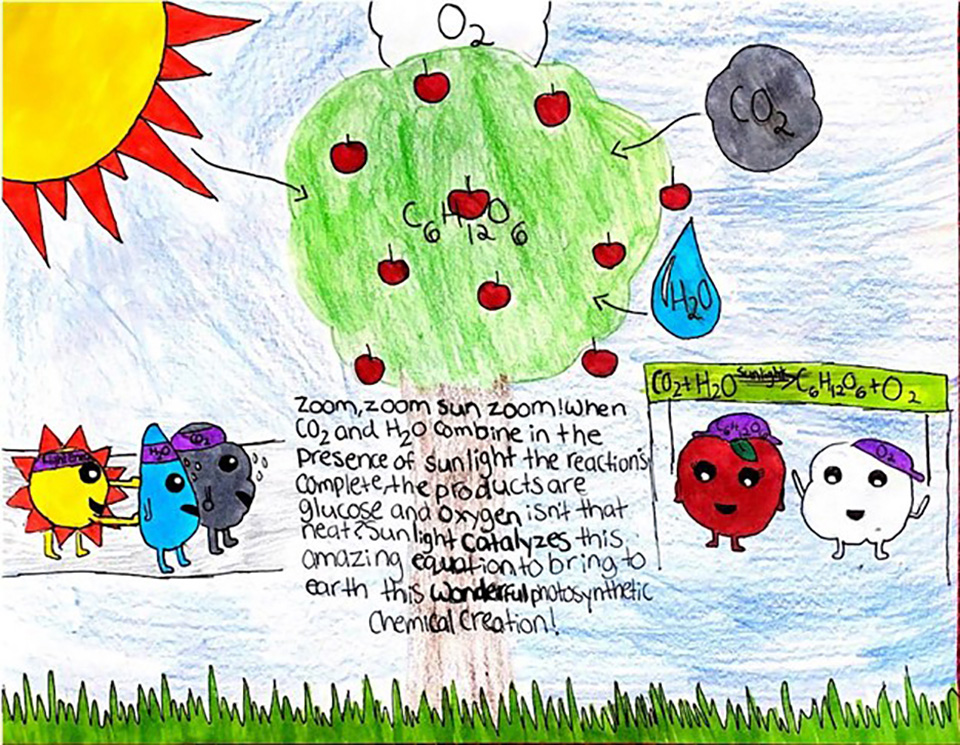
Akshara Kasinathan, 5th Grade, Barbara B. Rose Elementary School
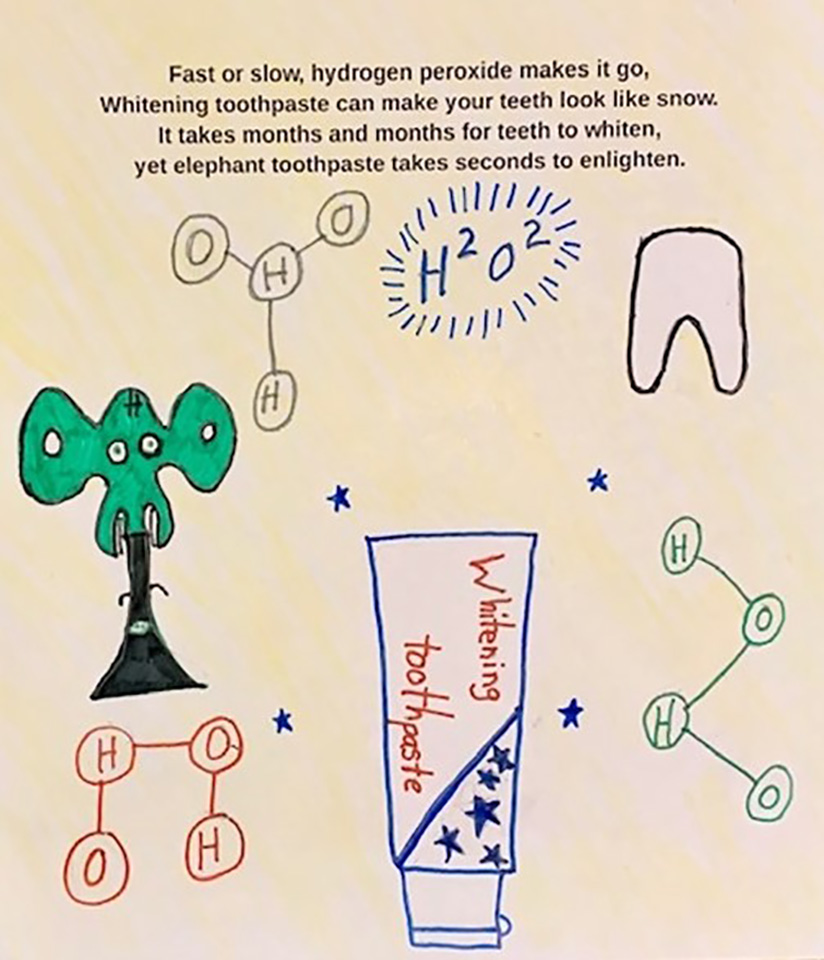
Caleb Stout, 6th Grade, Holy Family Catholic Academy
Member Spotlight
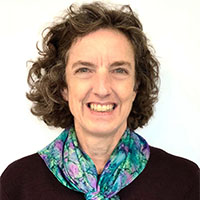
A Silly Song of Carbon
Margaret (Peggy) Schott, who served as editor of The Chemical Bulletin from 2019 - 2021 and was recently announced as 2022 Chair-Elect for the Chicago Section, was awarded Honorable Mention in an original art contest sponsored by the ACS Division of the History of Chemistry (HIST). The competition to celebrate the 150th anniversary of the Periodic Table was entitled “Elemental Art: A Contest!” and was open to artistic contributions in three categories: poetry, cartoons, and photography. The theme of the contest was the chemical elements, their discovery, and uses. We are delighted to showcase Peggy's original poem, “A Silly Song of Carbon (for Organikers),” below. Congratulations, Peggy!
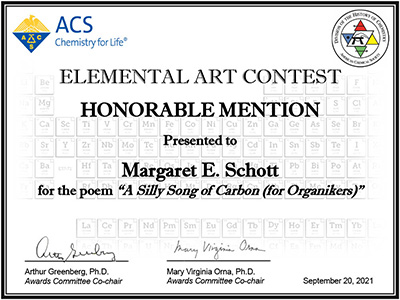
A Silly Song of Carbon
(for Organikers)
by Margaret E. Schott, PhD
If one considers carbon as an element essential
For life on Earth (or Krypton?), it has marvelous potential.
Our planetary Kohlenstoff seems almost providential, yet
Its cosmologic origins are not inconsequential.
But how is one to comprehend the Table’s entry 6 (six)?
It all depends, as one might guess, on how you choose to fix
Your mental gaze and plumb, for years, the depths of truth scholastic
In books of engineering, chem, or Kristalstruktur graphics.
In Nature, graphite, Lonsdaleite and diamond find their station,
As pressurized dead carbon forms of ancient allocation,
Along with peat and anthracite, and coke and coals — to mention
Just a few of many kinds of species ripe for conflagration.
To scan the realms of outer space for data spectroscopical
Reveals an awesome panoply of carbons allotropical:
The interstellar nanoscape hosts -enes and -ynes and radicals,
From buckyball (C-sixty) down to species diatomical.
With carbon’s tetrahedral core just right for bond creation —
(its 1-0-9-point-five degrees invites elaboration) — and
While not forgetting sp2, and 1, for C-construction,
A thousand million compounds can be slated for production.
With proteins, carbs and lipids – and the helices genetic,
We’ve got a biologic kit for life on earth (and under it).
Should experts target hybrid forms, with schemes retrosynthetic . . . well,
Good luck! And may your product yields be better than “pathetic”.
Upcoming Events

UPCOMING EVENTS
|
December 9 |
Chicago Board of Directors Meeting |
|
December 10 |
Articles due for the January Bulletin issue |
|
December 16 |
December Monthly Meeting (Virtual) |
|
January 10 |
Articles due for the February Bulletin issue |
Please also refer to the Section’s website chicagoacs.org and social media accounts.
Committee Spotlight
Younger Chemists Committee
The ACS Chicago Section has more than 3300 members, ranging in age and experience from undergraduate and graduate students to retired members with 50, 60, and 70 years of participation in the American Chemical Society. This diversity is a great strength. It also challenges us to ensure that resources are available to serve the needs of members at different stages of their professional and personal lives. Identifying and serving the needs of our diverse membership is the mission of the Membership Division and its Communities Committee, which includes four subcommittees:
- Younger Chemists Committee
- Senior Chemists Committee
- Women Chemists Committee
- Minority Affairs Committee
The goals of the Younger Chemists Committee (YCC) are to make the ACS relevant to younger chemists, increase their involvement in the ACS, and develop programs and resources to integrate them into the profession. Under the leadership of its current chair, Jana Markley, the Chicago YCC has developed innovative professional development activities to engage members and help them succeed. These activities have been instrumental in building community and giving members new technical and leadership skills. These are two things YCC members say they value the most.
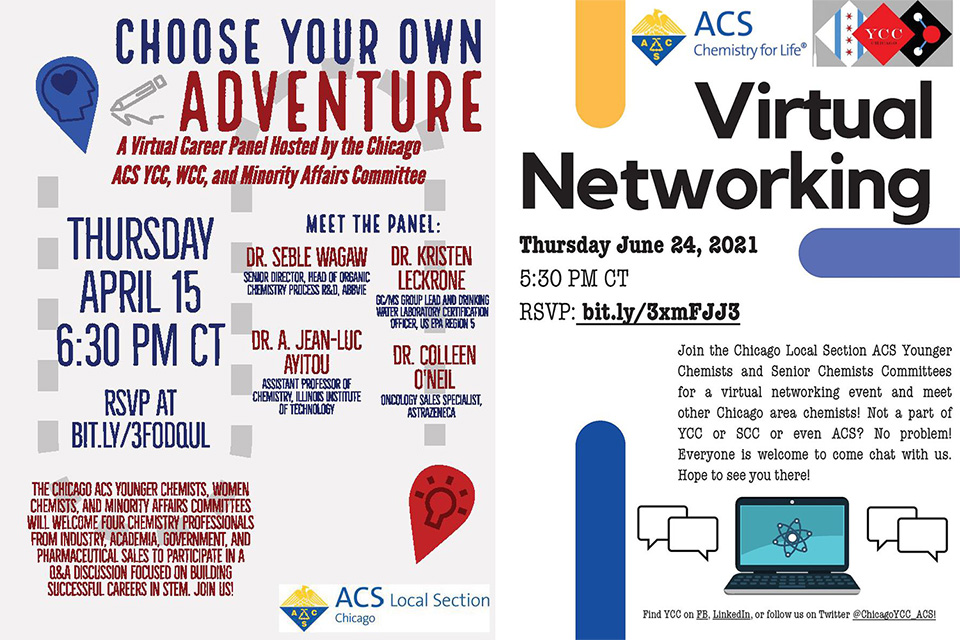
In the spring, on April 15th, YCC joined with the Women Chemists and Minority Affairs Committees to host a cross-committee career panel discussion. Four chemistry professionals discussed their career experiences, everything from their day-to-day work to how to transition between roles. The panelists were Dr. Kristen Leckrone (US EPA), Dr. Colleen O’Neill (AstraZeneca), Dr. A. Jean-Luc Ayitou (Illinois Institute of Technology), and Dr. Seble Wagaw (AbbVie).
On June 24th, YCC and the Senior Chemists Committee organized a virtual networking event. The attendees talked about navigating career choices and expanding their knowledge and expertise to embrace new opportunities.
 Flyers from 2021 YCC Spring/Summer Events
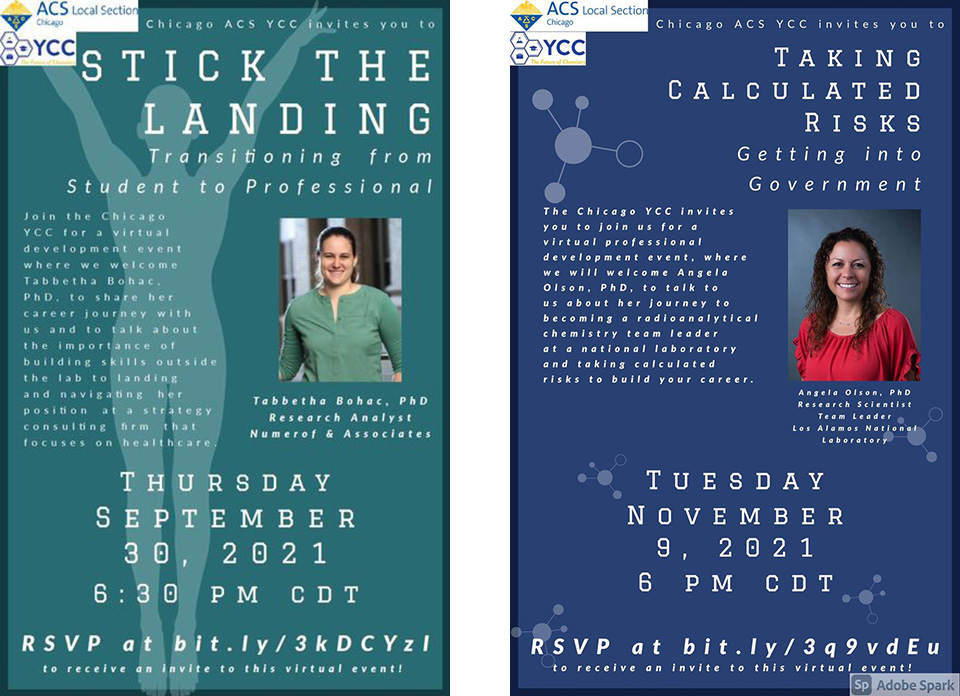
The Chicago YCC has been very active this fall with a series of events exploring different career paths for chemists. On September 30th, YCC welcomed Dr. Tabbetha (Tabb) Bohac, Research Analyst for Numerof & Associates, for a virtual professional development event, “Stick the Landing: Transitioning from Student to Professional.” Tabb spoke about the importance for graduate students to build skills outside the lab and her transition from graduate school to a career with a healthcare consulting firm. On October 21st, YCC hosted Dr. Matthew Katcher and Dr. Jana Markley to talk about careers in medicinal chemistry and the pharmaceutical industry. The event focused on the importance of networking and building an effective network. The fall series concluded on November 9th with a talk by Dr. Angela Olson, Research Scientist at Los Alamos National Labortatory, about her work at a national lab.
 Flyers from 2021 YCC Fall Events
With inspired leadership and creative programming, YCC is paving the way for all chemists to improve the world through the transforming power of chemistry.
Safety First
Electronics Recycling and Sustainability
As we approach the holiday gift-giving season, many of us look forward to the excitement of receiving new electronic devices. What will become, however, of the older phones, tablets, laptops, computers, televisions, and game consoles that may no longer be needed? Will they be reused? Recycled? Discarded?
In 2016, the United States generated almost 7 million tons of electronic waste (e-waste). The problem of e-waste is not limited, however, to the U.S.; it is a global concern. Worldwide estimates of the amount of e-waste surpass 50 million tons per year. These numbers are staggering, even more so when we consider the precious metal resources that are present in e-waste and the environmental costs and energy associated with extracting and processing metals.
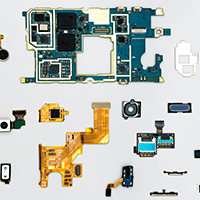
The elements of smartphones and computers include gold, silver, platinum, palladium, copper, nickel, tantalum, cobalt, aluminum, tin, zinc, and neodymium. These metals are found in motherboards and printed circuit boards, computer chips, hard drives and CPUs, as well as in keyboard components and RAM. As shown above in the Compound Interest infographic, many of these elements are endangered resources due to their ever-increasing use in electronics.
Improper disposal of electronic waste threatens the environment and has a negative impact on sustainability. Currently, only about 25% of e-waste generated in the United States is recycled each year.
The Environmental Protection Agency recommends that we think about the entire lifecycle of electronics when purchasing new items, and that we employ the same strategy for e-waste stewardship that we use for solid waste, namely, reduce, reuse, and recycle.
Think carefully when you purchase electronics in order to reduce consumption. Whenever possible, donate items that you no longer use to extend their lifespan. Recycle electronics through community collection centers or manufacturer take-back programs. Many recycled electronic items are refurbished and reused.
Safety and sustainability go hand-in-hand. None of us can do everything to solve the global issues affecting our future, but we can all do something. I cannot extract the gold, reportedly about a tenth of a gram, from my smartphone or computer. Manufacturers can, and do; in 2015, for example, Apple recovered more than a ton of gold from recycled devices.
- IRENE CESA
Thank you for your support of Safety First!
Best wishes for a happy holiday season to all who celebrate!
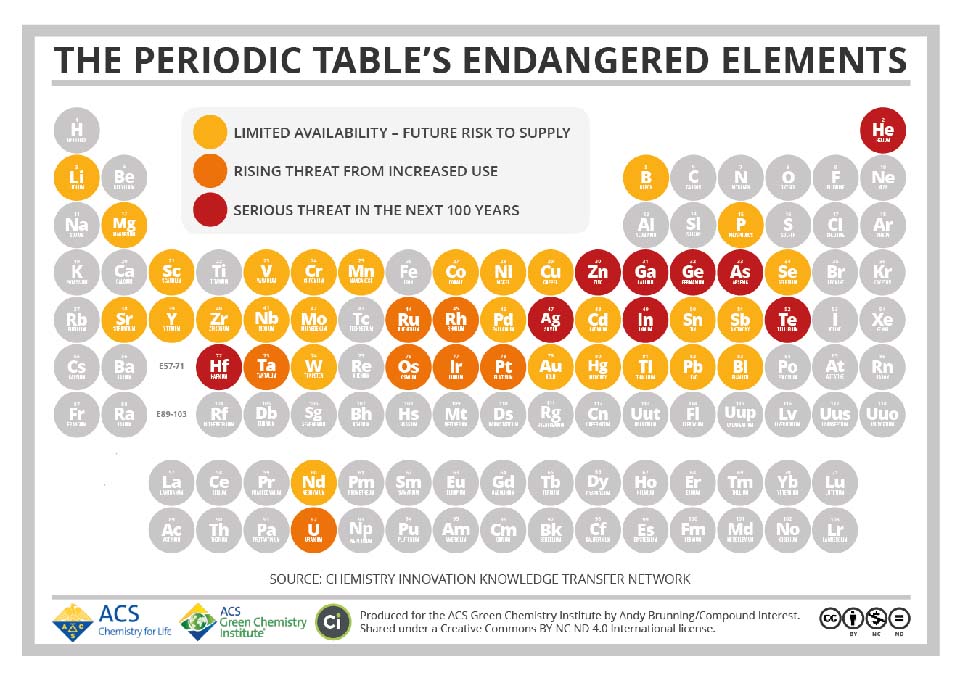 The Period Table’s Endangered Elements by Compound Interest, 2015, (https://www.compoundchem.com/2015/08/19/endangered-elements/)
Professional Development
ACS Resources:
Helping Students Succeed in
the Chemical Sciences
Some students may find starting a career in the chemical sciences daunting. Fortunately, the ACS has a variety of resources to help students select a career path, practice their interview skills, and find a job. ACS members have access to a multitude of online tools that can put them on a path to success.
Find a career path
Explore more than 40 careers in chemistry, academia, government, and nonprofit organizations. Read about the real-life experiences of more than 100 chemists, and get valuable information to help you prepare for entry into the job market.
Research experience, internships, and more
The ACS GETexperience database includes undergraduate research, internships, summer jobs, and co-ops that provide real-world experience for students who want to pursue careers in the chemical sciences. These global opportunities are available in industry, academic institutions, government agencies, and nonprofit organizations. For international undergraduate students, the job listings include multinational organizations that offer internships in countries around the world. Graduate students, postdocs, and other professionals can also find job opportunities at C&EN Jobs.
Career planning
ChemIDP is a career planning tool for graduate students and postdocs. Through immersive, self-paced activities, users explore potential careers, determine specific skills needed for success, and develop plans to achieve professional goals. ChemIDP tracks user progress and input, providing tips and strategies to complete goals and guide career exploration. Members can also use Career Pathways and ACS Career Navigator to grow in their careers.
Brush up your interview skills
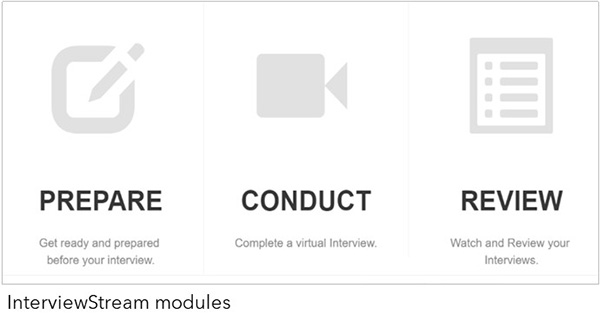
Use InterviewStream or schedule a mock interview with an ACS Career Consultant to improve your interview skills. InterviewStream is an online tool you can use to practice interviewing. You can also schedule a 30-minute meeting with an ACS Career Consultant and learn how to conduct a successful interview. Both tools allow you to answer interview questions and identify your strengths and weaknesses before you meet with prospective employers.
Gain knowledge via webinars
In the November 2021 issue of the Bulletin, we highlighted the impressive catalog of current and archived webinars accessible on the ACS website. The ACS has curated webinar collections geared towards professional development:
- How to Advance Your Career
- Alternative Careers
- Networking & Other Essential Skills
Explore other ACS resources, including workshops, leadership development and more, at
https://www.acs.org/content/acs/en/careers/developing-growing-in-your-career.html
and
www.acs.org/education.
Take advantage of your membership today by using the treasure trove of career tools provided by the ACS!
ChemShorts for Kids
“Plastic” Milk
In our previous ChemShorts activity, we experimented with an interesting property of polystyrene, the polymer in recyclable #6 plastic. Proteins, such as those found in milk, are natural polymers. Let’s see if you can turn milk into a “plastic.”
Materials
• Milk, one cup (any fat % milk may be used)
• Large spoon
• Microwave or stovetop
• Paper towels
• Saucepan or Pyrex® cup to heat the milk
• Strainer
• Vinegar
Optional: Food coloring, cookie or silicone molds
Be safe!
Adult supervision is required when using the microwave or stovetop.
Experiment
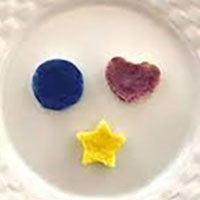
Gently heat the milk in a saucepan (stovetop) or cup (microwave) until you see steam coming from it. Heating the milk causes the proteins in milk to begin to open up. Add vinegar one tablespoon at a time. You should notice the milk curdle—the solids are called curds and the liquid is called whey. (Think of the “Little Miss Muffet” nursery rhyme.) Gently stir the mixture while adding the vinegar until curdling is no longer observed. Do not add more than four tablespoons of vinegar! Place a paper towel in the strainer and pour the milk contents onto the towel, allowing the liquid to run through the strainer and into a bowl. Take the curd (solid) remaining in the strainer and squeeze out more liquid. Use additional paper towels to dry the solid. You can add food coloring at this point if you want a colored product. To obtain a smoother product, soak the curd in vinegar for an hour or so and then repeat the straining/drying process. (Adding more vinegar or soaking the solid in vinegar may give the product a strong smell.) Shape the curd into shapes using cookie cutters or silicone molds. Allow the molded solid to dry for two days; it will turn into a hard “plastic.”
What’s happening?
Just like polystyrene, the proteins found in milk are very large molecules. Milk proteins, such as casein, are large enough to make milk appear cloudy, but not large enough to be seen with the naked eye. The structure of the milk protein looks like a long chain that has been folded up into a ball. Ionic, charged groups in the protein are hydrophilic (water-loving) and are on the outside of the protein, while neutral hydrophobic (water-hating) groups are on the inside where they are protected from interacting with water. As vinegar, an acid, is added to milk, some of the groups react with the acid and change how they interact with each other. This causes the protein to change its three-dimensional shape. This process is called protein denaturation. The milk curdles when the proteins are denatured. Protein denaturation also occurs when you heat an egg white.
You may have noticed that the word “plastic” appears in quotes in the title of this activity. Generally, a plastic is made from petroleum (oil) in a man-made process. The word plastic describes a polymer that is moldable. The hardened casein solid obtained from milk is a moldable polymer, but because it came from a cow, it is not officially a plastic!
Explore more at
https://chicagoacs.org/images/downloads/Chemical_Bulletin/2021_11_chembull.pdf
https://www.steampoweredfamily.com/activities/make-plastic-from-milk/
https://www.rookieparenting.com/milk-vinegar-experiment-polymerization/
https://www.mombrite.com/how-to-turn-milk-into-plastic/
To view all past “ChemShorts for Kids” activities, go to:
https://chicagoacs.org/ChemShorts
- PAUL BRANDT
Masthead
Bulletin Information
December 2021, Vol. 108, No. 10
Published by the Chicago Section of the American Chemical Society
https://chicagoacs.org
Editors: Amber Arzadon and Irene Cesa
editor-at-chicagoacs.org
Digital Editor: Josh Kurutz
Proofreaders: Helen Dickinson and Ken Fivizzani
ACS Chicago Section Office
Address: 1400 Renaissance Drive,
Suite 312
Park Ridge, IL 60068 (847) 391-9091
[email protected]
Board & Committee Members

Chicago ACS Section Officers for 2021
Chair Sherri Rukes [email protected]
Vice Chair Michael Koehler [email protected]
Chair-Elect Mark Cesa [email protected]
Past Chair Paul Brandt [email protected]
Secretary Aleks Baranczak [email protected]
Treasurer Jason Romero [email protected]
For additional information see:
https://chicagoacs.org/board.php
https://chicagoacs.org/Committees
https://chicagoacs.org/Volunteer
Social links
Follow ChicagoACS on social media!
Instagram: https://www.instagram.com/ChicagoACS/
Facebook: https://www.facebook.com/ChicagoACS
LinkedIn: https://www.linkedin.com/groups/1854603/