The May 2016 Chemical Bulletin 
Next Meeting
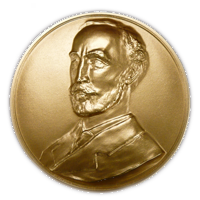
105th Presentation of the Willard Gibbs Medal
Professor Laura Kiessling
University of Wisconsin - Madison
Chemical Probes of Immunity and Tolerance
6:00 PM, MAY 20 at Meridian in Rolling Meadows
The Willard Gibbs Medal is the third most prestigious general award in the world of chemistry, after the Nobel Prize and the Priestley Medal. The Chicago Section of the ACS gave the first medal to Svante Arrhenius in 1911, and the list of awardees is a veritable showcase of the finest minds in chemistry. This year, Prof. Laura Kiessling is welcomed to their ranks in a gala reception, featuring top luminaries of the American Chemical Society and several former Gibbs medalists. The official citation describing the nature of Kiessling's award:
CITATION
For pioneering research in chemical biology, including insights into intercellular communication in bacteria and eukaryotes and elucidation of carbohydrate-mediated cell-surface interactions.
ABSTRACT
Design principles for compounds that selectively augment immune responses (vaccines) or mitigate them (treatments for autoimmune diseases) would be transformative. Such principles have been elusive because many immune system receptors (e.g., the B cell receptor) can transmit signals that lead to either immunity or tolerance. A molecular understanding of how to control B cell signaling could enhance our ability to design carbohydrate-based vaccines. New synthetic methods have emerged that can be applied to exert extraordinary control over antigen structure, and these methods provide the opportunity to elucidate how this structure influences signal output. Specifically, features of an antigen’s structure (e.g., valency, size, affinity, co-receptor binding) can be altered to optimize its function. We are using living polymerization strategies to generate polymers and nanoparticles that function as antigens. This presentation will focus on our recent results in synthesizing and elucidating the features of antigens that activate targeted immune signaling pathways.
DATE, TIME, LOCATION
Register Now
PROGRAM
- 6:00 - 7:00 Reception with hors d'oeuvres, and 2 complimentary drinks
- 7:00 - 8:30 Dinner
- 8:30 - 8:45 ACS Award Ceremony
- "A History of the Willard Gibbs Award"
- Mary Jo Boldingh, Chicago Section Chair
- Introduction of Professor Kiessling
- Thomas O'Halloran, Northwestern University
- Presentation of the Gibbs Medal
- Dr. Robert Bergman, UC Berkeley and 2011 Gibbs Medalist
- 8:45 - 9:45 Gibbs Award Lecture by Prof. Kiessling
- 9:45 - Networking
MENU
- Cream of Tomato Basil with Bleu Cheese
- Meridian Salad
- Wine
- Choice of entree:
- Roast Top Sirloin of Beef with rosemary merlot sauce
- Fresh Broiled Norwegian Salmon with dill sauce
- Portobello Mushroom with zucchini
- Green Beans Almondine
- Duchess Potato
- Hot Fudge Brownie with Vanilla Ice Cream and Hot Fudge Sauce
RESERVATIONS:
Registration Deadline: 12:00 Noon on Monday, May 16
PLEASE HONOR YOUR RESERVATIONS. The Section must pay for all dinner orders. No-shows will be billed. Please contact the Section Office via phone (847-391-9091) or email ([email protected]) if you have any questions
DIRECTIONS and PARKING:
| From Chicago |
From I-294 North/South |
From I-88 |
| Take I-90 west to Arlington Heights Road. Exit north to the first light, Algonquin Rd., Route 62, turn left/west and travel to Meridian Banquets on the left. |
Take I-294 north or south to the I-90 junction near O'Hare. Travel west on I-90 and follow the directions above. |
Travel north past I-90 as 355 turns into 53. Exit Algonquin Rd., Rt. 62 east and go to Meridian Banquets on the right. |
PARKING: Free
BIOGRAPHY
Dr. Kiessling received her undergraduate training in Chemistry at the Massachusetts Institute of Technology. There she conducted undergraduate research in organic synthesis with Professor Bill Roush. She received her Ph.D. in Chemistry from Yale University where she worked with Stuart L. Schreiber on the synthesis of anti-tumor natural products. Her postdoctoral training at the California Institute of Technology in the research group of Peter B. Dervan led her to explore the recognition of duplex DNA through triple helix formation. She began her independent career in the Department of Chemistry at the University of Wisconsin-Madison in 1991.
She is a member of the American Academy of Arts & Sciences, the American Academy of Microbiology, and National Academy of Sciences. Laura's honors and awards include a Guggenheim Fellowship, an ACS Frances P. Garvan-John M. Olin Medal, a Harrison-Howe Award, an Arthur C. Cope Scholar Award, the Hudson Award in Carbohydrate Chemistry, the Alfred Bader Award in Bioorganic or Bioinorganic Chemistry, and a MacArthur Foundation Fellowship. She is also the founding editor-in-chief of ACS Chemical Biology.
Her interdisciplinary research interests focus on elucidating and exploiting the mechanisms of cell surface recognition processes, especially those involving protein-glycan interactions. Another major research interest is multivalency and its role in recognition, signal transduction, and direction of cell fate.
Tickets
$50.00 Member
$52.00 Non-member
$15.00 T-shirt: CHICAgO Elements
$10.00 Tote bag: CHICAgO elements - blue
$0.00 Lecture only
Individual Donation (specify amount after Adding to Cart)
Company Sponsorship (Specify amount after adding to cart)
Donation to Project SEED (specify amount after Adding to Cart)
Back to top
Historical Feature
The Willard Gibbs Award
by Paul Brandt
The Willard Gibbs Award has been presented by the Chicago Section of the American Chemical Society since 1910. It was founded by William A. Converse (1862-1940), a former Chairman and Secretary of the Chicago Section and named for Professor Josiah Willard Gibbs (1839-1903) of Yale University. Gibbs, whose work with Maxwell and Boltzmann developed the field of Statistical Mechanics and is known to millions of undergraduates for Gibbs Free Energy (developed in 1933), as he solved the question of the maximum amount of work that can be done by a system on the universe during a change in state of the system (ΔGsys=-TΔSunv) and ultimately the more familiar ΔG=ΔH-TΔS.
The purpose of the award is "To publicly recognize eminent chemists who, through years of application and devotion, have brought to the world developments that enable everyone to live more comfortably and to understand this world better." Gibbs was chosen to be the model for the award as an outstanding example of creativity in scientific investigation. Medalists are selected by a national jury of twelve eminent chemists from different disciplines elected by the Chicago Section ACS Board. The nominee must be a chemist who, because of the preeminence of their work in and contribution to pure or applied chemistry, is deemed worthy of special recognition.
Mr. Converse supported the award personally for a number of years, and then established a fund for it in 1934 that had subsequently been supported by the Dearborn Division of W.R. Grace & Co. Considerable contributions to the award have also been made by J. Fred Wilkes and his wife. The award consists of an eighteen-carat gold medal having, on one side, the bust of J. Willard Gibbs, for whom the medal was named. On the reverse is a laurel wreath and an inscription containing the recipient's name.
Most of the awardees that you see below are familiar to chemists regardless of specialty. This fame may result from later recognition, including, in many cases, the Nobel Prize, or the reason may be that textbooks have permanently associated many of these names with classic reactions or theories.
1922 no award
2015 John F. Hartwig
See more details, including citations for many of the medalists, at: https://en.wikipedia.org/wiki/Willard_Gibbs_Award
Back to top
Someone You Should Know
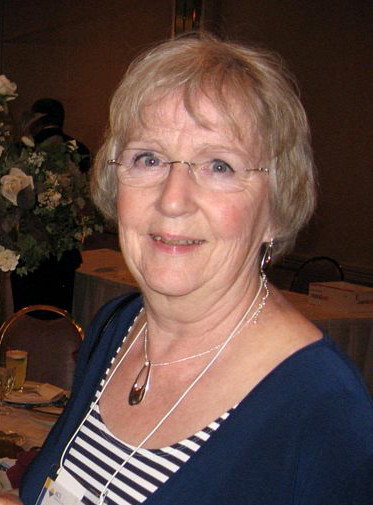
Susan Shih
by Fran Kravitz
Susan Shih is someone we all know. She is a regular at most Chicago Section Monthly Dinner meetings and an integral part of the board and the Section office. I first met Susan when we co-chaired the 2001 National ACS meeting host committee. She is a warm and friendly individual who is always on the go. Susan chaired the Section in 2002-2003 and is currently one of the ten Chicago Section’s Councilors, chair of the Office Affairs Committee and chair of the Great Lakes Regional Meeting Committee.
Susan was born in Melrose, Massachusetts which is a suburb of Boston. Her father was a sales executive with an A.B. in the classics and her mother was a stay-at-home mom. Susan has three sisters and a brother. The science bug was genetic with her mother’s father and sister being a physician and her mother earning an A.B. in chemistry. Susan’s uncle is also a chemist.
Ms. Shih was inspired by a female high school chemistry teacher to become a chemist. She earned an A.B. in chemistry, cum laude, from Rosemont College just outside of Philadelphia. Susan went on to earn a M.S. in Inorganic Chemistry from Ohio State University. Her thesis was on tin complexes with acetlyacetonate. She also completed an additional 150 credit hours beyond her master’s degree.
Susan’s first position was as an instructor at Roosevelt University where her responsibilities included teaching as well as lab supervision of students. She developed a course for non-science majors while at Roosevelt University. Her second position was with Joliet Junior College as an instructor for two years. Susan took a break from teaching and returned eight years later as an adjunct at the College of DuPage. She worked her way up to become a full professor and coordinator of the chemistry program and retired 27 years later in 2008. Susan’s passion is being in the classroom and the lab. She finds interactions with students challenging but rewarding. She modernized the laboratory experience in general chemistry and eliminated “cookbook” labs.
Ms. Shih has been a member of the ACS for 52 years. She joined as a student affiliate while earning her bachelors degree. Susan has served on many Chicago Section committees and volunteered for Chemistry Week, the Boy Scout Chemistry Merit Badge program, the Marie Curie Girl Scout Chemistry Day program including authoring a chapter in the chemistry booklet given out during that program and served on the IL State Fair Committee during its early years. She serves regionally as a member of the Great Lakes Regional Board and chaired it for two years. Nationally, she serves on SOCED and served on the Two Year College Advisory Board. She has also been a long time member of DIVCHED and currently serves on two of its committees.
Susan married a few years after graduate school and has two grown children. Her daughter has a degree in Math with Computer Science as well as an MBA in International Business and works as a consultant on financial IT issues. Her son has a degree in English and does PR for a health related non-profit. Besides chemistry, her passions include reading, travel and gardening. I can attest to the fact that she has a beautiful yard. Most of us don’t know that Susan has rafted down the Grand Canyon twice. She also volunteers at a local food pantry and a non-profit foundation raising funds for a congregation in Tanzania.
I asked Susan who she might want to have lunch with, dead or alive. She chose Hiram Bingham. He revealed Machu Picchu to the world in the early 1900s. She confessed that she would love to talk to him about his discovery. It is interesting that this relates to her passion of travel. She also noted that she would have become an archeologist if her undergraduate school had a major in archeology. That is a loss to the world of archeology but a gain for us that she chose chemistry.
Susan’s final words of wisdom to all of us are to find a position where you really enjoy the chemistry that you do.
Back to top
State Fair
Volunteers Needed For
the Illinois State Fair Science Tent
The 2016 Illinois State Fair is just around the corner and WE NEED YOU! Illinois Local Sections of the ACS will have a Chemistry Tent in Conservation World at the Illinois State Fair. This will be our 13th year for this community outreach project. The Illinois State Fair is scheduled from Friday, August 12 through Sunday, August 21.
Our tent provides information to the public on chemistry by way of demos, hands-on activities, literature and give-aways. Last year, we had over 17,000 people come through our tent. WE CAN’T DO THIS WITHOUT YOU!
We are looking for volunteers to help us at this year’s fair. This is a very rewarding activity and a chance to meet new colleagues from other Sections while reaching out to the public. We need demonstrators, individuals willing to help with hands-on activities and individuals who are a “jack of all trades”. Come for a shift or for the day or participate for several days. Parking and admission to the fair is FREE for volunteers who participate. There are nearby reasonably priced hotels, motels & campgrounds for accommodations during the fair.
Please contact either Fran Kravitz at [email protected] or Milt Levenberg at [email protected] if you are interested in more information on this fun, rewarding and challenging opportunity. You may also register soon, directly on line at http://chicagoacs.net/statefair/volunteers.html. Registration opens May 1 for volunteers.
Thank you in advance for helping us make this program a continued success!!!
Fran Kravitz ([email protected])
Milt Levenberg ([email protected])
(Co-Chairs of the Illinois Sections of the ACS State Fair Project)
Back to top
A Company You Should Know
The Water Quality Association
by Paul Brandt
The Water Quality Association (WQA) is a not-for-profit association for the residential commercial, and industrial water treatment industry. WQA represents more than 2,700 member companies around the globe, including large firms such as Dow Water and Process Solutions, Culligan International, and The Brita Products Co. Our membership is comprised of equipment manufacturers, suppliers, dealers and distributors of water quality improvement products and services. WQA proudly serves as an educator of water treatment professionals, certifier of water treatment products, public information resource and voice of the water quality improvement industry.
WQA was created in 1974 from the merger of two trade associations. WQA’s mission is to be the recognized resource and advocate for the betterment of water quality, with a vision of improving water quality to enhance quality of life through sustainable technologies and services.
The industries devoted to treating and delivering water are complex and varied. WQA primarily represents the sector of the water treatment industry devoted to treating water on the homeowner's or business-owner's property. We often refer to this aspect of treatment as the Final Barrier that prevents waterborne contaminants from entering a home or business.
Earlier this month, WQA unveiled its newest service, a career center specifically for the drinking water treatment industry. The WQA Career Center will offer employers access to the brightest and best talent within and outside of the water treatment industry across all categories of employment. The Career Center also provides job seekers with professional development tools, networking opportunities and access to high-quality jobs with the most respected employers in our industry.
Many professionals in point-of-use/point-of-entry (POU/POE) water treatment reinforce their expertise through a voluntary professional certification program provided by the WQA. This program, recognized in 1977, helps consumers and employers identify individuals in the industry who have demonstrated a certified level of professional expertise and are dedicated to high professional standards. WQA’s online education and training program for professional certification includes: installation, design, service, and sales. Master levels are also available for service and design that incorporate a higher level of knowledge of water chemistry and hydraulics.
POU is water treatment installed at the point where water is consumed, at the tap, and is considered a Final Barrier of protection. POU technology includes activated carbon, ion exchange resins, membranes (reverse osmosis, nano-, ultra-, and micro-filtration), UV light devices, ozone, distillation, and other specialty or selective media. The WQA advocates the Final Barrier as a proactive risk management tool for the protection of public health from the unpredictability of drinking water contamination events.
The Water Quality Research Foundation (WQRF) was formed in 1949 to serve on behalf of the WQA as a universally recognized, independent research organization. Last year, WQRF concluded its largest fundraising campaign ever, raising over $2.8 million for research.One of the WQRF’s most recent projects includes a qualitative analysis of data trends relative to reported frequency, causes/sources and spatial/temporal characteristics of boil water notices (BWN) in the United States from 2012-2014. A BWN, also referred to as a boil water advisory, is issued by a public water system when there is a known or suspected microbial contaminant in the drinking water distribution system.
BWN situations specifically involving microbiological contamination can be adequately handled by home water treatment devices, such as the POU devices mentioned above, certified as capable of producing microbiologically-safe water. An increase in water main breaks and, therefore, BWN’s were warning signs of the corrosion issues occurring in Flint, Michigan that ultimately caused lead poisoning of residents.
 Lead can exist in water in a broad array of forms, therefore, more than one type of technology may be needed for adequate removal at the tap. Soluble (or dissolved) lead may be removed by ion exchange, reverse osmosis, adsorption, or distillation. Insoluble (or particulate) lead may be removed by fine filtration and adsorption as well as by reverse osmosis and distillation. System performance characteristics should be verified by tests conducted under established test procedures and water analysis. Thereafter, the resulting water should be monitored periodically to verify continued performance.
Product certification helps ensure public safety of products being used and sold in households and community water systems across the United States. WQA has been testing drinking water treatment products since 1959 and certifying products since 1960. Gold Seal certifies drinking water treatment units for contaminant reduction claims, material safety, compliance with lead-free laws, and drinking water additives to accredited industry standards. The WQA lab is fully accredited through International Accreditation Service (IAS) according to ISO 17025, and is equipped with analytical instrumentation including a Perkin Elmer Elan 9000 ICP-MS, Dionex IC, Thermo Fisher GC-MS, and an LC-MS-MS will be another addition later this year.
After reports of lead contamination in the Flint drinking water started being released in 2015, WQA offered assistance to government and public health officials as well as the public to provide information on POU/POE water treatment applications. WQA helps professionals in the field provide education on water treatment products and the importance of proper maintenance to residents in areas, like Flint, who are faced with water contamination issues.
In February 2016, WQA staff and members visited Flint to provide education on common concerns and misconceptions with water purification. WQA members also provided the community with free water treatment products certified for lead reduction. This on-the-ground effort is another example of WQA’s mission for the betterment of water quality, ensuring that our industry continues to be a part of the solution and provide best practices and technologies to keep people’s water as safe as ever.
Back to top
ChemShorts for Kids
May, 2016:
Kids, back in 2010, we looked at the reaction of iron in steel wool with oxygen by combining the wool with vinegar to remove the protective coating on it and saw the temperature rise as the wool is wrapped around a thermometer - http://chicagoacs.org/articles/212. The temperature went up because of the reaction of the steel wool with the atmospheric oxygen.
Now that camping season is upon us, we can take advantage of this very hot reaction to help us make our campfire. You know that when starting a campfire, it is often best to have some very small twigs or dried leaves to get the fire started because logs don’t catch fire easily. We’ll take advantage of the very fine steel wool for the same reason – the small twigs and the steel wool both have a lot of surface area for the reaction to take place.
Please note: All chemicals and experiments involve an element of risk, and no experiments should be performed without proper adult supervision.
Materials:
- Very fine steel wool (grade 000 or 0000)
- A 9V battery
- An aluminum pan
Make sure that an adult is present anytime fire is involved.
Try this:
- Pull a piece of steel wool off from the pad and pull it apart so that it is not a compact ball.
- Touch the leads of the 9V battery to the steel wool and remove the battery from the wool.
Did you see the sparks in the wool? If you’re looking to start a campfire you will want some tinder nearby to get the fire started. Blowing on the sparks will allow them to travel through the wool more completely.
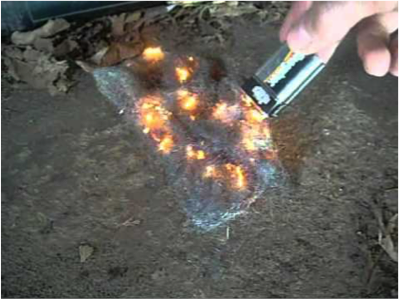 By touching the leads of the battery to the wool, you complete the circuit of the battery. Electricity will begin to flow through the wire (just like in an incandescent light bulb). As electrons flow, friction is created and the fine wire heats up and the iron is able to react with the oxygen in the atmosphere. Blowing on it keeps oxygen coming to the wire for the reaction to continue. Larger iron blocks will not catch fire because the iron does not have enough oxygen around it and the iron cannot get hot enough because the heat can too easily disperse to deep inside the block of iron. There is not enough surface area in the block of iron.
The wool may also have a bit of an oil residue on it and that oil will also combust. The reaction that is occurring is:
4 Fe + 3 O2 -> 2 Fe2O3
Although it may not seem like it, the mass of the combusted wool should be significantly more than the mass of the initial wool because it has added to it the mass of the oxygen from the atmosphere.
To view all past “ChemShorts for Kids”, go to: http://chicagoacs.org/articles.php?article_category=1
Back to top
Award Winner
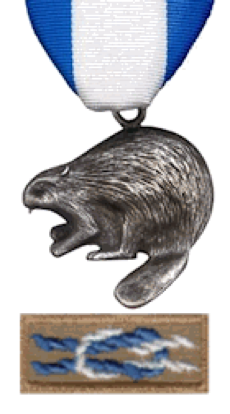
Fran Kravitz Wins Boy Scouts of America
Silver Beaver Award
Fran Kravitz has been active for many years in the Three Fires Council of the Boy Scouts of America which services 14,000 youth in Cook, DeKalb, DuPage, Kendall, and Will Counties, IL. She is one of the winners of 2016 Silver Beaver Award!
The Silver Beaver Award is the council-level distinguished service award of the Boy Scouts of America. Recipients of this award are registered adult leaders who have made an impact on the lives of youth through service given to the council.
Fran was instrumental in making the BSA Chemistry Merit Badge Program available in the Chicagoland area in conjunction with the Chicago Section of the American Chemical Society. 2015 was Fran’s 11th year running the program.
Each year 128 scouts register to attend the merit badge clinics. The program is held at different locations in Chicago and NW Indiana on three Saturdays in the fall. She designs experiments in congruence with the Merit Badge booklet, gets volunteers and venues for the events. During the clinic there is time for the students to interact with chemists in a casual setting. It’s a very popular program, as evidenced by the feedback from scouts and parents alike.
This is the highest honor a Boy Scout council can bestow on adult volunteers. These individuals will officially be recognized, June 16 at the Three Fires Council’s Annual Dinner.
The Chicago Section congratulates Fran Kravitz for her achievements and this award!
Back to top
Councilors' Report
Report of ACS Council Meeting
San Diego National ACS Meeting
March 16, 2016
by Barbara Moriarty
The 251st National Meeting of the ACS was held in San Diego, CA, from March 13 – 17, 2016. The theme of this meeting was “Computers in Chemistry.” The Chicago section was represented by Charles Cannon (Local Section Activities), Dave Crumrine (Constitution and Bylaws), Russ Johnson (Chemistry and Public Affairs), Fran Kraviz (Local Section Activities), Michael Koehler (Chemical Safety), Margaret Levenberg (Meetings and Exposition), Milt Levenberg (Public Relations and Communication), Inessa Miller, Barbara Moriarty (Science) and Susan Shih (Education). The national activities committees for each, as I know them, are in parentheses.
Governance: The Council elected two candidates for the fall 2016 ACS national election for President-Elect 2017. The candidates are Peter K. Dorhout and Thomas R. Gilbert. Ballots will be distributed on September 29, 2016.
Finances: The Society’s 2015 year-end financial position was reviewed. The Society ended 2015 with a Net Contribution from operations of $16.6 million on revenues of $511.7 million and $495.1 million in expenses. This was favorable to the 2015 Approved Budget. The Society’s financial position strengthened in 2015, with Unrestricted Net Assets, or reserves, increasing from $144.7 million at December 31, 2014 to $163.3 million at year-end 2015. Even with the positive financial picture of 2015 the Society only met four of the five Board-established Financial Guidelines, but did not meet the reserve adequacy guideline again in 2015.
Additional information can be found at www.acs.org, at bottom, click ‘About ACS’, then ‘ACS Financial Information’. There you will find several years of the Society’s audited financial statements and IRS 990 filings.
The Council voted to set the member dues for 2016 at the fully escalated rate of $166. This rate is established pursuant to an inflation-adjustment formula in the ACS Constitution and Bylaws.
Meetings and Expositions: The attendance at the San Diego meeting was reported to be 16,327with 8,398 attendees and 5,979 students. The Exposition has 415 booths with 270 exhibiting companies. This is a slight decrease in the number of exhibitors compared to the Boston Meeting. The early meeting registration fee for 2017 was recommended to be $440.
Committee on Economic and Professional Affairs (CEPA): The Committee on Economic and Professional Affairs (CEPA) reported that the unemployment rate for member chemists was 3.1%, compared to the overall US unemployment rate of 5.5%. However, the new graduate unemployment rate was 13.0%. The on-site career fair at the meeting had 739 job seekers and 30 employers with 106 positions. Résumé reviews (360) and mock interviews (217) were held at this meeting.
The revised Academic Professional Guidelines were approved by Council, subject to approval by the Board of Directors. The guidelines apply to those members of the academic community whose job function impacts directly or indirectly on scientists practicing the profession of chemistry. A revised Chemical Professional’s Code of Conduct was presented to Council.
Membership: As of December 31, the ACS membership was nearly 157,000, which is 0.96% less than at the end of 2014. The number of new members who joined in 2015 is 25,000. The Society’s overall retention rate is 84%. The committee also reported that the number of international members has increased to 26,022 and that the number of student members increased. The international growth rate is 3.85%.
Local Sections: The theme for National Chemistry Week in 2016, is “Solving Mysteries Through Chemistry.” The theme for Chemist Celebrate Earth Day, to be celebrated in April 2016, is “The Great Indoors – The Home Ecosystem.”
Special Discussion: The Council discussed the topic of the US Employment of Chemists. This discussion topic is of special interest to President Donna J. Nelson who has assembled a task force on employment in the chemical sciences. Councilors discussed the factors which determine supply and demand, employment options for chemical technicians, possible certification of chemical professionals, preparation of graduates for industrial employment and global employment. In addition, a presidential symposium was held at this meeting and a symposium entitled “Standing Up for Science: Difficult discussions about jobs” is planned for the next ACS national meeting in Philadelphia.
If you have any questions and/or comments about the above actions, please contact me or one of your other representatives. You may contact me by email ([email protected]).
Back to top
Calendar of Events
May 7: The Marie S. Curie Girl Scout Chemistry Day program at College of Lake County, Grayslake.
May 14: STEAM Conference, Northeastern Illinois University. http://www.steamconf.org/
May 20: Chicago Section ACS Willard Gibbs Award Banquet. Dr. Laura Kiessling, University of Wisconsin, Madison, is the recipient of the 2016 Willard Gibbs Medal. See details in this issue.
May 28: Chicago Section Scholarship Exam at North Central College.
June 14-16: The 20th Annual Green Chemistry & Engineering Conference (GC&E), Portland, OR. The theme is Advancing Sustainable Solutions by Design.” For details, visit http://www.gcande.org/
August 11-21: The Illinois State Fair in Springfield. Come volunteer at the ACS booth. http://chicagoacs.org/Illinois_State_Fair
August 21-25: The 252nd National ACS Meeting in Philadelphia. The theme will be “Chemistry Of The People, By The People, For The People.” See details at http://www.acs.org/content/acs/en/meetings/fall-2016.html?cid=home_meetings
Back to top

 Lead can exist in water in a broad array of forms, therefore, more than one type of technology may be needed for adequate removal at the tap. Soluble (or dissolved) lead may be removed by ion exchange, reverse osmosis, adsorption, or distillation. Insoluble (or particulate) lead may be removed by fine filtration and adsorption as well as by reverse osmosis and distillation. System performance characteristics should be verified by tests conducted under established test procedures and water analysis. Thereafter, the resulting water should be monitored periodically to verify continued performance.
 By touching the leads of the battery to the wool, you complete the circuit of the battery. Electricity will begin to flow through the wire (just like in an incandescent light bulb). As electrons flow, friction is created and the fine wire heats up and the iron is able to react with the oxygen in the atmosphere. Blowing on it keeps oxygen coming to the wire for the reaction to continue. Larger iron blocks will not catch fire because the iron does not have enough oxygen around it and the iron cannot get hot enough because the heat can too easily disperse to deep inside the block of iron. There is not enough surface area in the block of iron.