The February 2026 Chemical Bulletin 
PDF of the Latest Bulletin
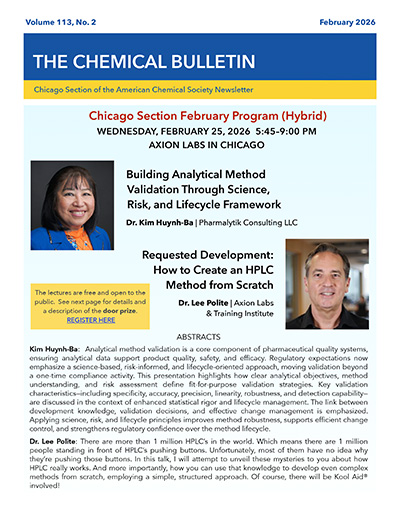
https://chicagoacs.org/images/downloads/Chemical_Bulletin/2026_02_chembulll.pdf
Next Meeting
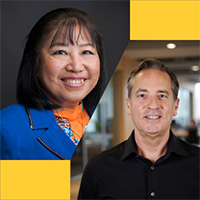
February Program (Hybrid)
Wednesday, February 25
5:45 - 9:00 PM
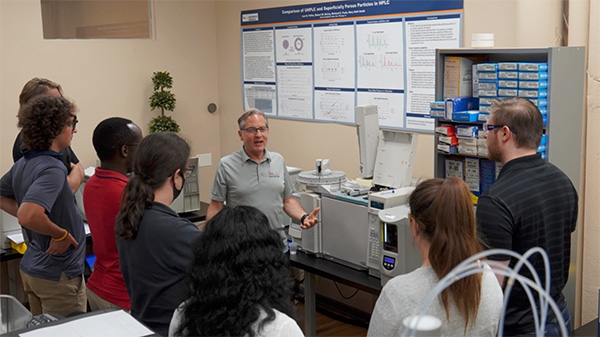
axion Labs
Chicago, IL
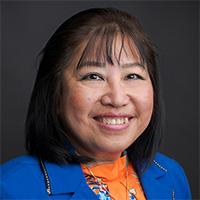
Dr. Kim Huynh-Ba
Pharmalytik Consulting LLC
“Building Analytical Method Validation
Through Science, Risk, and
Lifecycle Framework”
ABSTRACT - Dr. Huynh-Ba
Analytical method validation is a core component of pharmaceutical quality systems, ensuring analytical data support product quality, safety, and efficacy. Regulatory expectations now emphasize a science-based, risk-informed, and lifecycle-oriented approach, moving validation beyond a one-time compliance activity. This presentation highlights how clear analytical objectives, method understanding, and risk assessment define fit-for-purpose validation strategies. Key validation characteristics—including specificity, accuracy, precision, linearity, robustness, and detection capability—are discussed in the context of enhanced statistical rigor and lifecycle management. The link between development knowledge, validation decisions, and effective change management is emphasized. Applying science, risk, and lifecycle principles improves method robustness, supports efficient change control, and strengthens regulatory confidence over the method lifecycle.
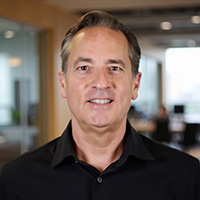
Dr. Lee Polite
Axion Labs & Training Institute
“Requested Development:
How to Create an HPLC Method from Scratch”
ABSTRACT - Dr. Polite
There are more than 1 million HPLC’s in the world. Which means there are 1 million people standing in front of HPLC’s pushing buttons. Unfortunately, most of them have no idea why they’re pushing those buttons. In this talk, I will attempt to unveil these mysteries to you about how HPLC really works. And more importantly, how you can use that knowledge to develop even complex methods from scratch, employing a simple, structured approach. Of course, there will be Kool Aid® involved!
Program:
• 5:45 – 6:00 PM Check-In, Networking
• 6:00 – 6:15 PM Announcements
• 6:15 – 7:15 PM Dinner / Open House
• 7:15 – 8:45 PM Technical Presentations
• 8:45 – 9:00 PM Q&A and Door Prize of an HPLC/GC Training Course
DOOR PRIZE!!
ATTENDEES, BOTH ON ZOOM AND IN PERSON, CAN BE ENTERED INTO A DRAWING FOR A 5-DAY TRAINING COURSE AT AXION LABS VALUED AT $4,495
Buffet Dinner
Traditional Greek Buffet with a vegetarian option, Dessert, Assorted soda/sparkling water, Wine/beer
Event VENUE, COST, and Parking
Axion Labs & Training Institute
14 North Peoria, Suite 100
Chicago, IL 60607
$20 ACS Members, Students, Postdocs, Guests, and Non-ACS Members
- No charge to attend lecture only (hybrid)
Parking is 1/2 block from Axion Labs at Peoria and Washington
The self-pay kiosk fee is $20. Axion will reimburse $10 before your departure.
Park One 850 W. Washington, Chicago, IL 60607
REGISTRATION
REGISTER NOW
Deadline To Register
12:00 noon, Monday, February 23
https://chicagoacs.starchapter.com/meet-reg1.php?id=238
Questions? Email us (info-at-chicagoacs.org)
or contact us by phone (847-391-9091).
Meet the SpeakerS
Kim Huynh-Ba is the Managing Director of Pharmalytik, bringing nearly three decades of experience in pharmaceutical quality systems, strategic drug development, CMC, analytical development, and stability. She advises global organizations on GxP compliance and teaches graduate-level courses on pharmaceutical development as an Adjunct Professor at IIT and Temple University School of Pharmacy. She is also a Short Course Instructor for the American Chemical Society, Eastern Analytical Symposium (EAS), US Pharmacopeia (USP), International Council for Harmonization of Technical Requirements for Pharmaceuticals for Human Use (ICH), Center for Professional Innovation & Education, Inc. (CfPIE), and Pittsburgh Conference. She is a member of the USP Biologics Expert Committee and served on the USP Council of Experts from 2015 to 2025. She also serves on the Governing Board of Directors of the EAS and was President in 2013. She was named a Fellow of the American Association of Pharmaceutical Scientists (AAPS) in 2020 and received the EAS Distinguished Service Award in 2021. Kim has published over 50 peer-reviewed articles and book chapters, edited leading stability references, and remains actively involved with USP, AAPS, and EAS.
Dr. Lee N. Polite earned his Ph.D. in Chemistry from Virginia Tech under the guidance of Professor Harold McNair, a pioneer in chromatography. Lee also holds a bachelor’s degree in chemistry from DePauw University and an MBA from Northwestern University. He has been teaching chromatography (GC and HPLC) to scientists and engineers for over 30 years. In 1995, Dr. Polite established Axion Labs and Training Institute to offer hands-on HPLC and GC training to chromatographers worldwide. Since then, he has instructed over 14,000 professionals, including staff from top pharmaceutical, chemical, and petroleum companies in the U.S., as well as numerous government agencies such as the DEA, FBI, FDA, EPA, Homeland Security, and more than 500 lawyers and judges! He has served as a National Instructor of Chromatography for the American Chemical Society (ACS) since 1991, and he remains one of the top-rated instructors. He is the President of Axion, an adjunct chemistry professor at Illinois Institute of Technology (IIT), and actively shares his passion for chromatography whenever possible.
From the Editor's Desk
FROM THE EDITOR’S DESK
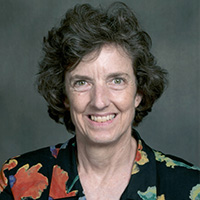
Dear Readers,
Throughout 2026, the American Chemical Society will mark 150 years of advancing chemistry since its founding in 1876 by 35 chemists in New York City. Each month of the year has its own theme, and there are a number of ways we can all participate. The society wants to hear about our stories as part of the ACS Community Spotlight initiative: “Chemistry wouldn’t be possible without you. Join the celebration by telling us a little more about you and sharing what the phrase Chemistry is Everything means to you.” If you are an undergraduate or grad student planning to attend the Spring National Meeting in Atlanta (March 22–36), plan to check out the Trivia Challenge with prizes at the ACS Booth on March 24th. A young professor named Dr. Fun Man Fung enthusiastically shares his insights on Chemistry is Leadership in a short YouTube video. Additional resources will be posted on acs.org/150. And be sure to mark your calendar for the Fall National Meeting in Chicago (August 23–27).
I wish to acknowledge the dozen or so hard-working volunteers who help with the bulletin production. Sometimes it seems to take hundreds of email exchanges (with a wee bit of exaggeration) to collect the articles, images, and other info-bytes. But it’s important to get the details right for the sake of our members. Speaking of details, this month we welcome a new proofreader, Nicolas Gerst, who has been generous with his time in many ways on behalf of the Chicago Section. Although his first language is French, Nic was willing to give proofreading try, and I’m quite sure he will be a valuable contributor. Enjoy reading, and let me know how you find the issue.
— MARGARET E. SCHOTT
Letter from the Chair
Chicagoans’ Impact on Chemistry
While learning more about Chicago’s impact on the chemistry community, I discovered Paul Alivisatos. Ten points if you know who he is. On September 1, 2021, the Board of Trustees of the University of Chicago appointed him the fourteenth President of the renowned institution. Another ten points: What is his significance to ACS? Forty years earlier, in 1981, Alivisatos received a Bachelor of Arts in Chemistry degree from the same university. His credentials represent a researcher in nanomaterials, an inventor holding more than 50 patents, and a business founder of two nanotechnology companies that are now part of Thermo Fisher. He served as founding editor for the ACS publication Nano Letters and is a senior editorial board member for Science. Among other awards from the American Chemical Society, Alivisatos was recognized in 2021 with the Priestley Medal, the highest honor conferred by the ACS, for “pioneering work in nanomaterials and service to the science community”.
As a lecturer at Loyola University Chicago, I mentor a doctoral student who is learning to become an undergraduate professor. Studious and enthusiastic, his dream is to make more chemists in the Chicago style – homegrown Midwest scientists who value their craft.
At opposite ends of their chemistry careers, these two chemists represent the best, most valuable resource Chicago has to offer: its human element. On the 150th anniversary of ACS, it is important that we honor and express our gratitude to the Chicagoans who bring enthusiasm, diligence, innovation, and success to chemistry.
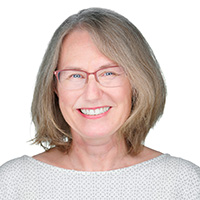
As I stated at my inaugural executive board meeting, my vision for my tenure as Chair is to create pathways for member development, connection, and success. I hope that you will join me in this mission by sharing your chemistry story with another member and inviting others to join you as part of the talent pipeline to find solutions for our world issues through ACS activities or community projects. Why not host a neighborhood chemistry party for 5 year-olds, speak at a career night at the local high school, or surprise President Alivisatos with a thank-you for being a chemist? His email address is president-at-uchicago.edu.
— AMY BALIJA
Explore 150 years of milestones that shaped chemistry and ACS
Younger Chemists Committee
Younger Chemists Explore Career Paths
The Younger Chemists Committee (YCC) hosted its first chemistry career panel in collaboration with Loyola ChemScholars, drawing one of our largest audiences this year despite severe weather. The event took place on November 8, 2025 at Loyola University’s Lake Shore Campus. Panelists included Dr. Lily D’Angelo (Global Food and Beverage Technology Associates, LLC), who spoke previously at a Chicago Section Meeting, along with Dr. Julia Neuman (Argonne National Laboratory) and Dr. Nadjali Chung (Abbvie).
The three speakers discussed making the transition from academia to industry, interdisciplinary opportunities at national laboratories, and the importance of communication, professionalism, and leadership. A post-panel networking session lasted for more than an hour, with the speakers engaged in conversations and many participants sharing their excitement about upcoming YCC events.
Despite being the first event of this kind, the career panel was a tremendous success. The program aligned well with YCC's mission of exposing early career chemists to various career pathways and demonstrating the range of options. YCC hopes to continue organizing additional career-focused events in the future.
— Gowri Kuda-Singappulige & Ana Leal,
Younger Chemists Committee Co-Chairs
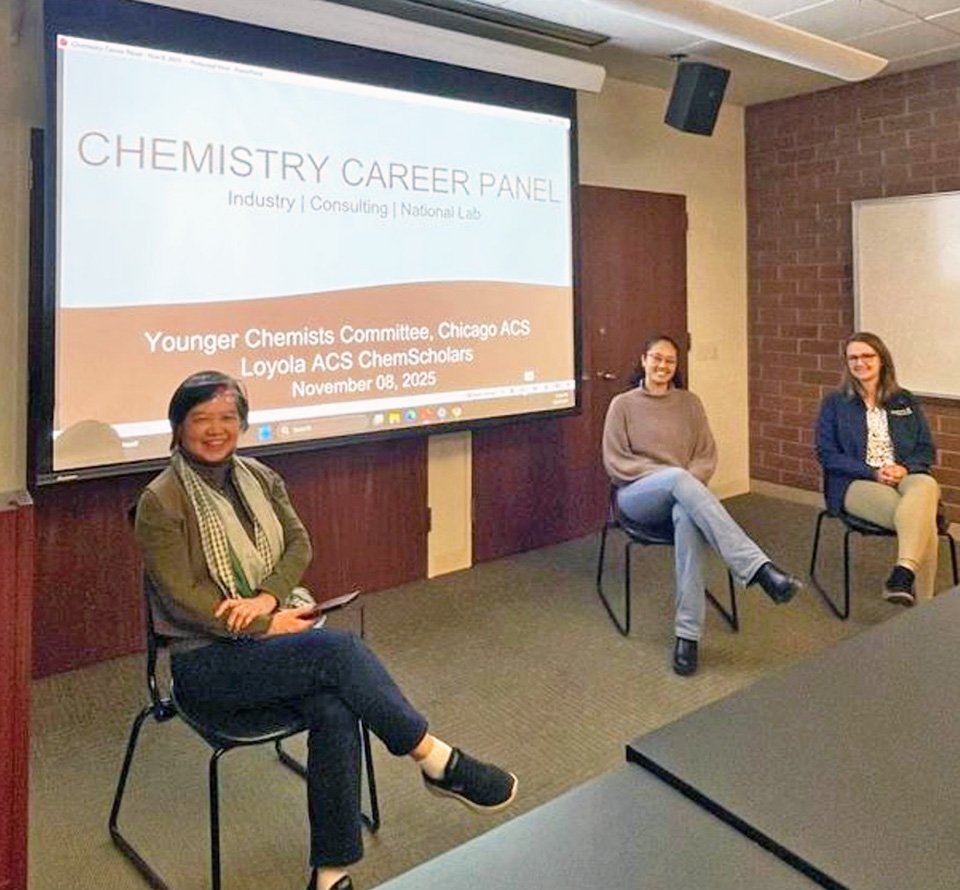
Panel members (L to R) Lily D’Angelo, Nadjali Chung, and Julia Neuman
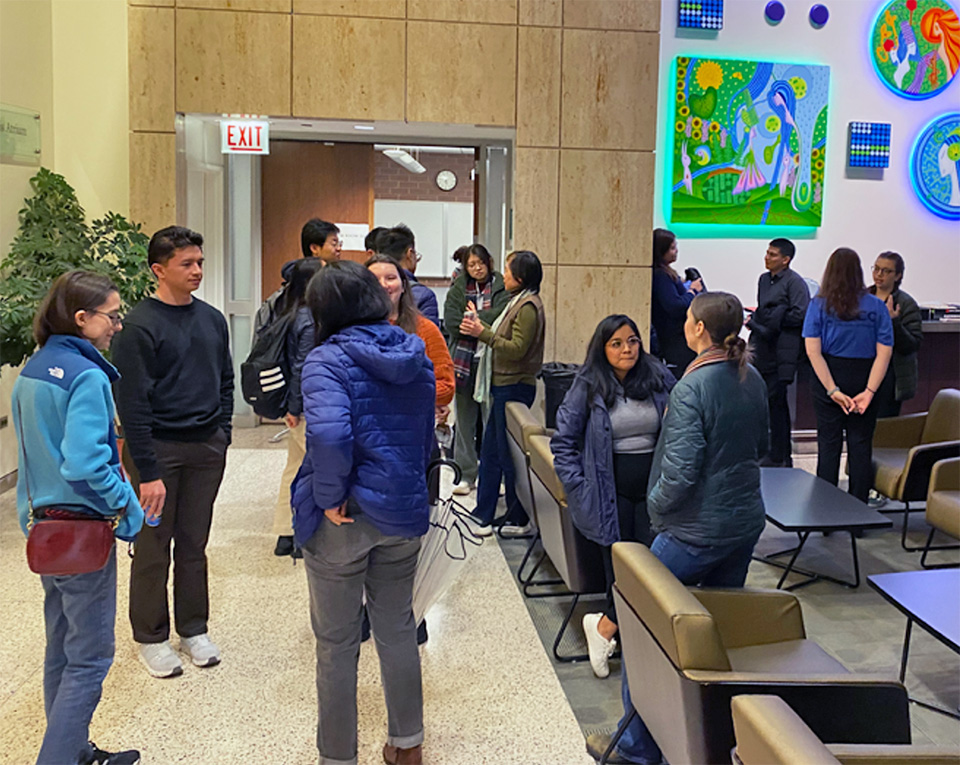
Participants engaged in networking
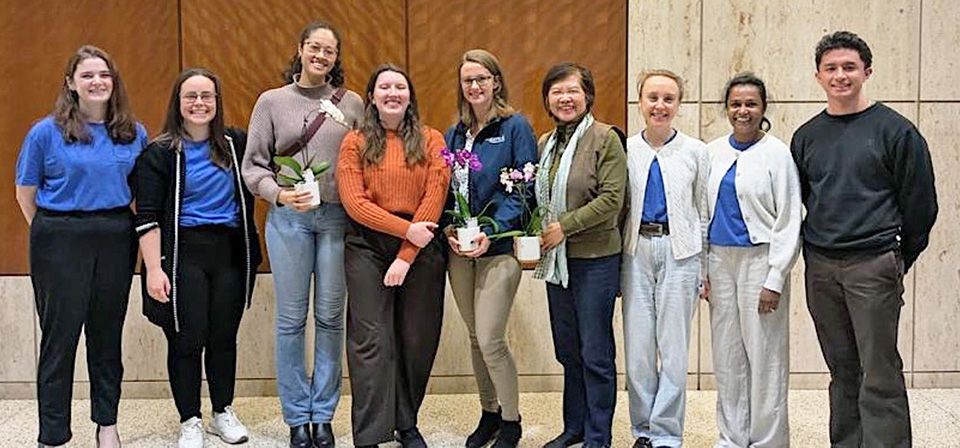
From left to right, the individuals are Anne Aevitt (YCC), Ana Leal (YCC), Nadjali Chung (Panelist), Claire Kennedy (Loyola ChemScholars), Julia Neuman (Panelist), Lily D’Angelo (Panelist), Liliia Shanina (YCC), Gowri Kuda-Singappulige (YCC), and Christian Quinto (Loyola ChemScholars).
Outreach
Chicago Families Get Active with Chemistry
The Chicago Section Outreach Committee took the “stage” once again at Navy Pier for an event that integrated two themes—the annual Spookiest and National Chemistry Week (NCW) activities on the Hidden Life of Spices. The event took place on Saturday, October 25th. Over 20 hands-on stations were readied ahead of time to engage kids, parents, and passersby. Spooky Demonstration Shows were held throughout the day.
Hands-on experiments included: Growing Marshmallow Face, Electrifying Putty, Graphite Circuits, Slime (a perennial favorite), Turmeric Glow, Algae Glow, Spicy Lotion, Are You Stronger Than Cotton, Can You Make the Scent, Mirror Molecules, Bubbling Lava Lamps, Secret Messages, Expanding Powders, Gum + Chocolate, and Hydrophobic Spoons. There was also a table for kids to draw, color, and create a poem. Every station saw over 1000 kids. In addition, 50 volunteers handed out hundreds of safety goggles and bags with activities to do at home. On the bags was a QR code for parents to obtain the directions and understand the science of each station. Families also went home with copies of the NCW magazine and information about the Chicago Section’s outreach and education.
One of the best moments of the day was when several families hunted me down and wanted to tell me that their kids could not wait for this day and were anxious to come. They woke up like it was Christmas—at 6 am, ready to go, and our stations were the highlight for them. This year’s NCW was one of our best years yet. It was non-stop families! Another exciting development is that recent outreach events have gotten more members involved. Another such event is planned for next year. We are making a difference!
In another project, 75 teacher kits were sent to various Title One schools to help with promoting chemistry. The kits provided simple activities to do in the classroom. We went to several of the locations to help the teachers feel more comfortable with the activities and to answer their questions. The teacher kits were a huge success—they loved the variety of activities that incorporated spices. The Chicago Section also coordinated the annual NCW Illustrated Poem Contest.
— SHERRI RUKES, Outreach Committee Chair


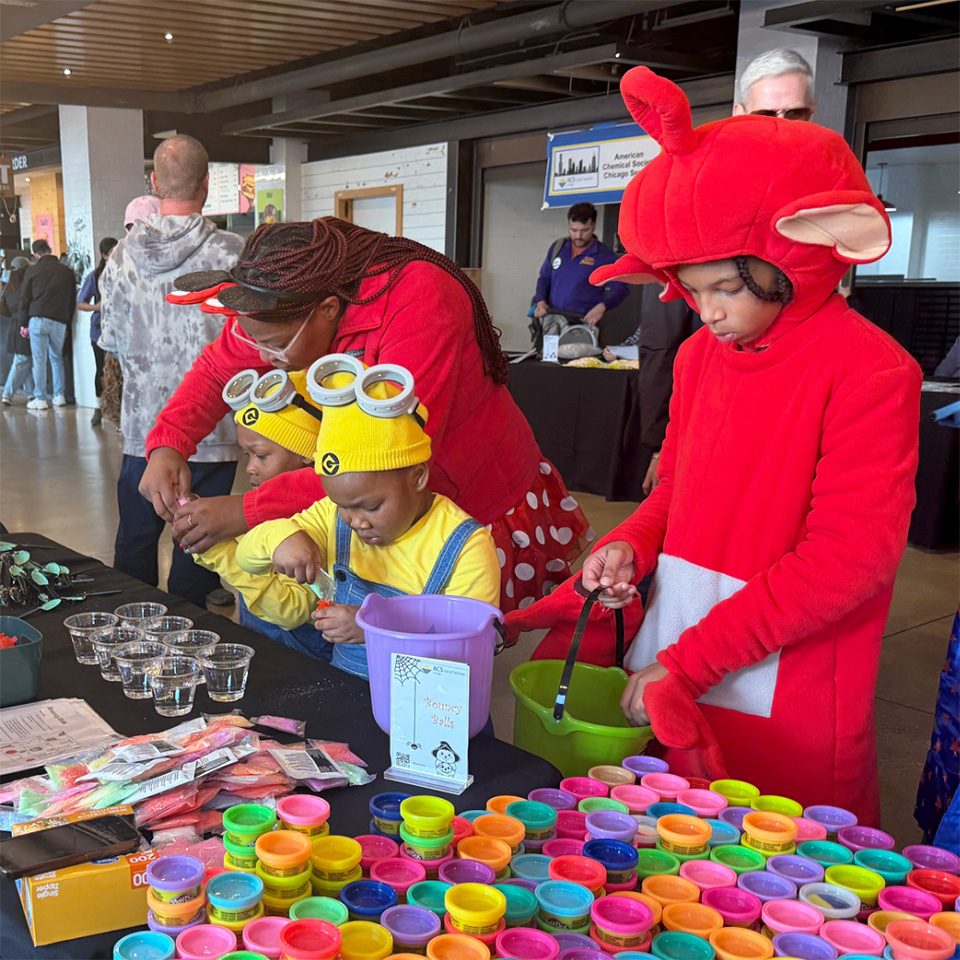

Costumed adults and kids attending Chicago’s Spookfest (aka Slightly Spooky Saturday) at Navy Pier enjoy the Chicago Section American Chemical Society’s activity tables for National Chemistry Week (2025 theme = Hidden Life of Spices)
Photographer: Jacki Ripson
Obituary
Remembering Sir Fraser Stoddart
(1942–2024)
Professor James Fraser Stoddart (1942–2024) was a member of the ACS Chicago Section and the chemistry faculty at Northwestern University (NU). When he passed away on December 30, 2024 at the age of 82, word spread around the world swiftly, the loss being felt intensely by former group members, friends, colleagues, collaborators, and the many young scientists he mentored in the course of his global travels. He was laid to rest in the family plot at Inveresk Cemetery near Edinburgh, Scotland.
Fraser, as he was known, was knighted by Queen Elizabeth II in her 2007 New Year’s Honours List. Upon NU’s hiring of the “nano Knight” in January 2008, Prof. Mark Ratner commented, “He is big stuff—famous, Scottish, and ambitious.” Prior to joining Northwestern, Stoddart served as the inaugural director of the California NanoSystems Institute at UCLA. Earlier academic positions included periods at the Universities of Sheffield and Birmingham in the UK.
The Stoddart group was the first to move into Richard and Barbara Silverman Hall, a $100M facility made possible through a donation of a portion of the royalties from the sales of the blockbuster drug Lyrica®. Fraser called his large laboratory the Research Palace, or RP for short. The promise of this new building, the outstanding faculty, and a commitment by the university to construct a state-of-the-art analytical characterization laboratory had been part of the attraction that lured him to NU. He also relished the opportunity to help lift the department into the echelon of world-class academic institutions.
Fraser was awarded the Nobel Prize in 2016, along with Ben Feringa and Jean-Pierre Sauvage, for the design and synthesis of molecular machines. At a celebration following the announcement, former President Henry Bienen remarked that bringing Fraser to Northwestern was the most expensive hire he had ever made—and it paid off in spectacular fashion!
Sadly, Fraser’s spouse Norma died of cancer in 2004. Her positive impact on the Stoddart group was legendary. According to Fraser, Norma was the matriarch of the Stoddart group for a quarter-century, as well as the proud mother of their two daughters, who, like their parents, went on to earn PhD degrees in chemistry (Norma’s was in biochemistry). In addition to her administrative skills, Norma was someone who could give advice, lend a listening ear, or offer tough love, as needed.
For Fraser, there was no distinct line between science and the humanities. For example, he enjoyed speaking to general audiences on the theme of “Mingling Art with Science”—a talk replete with images of Borromean rings found on medieval castle walls. One of his signature accomplishments in chemistry was the synthesis of molecular Borromean rings, a compound having three entwined and inseparable rings thanks to the presence of mechanical bonds.
He was a visionary thinker who had great expectations for the future of chemistry, particularly as it would be advanced by the next generation. He was also steadfast in his belief that fundamental research—as opposed to application-oriented or development work—was key to the emergence of pioneering discoveries. To this end he gave those under his mentorship a long tether. When it came to encouraging newly minted faculty to exercise their creativity in research, Fraser passed along a piece of advice he had once received, namely, “Identify a big problem!”
Fraser was an indefatigable promoter of other people, and he made a special effort to support younger women in academia. He was intensely pleased about the international character of his research group. Over time, the group’s makeup became more predominantly Asian as he traveled widely in China and elsewhere to present keynote lectures and hold informal Q&A sessions with budding chemists. He also delighted in introducing his proteges to all manner of British- and American-English colloquialisms.
Fraser was a proud Scotsman who made a point of celebrating Robert Burns Day each year on the 25th of January. The event might include readings of Burns’ poetry, the recitation of long dramatic speeches, and of course the required haggis. One year he invited several other Scots in academia and held a scientific symposium.
In his early eighties, Fraser embraced another academic challenge when he moved his group to Hong Kong University (HKU) in the summer of 2023, while retaining a part-time position at NU. In a nod to the 8th floor walk-out garden that overlooked the Hong Kong city skyline, the newly refurbished laboratory at HKU was named the Research Palace and Garden, or RPG.
Personal Recollections
For over fifteen years, I had the extraordinary privilege of serving as Fraser’s personal assistant, or right arm, at Northwestern University. Some years earlier, I had earned my doctoral degree in chemistry at NU under the direction of Prof. Robert Letsinger.
When I interviewed with Fraser in the fall of 2007, he told me he was looking to hire someone with a doctorate in chemistry who could perform administrative tasks in support of both him and his group. It was also essential that the individual learn to read his mind and be someone with whom he could relate personally on those occasions when he arrived back in the office, exhausted from overseas travels. There was also the matter of keeping up with the production of a constant stream of publications coming out of the office—with one paper in preparation, one submitted for review, and one at the proofreading stage in a given week.
I still recall Prof. Letsinger saying, when I was deciding whether to accept the job offer, “If you join Stoddart, you will be at the center of a whirlwind of activity!” Indeed, I came to learn firsthand that something new was always happening with Fraser. He had a lot on the go.
Being hired by NU to work with Fraser was a lucky break that proved to be the capstone of my career. It was a heady and exciting time, yet not without its challenges. My experience as a chemistry staff member was at times thrilling, intense, exasperating, fast-paced, celebratory, hilarious, and rewarding. In the beginning there was a huge learning curve as I struggled to understand research budgets, navigate the online grant proposal system, process orders, and keep the office machines running smoothly. Over time I learned to say, “Yes, I can help you with that” to tasks large and small.
I appreciated the intellectual stimulation of being introduced to new chemistry and nanoscience in the areas of molecular switches and machines, metal-organic frameworks, mechanically interlocked molecules, and a lot more. There was an entirely new vocabulary to master: catenanes, rotaxanes, donor–acceptor stations, Blue box, secondary building units, nano valves—along with colors assigned to the various functional groups in ChemDraw.
Fraser’s frequent travels posed no barrier to getting work done, as he found time to write long email messages and send along scanned versions of his hand-written pages. (He never took up use of word-processing software.)
In working alongside Fraser, I learned—out of sheer necessity—to work fast in order to keep up with assignments that kept landing on my desk. On arriving at the office on a typical morning, I would be greeted by an orderly stack of lined yellow pages consisting of hand-written letters, manuscript drafts, travel expenses, keynote speeches, and so on. The pages were penned in red and blue ink from his prized fountain pens. It was a good thing I had learned to type—and even enjoyed it!
Many will remember with gratitude the “farewell lecture” Fraser delivered on his birthday in May 2023. Walking across the stage of a packed Ryan Hall in the Technological Institute, Fraser cut a striking figure in his tartan kilt. “Around the World in Eighty Years” was the title he selected. The presentation was edifying, engaging, wide-ranging, inspiring, highly personal, witty, and exceptionally moving. The story of a brilliant career told with humility by a master storyteller.
Working with Fraser was the opportunity of a lifetime. With profound gratitude and a trove of memories, I am immensely proud to be a member of the worldwide Stoddart family of chemists and colleagues.
— MARGARET E. SCHOTT
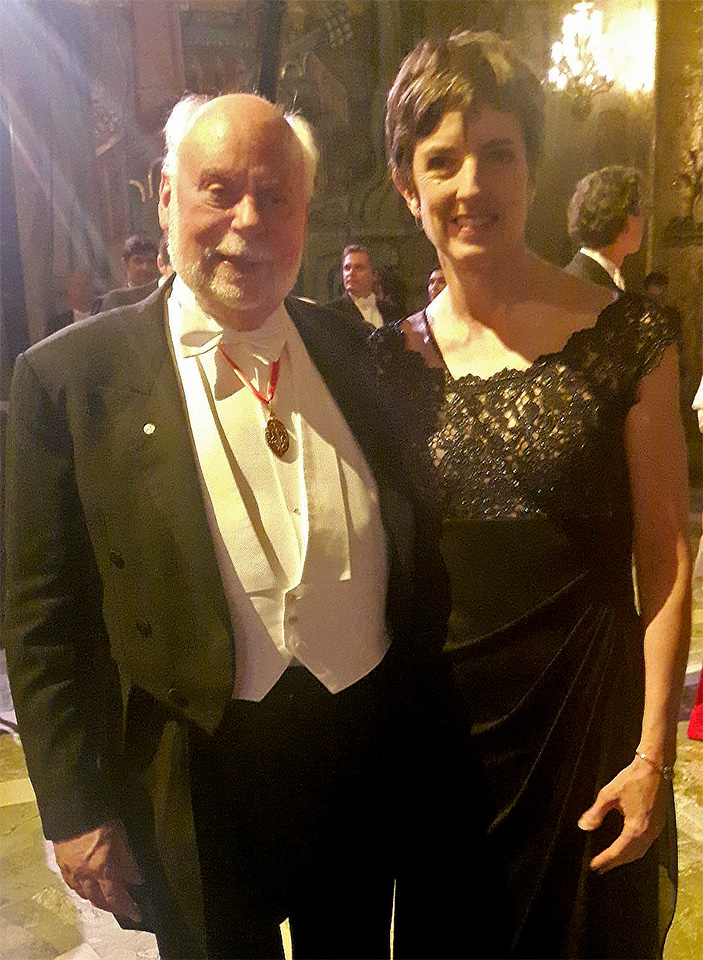
Sir Fraser Stoddart with Margaret Schott at Prof. Stoddart’s Dec 10, 2016, Nobel Prize reception in Stockholm, Sweden. Photo by Alyssa Avestro.
Additional resources:
1. David, D. A. Obituary – James Fraser Stoddart (1942–2024). Nature 638, 38 (2025).
2. Halford, B. Organic chemist and nanoscientist Fraser Stoddart dies at 82. C&EN (Dec 31, 2024).
3. Rowan, S. J., Dichtel, W. R. & Schott, M. E. Fraser Stoddart (1942–2024). Nat. Nanotechnol. 20, 588–589 (2025).
4. Nobel lecture: Sir J. Fraser Stoddart, Nobel laureate in chemistry 2016. YouTube (Dec 11, 2016); https://www.youtube.com/watch?v=V7DqCz0nQzU
5. Professor Stoddart’s papers are located in the Northwestern University Library Archives.
Profile photo credits: Jim Prisching Photography (Oct 5, 2016)
From the Archives
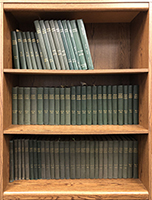
The Colloid Chemist
The song text on this page is attributed to Jerome Alexander (1876–1959), who was a pre-eminent American scientist in the field of colloid chemistry. The humorous ditty represents one of many parodies of the patter song “I am the Very Model of a Modern Major-General” from the Gilbert and Sullivan operetta Pirates of Penzance. “The Elements” by Tom Lehrer is perhaps a more familiar example of the galloping, rhythmic, rapid-fire style.
The colloid version of this patter song appeared in the June 1925 issue of The Chemical Bulletin (Vol. 12, No. 6). Curiously, the same text was published again in June 1927 in the Spinthariscope column of the bulletin (Vol. 14, No. 6). That version, attributed to pseudonymous author “Preserved Fish”, states that the song text had been published in The Indicator (year unknown) “with relayed apologies to Mr. Gilbert.” The Indicator probably refers to the newsletter published by the North Jersey and New York Local Sections of the American Chemical Society. The same song text appeared yet again in the July 8, 1927 issue of The Collecting Net (Vol. 2, No. 1), the weekly newsletter of the Marine Biological Laboratory at Woods Hole, Massachusetts, this time attributed to “pH. D.”
“The Colloid Chemist” has now been listed on the “Modern Major General” parodies website maintained by William Gasarch at the University of Maryland: https://www.cs.umd.edu/~gasarch/FUN/modmajgen.html. —Ed.
The Colloid Chemist
I am the very pattern of a modern Chemist Gineral—
I've information vegetable, animal, and mineral.
I am well up in physics, quote experiments historical,
From Thales, Volta, Faraday, in order categorical.
Equations both of integral and differential calculus,
I use to plumb the vagaries of beings animalculous—
In fact, in matters vegetable, animal, and mineral, I am the very pattern of a modern Chemist Gineral.
The filter-passing haze that spoils the very best analysis,
Impurities that wreck your final product by catalysis,
The clouds, and fogs, and rains that go to make the weather fair or foul,
The mists a gas-mask won't adsorb, but make the soldiers swear or howl,
And where the agates get their rings, and how the comet swings its tail,
And how the pearly nautilus on tropic waters flings its sail—
In all these questions vegetable, animal, and mineral,
The colloid chemist shows he is the modern Chemist Gineral.
If you would know how plants suck up their food by capillarity,
The differences in grade of crops, the cause of their disparity,
If you would use the messes that organic chemists cuss like sin,
See lifelike ultramicrons wriggle in a sol of protein,
If you would know of dyeing rubber, leather, or linoleum,
Of foods, flotation, brewing, soaps, glues, paper or petroleum,
You'll find in matters vegetable, animal, and mineral,
The colloid chemist proves he is the modern Chemist Gineral.
– Jerome Alexander
ChemShorts for Kids
Wait, a rainbow can walk?!
Introduction:
This fun and colorful experiment shows how capillary action works using simple household materials. We will be utilizing science to allow water to walk and blend the primary colors!
Materials:
• Clear cups, 7 (glass or plastic)
• Red, blue, and yellow food coloring
• Paper towels
• Water
Experiment:
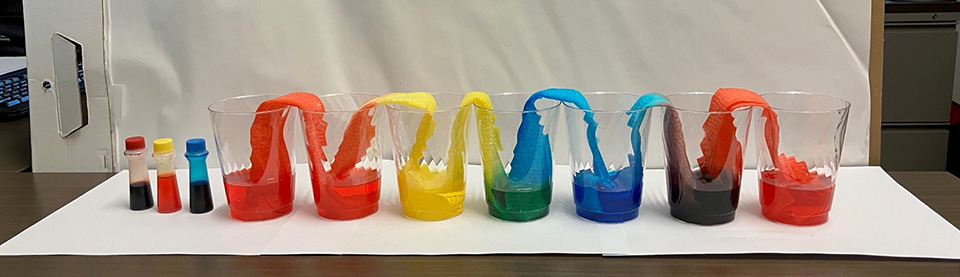
Line up 7 clear plastic cups and fill the 1st, 3rd, 5th, and 7th cups full of water. In the 1st and 7th cups add 5 drops of red food coloring; in the 3rd cup add 5 drops of yellow food coloring, and in the 5th cup add 5 drops of blue food coloring. Mix the solutions in each of those cups. Leave the 2nd, 4th, and 6th cups empty. Fold 6 half-sheets of paper towels twice, hot dog style, into long, thin strips and then fold them in half lengthwise. Cut the ends of the paper towels so that their length is about the height of the cups. Place one end of the first strip into the 1st cup and the other end into the 2nd cup. Repeat with all cups until you have created a bridge of paper towels. Watch what happens over the course of the day. Did you see the full rainbow of colors appear in the seven cups?
What’s Happening?:
So, how is the water moving against gravity? Adhesive forces occur with the paper towel and water molecules, allowing the water to “stick” to the towel, traveling upwards! As the primary colors in the 1st, 3rd, 5th, and 7th cups travel up the paper towel and into the 2nd, 4th, and 6th cups, the even-numbered cups will fill with the mixture of colored water. The primary colors (yellow, red, and blue) will mix to form the secondary colors (orange, green, and purple). In the end, all the cups have the same volume of water. This occurs because once the water finds its way into the empty cup, it can begin to climb in the reverse direction and back to the original cup. It will only do that, however, if the once-empty cup were to get higher in volume than the original cup. We call this equilibrium. Next month, we will see this action occur in Nature!
Extension/Final Notes:
Could you experiment with different colors? Can you get tertiary colors to appear if you start with the secondary colors? Could you use just one color and attempt an ombre effect? What will happen if the originally empty cups are filled with only tap water? Could you align the cups in a circle to create a flower-like rainbow?
Resources:
https://www.youtube.com/watch?v=1PWVSt5zYaI
To view past “ChemShorts for Kids” activities, go to:
https://chicagoacs.org/ChemShorts.
— MAGGIE KNOPF & PAUL BRANDT
Upcoming Events

ACS Webinars
REGISTER HERE for these and other upcoming and archived ACS webinars:
https://www.acs.org/acs-webinars.html
The Chemistry of Romance, Flavor, and Drink:
Roses, Chocolate, & Wine
February 6
12:00 noon CST | 1:00 PM EST
•
View past webinars PLUS slide decks on these and other topics:
Ice Cream Chemistry
(Jun 2025)
Cook, Taste, Learn: How the Evolution of Science Transformed the Art of Cooking
(Jan 2020)
What’s All This Dry Stuff Doing in My Wet Beer?
(Mar 2022)
Check out other food & drink webinars: what’s in your cup of tea? / espresso chemistry / mushrooms, ERGO, aging / and many others.
IUPAC’s GLOBAL WOMEN’S BREAKFAST (GWB)
x
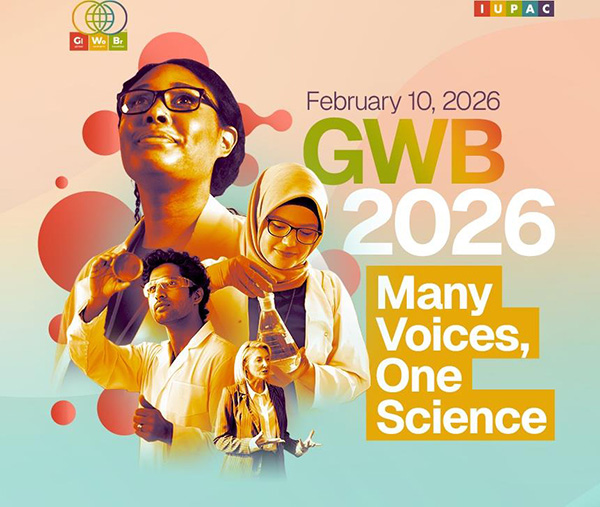
Tuesday Feb. 10th , 8:00 am - 9:30 am
Bryn Mawr Breakfast Club, Belmont Gardens
4459 W Belmont Ave
Chicago 60641
All Chicago-area Chemists!
• Enjoy breakfast & conversation
• Help celebrate IUPAC’s Global Women’s Breakfast
• RSVP to Sunshine Silver sunshine.silver-at-elmhurst.edu with subject line GWB
Learn more about the event at: https://iupac.org/gwb/
CHICAGO-AREA SEMINARS,
COLLOQUIA & SCIENCE CAFES
American Institute of Chemical Engineers (AIChE)
- Plant Tours!
Refer to the AIChE newsletter for a listing of future local, regional, and national events
https://www.aiche.org/community/sites/local-sections/chicago
• Feb 23 – Baxter Plant Tour (Round Lake)
• Mar (date TBA) – Tour of the Chicago Mondēlez International Bakery & Process Safety in the Food Industry.
•
NORTHERN ILLINOIS UNIVERSITY (NIU) –
STEAM CAFES
Event venue is Fatty’s Pub and Grille in DeKalb.
Wednesday, February 4, 6:30 PM
“Unlocking the Science Behind Olympic Glory”
-
Wednesday, March 4, 6:30 PM
“Turning Sewage into Energy"
https://niusteam.niu.edu/programs-events/
•
NORTHWESTERN UNIVERSITY (NU), EVANSTON –
FRONTIERS IN NANOTECHNOLOGY SEMINAR SERIES
Free and open to the public. Coffee, tea, and pastries served 15 minutes prior to the seminar.
• Feb 19 at 3:00 pm – Sara Skrabalak (Indiana University) Nanocrystals for electrocatalysis
• Mar 12 – Justin Hanes (Johns Hopkins University) / Apr 30 – Mircea Dinca (Princeton University)
• May 7 – Todd Emrick (University of Massachusetts Amherst) / May 14 – Chibueze Amanchukwu (UChicago)
• May 21 – Younan Zia (Georgia Institute of Technology)
CHICAGO SECTION BOARD MEETINGS
Open to all Section members. For Zoom link, contact: office-at-chicagoacs.org
2026: February 12, March 12, April 9, May 14, June 11, August 7, Sep 13, October 8, Nov 12, Dec 3
•
Deadlines for Bulletin Submissions
Deadline for bulletin submissions is the 16th of each month. Content can include photos, reports, past event summaries, flyers and information for upcoming events, original articles, current chemistry, etc. Contact editor-at-chicagoacs.org. Thank you!
February 16th for March issue
March 16th for April issue
Chicago ACS Section Programs
https://chicagoacs.org/meetinginfo.php
|
Tuesday, Febuary 10, 2026 Bryn Mawr Breakfast Club, Belmont Gardens, Chicago |
IUPAC - Global Women’s Breakfast. Theme is "“Many Voices, One Science”. https://iupac.org/gwb/ RSVP to sunshine.silver-at-elmhurst.edu |
|
Sunday, Febuary 15, 2026 Libertyville Civic Center,
|
Chinese American Chemists New Year’s Party |
|
Wednesday, February 25, 2026 Axion Labs, Chicago |
Monthly program at Axion Labs (hybrid) |
|
Friday, March 13 |
Senior Chemists Luncheon with Dr. Katherine Lee |
|
March 22-26, 2026 Atlanta, GA |
ACS Spring National Meeting |
|
Saturday, April 25, 2026 |
TBA |
|
Friday, May 15, 2026 |
Gibbs Medal Lecture and Banquet |
|
Jun / Jul |
Family-friendly event |
|
Aug 23 - 27, 2026 McCormick Place, |
Chicago Section to host Fall ACS National Meeting of the American Chemical Society |
Please also refer to the Section’s website chicagoacs.org/meetinginfo.php and social media accounts.
Other Local Section Events
Feb 10 at 5:30 pm CST: “History & Chemistry of Mirror Through the Centuries” with speaker Dr. Paris Svoronos. Hosted by the Long Island NY ACS Subsection. Register to receive Zoom link at https://suny-ow-edu.zoom.us/meeting/register/e_tKbLBMTTud7pX7ysR9UA#/registration.
Feb 11 at 4:00 pm PST / 6:00 pm CST: Scripps Front Row lecture series, “The sweet side of drug discovery: How sugars can help shape the future of medicines” with speaker Dr. Yuzhong Liu. Reserve your Zoom seat now at https://frontrow.scripps.edu/lectures/yuzhong-liu/.
Board & Committee Members

2026 Chicago ACS Section Officials
|
Chair Chair-Elect Past Chair Vice Chair Secretary Treasurer |
Amy Balija Inessa Miller Anita Mehta Sunshine Silver Michael Koehler Russ Johnson |
|
|
Directors |
2025-2026 Daniela Andrei 2026-2027 Ken Fivizzani |
directors-at-chicagoacs.org |
|
Councilors |
2024-2026 Paul Brandt 2025-2027 Josh Kurutz 2026-2028 Amy Balija |
councilors-at-chicagoacs.org |
|
Alternate |
2024-2026 Avrom Litin 2025-2027 Katie Leach 2026-2028 Nicolas Gerst |
altcouncilors-at-chicagoacs.org |
* One vacancy to be filled by the Board
Masthead
Bulletin Information
February 2026, Vol. 113, No. 2
Published monthly (10 issues, Sept – Jun) by the Chicago Section of the American Chemical Society
https://chicagoacs.org
Editor: Margaret E. Schott
editor-at-chicagoacs.org
Digital Editor: Josh Kurutz
historian-at-chicagoacs.org
Proofreaders: Nicolas Gerst, Kshitish Patankar, Bethel Shekour
How to reach us
office-at-chicagoacs.org (847) 391-9091
ACS Chicago Section Office
Krasa 035B and C
5700 College Road
Lisle, IL 60532
Website: https://chicagoacs.org
Social links
Follow ChicagoACS on social media!
Bluesky (new!): https://bsky.app/profile/chicagoacs.bsky.social
Instagram: https://www.instagram.com/ChicagoACS/
Facebook: https://www.facebook.com/ChicagoACS
LinkedIn: https://www.linkedin.com/groups/1854603/