The May 2024 Chemical Bulletin 
PDF of the Latest Bulletin

https://chicagoacs.org/images/downloads/Chemical_Bulletin/2024_05_chembull.pdf
Next Meeting
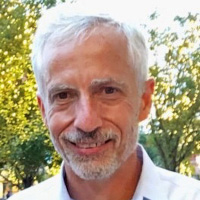
113th Willard Gibbs Award Celebration
Friday, May 17
6:00 to 10:00 PM, CDT
Meridian Banquets, ROlling Meadows
Eric Jacobsen
Sheldon Emory Professor of Organic Chemistry
Department of Chemistry and Chemical Biology,
Harvard University
"Selectivity and Generality in
Small-Molecule Catalysis"
My research program has been dedicated to the discovery of catalytic systems that control stereochemical outcomes in organic reactions of interest. In the course of our efforts, we have had occasion to perform deep mechanistic analyses of the catalysts we have discovered. In this lecture, I will relate different stories where seemingly minor “misbehaviors” in our experimental data were examined closely and found to reveal unexpected insights into the catalytic mechanisms and ultimately led us to improved or entirely new catalytic systems.
CITATION
For discoveries of fundamentally important catalytic reactions which have led to:
- the redefining of the way molecules are synthesized
- the uncovering of effective methods for a wide variety of stereoselective reactions
- the development of chiral Schiff base complexes of main group and transition metals
- the discovery and application of novel organic catalysts

In-Person DINNER MEETING ONLY
Dinner and Award Address
Meridian Banquets
1701 Algonquin Rd.
Rolling Meadows, IL 60008
http://www.meridianbanquets.com
847-952-8181
REGISTRATION
Deadline to register: NOON, Monday, May 13
Questions? Email us (info-at-chicagoacs.org) or
contact us by phone (847-391-9091).
PROGRAM:
- 6:00 - 7:00 Reception with hors d’oeuvres and two complimentary drinks
- 7:00 - 8:30 Dinner
- 8:30 - 8:45 ACS Award Ceremony
- “A History of the Willard Gibbs Award” - Vivian Sullivan, ACS Chicago Section Chair
- Introduction of Professor Jacobsen - Mark Levin, University of Chicago
- Presentation of the Gibbs Medal
- 8:45 - 9:45 Gibbs Award Lecture by Professor Jacobsen
Dinner
• Starter: Minestrone soup, Meridian salad
• Choice of entree:
- BEEF: Roast top sirloin with rosemary merlot sauce
- FISH: Fresh broiled Norwegian salmon with dill sauce
- VEGETARIAN: Portobello mushroom with zucchini
• Dessert: Hot fudge brownie a la mode
Cost: $50
Lecture-only attendance is free
Meet The Speaker
Eric Jacobsen was born in New York City to Cuban parents, received his primary and secondary education at the Lycée Français de New York, and graduated from New York University in 1982 with a B.S. in Chemistry. His Ph.D. work was done at U.C. Berkeley under the direction of Robert Bergman. In 1986, he returned to the East Coast of the U.S. for an NIH postdoctoral fellowship with Barry Sharpless. In 1988, he began his independent career at the University of Illinois. He moved to Harvard University as a full professor in the summer of 1993. He was named the Sheldon Emory Professor of Organic Chemistry in 2001 and served as Chair of the Department of Chemistry and Chemical Biology between 2010 and 2015.
Professor Jacobsen's research group is dedicated to discovering useful catalytic reactions and applying state-of-the-art mechanistic and computational techniques to the analysis of those reactions. Several of the catalysts developed in his labs have found widespread application in industry and academia. These include metal-salen complexes for asymmetric epoxidation, conjugate additions, and hydrolytic kinetic resolution of epoxides; chromium-Schiff base complexes for a wide range of enantioselective pericyclic reactions; and organic hydrogen-bond donor catalysts for activation of neutral and cationic electrophiles. Eric's mechanistic analyses of these systems have helped uncover general principles for catalyst design, including electronic tuning of selectivity, cooperative homo- and hetero-bimetallic catalysis, privileged catalysis, hydrogen-bond donor asymmetric catalysis, and anion binding catalysis. The recognitions he has received include the Arthur C. Cope Medal of the American Chemical Society, the Chirality Medal, and elections to the U.S. National Academy of Sciences and the American Academy of Arts and Sciences.
For history about the Willard Gibbs Award and a list of previous award winners, please visit
https://chicagoacs.org/Willard_Gibbs_Award
Save the Date - Following Meeting
Join the ACS Chicago Section
for Chicago Dogs Baseball
The ACS Chicago Section will be holding its Summer Social Outing on Sunday, June 23, when the Chicago Dogs host the Kansas City Monarchs at Impact Field in Rosemont, Illinois. Tickets include game admission and a food voucher valid for a hot dog, chips, and a soda. Parking will be available at Impact Field adjacent to the stadium at a rate of $3 per vehicle. Public transportation is also available in the form of either the CTA Blue Line or Metra. A Rosemont Entertainment Connector Trolley will be available for transport between Rosemont Station and Impact Field. See the Chicago Dogs website for more direction information.
WHEN: Sunday, June 23, 3 PM to 8 PM
WHERE: Impact Field, 9850 Balmoral Ave, Rosemont, IL, 60018
TICKETS: $23.75 (includes food voucher)
Click here to REGISTER
https://chicagoacs.org/meet-reg1.php?id=207
Recent Meeting
Earth Day
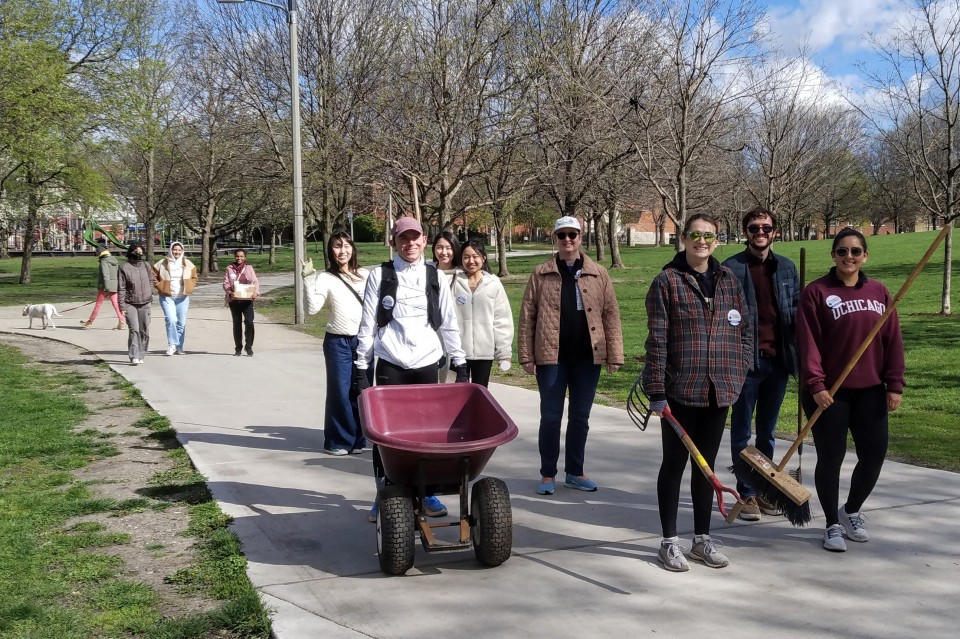
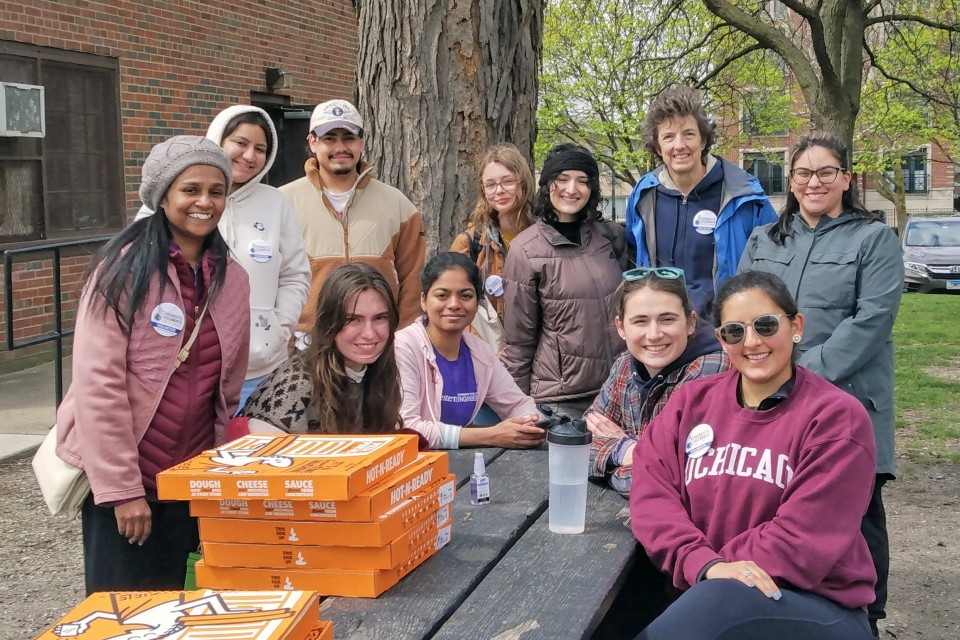
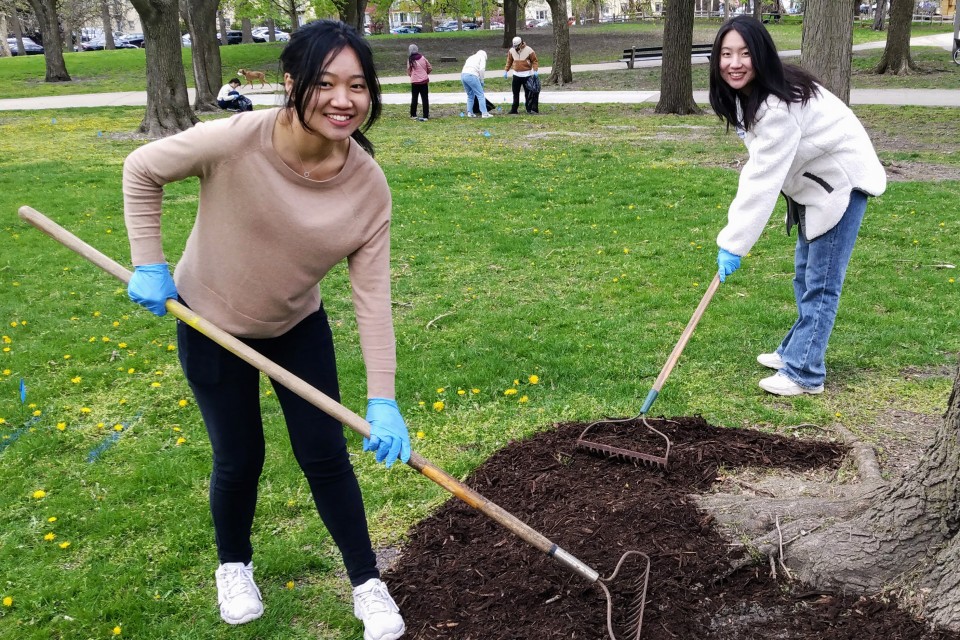
For the ACS Chicago Monthly Program Event on April 20, 2024, the Younger Chemists Committee teamed up with Friends of the Parks to host an Earth Day Chicago Park Cleanup. Section members pitched in to help beautify the park grounds of Henry Horner Park. Small teams either collected trash or placed wheelbarrows full of mulch around trees. We learned from the park manager that, over a period of years, the clay in a large area of the park was dug up for brick-making. Later, the 45-feet deep hollowed-out area was filled in with used bottles, which might explain why several participants found old bottles or pieces of glass with striking colors. Thanks to YCC Co-Chair Gowri Kuda-Singappulige for organizing a successful event! Please enjoy these photos of the event.
See more photos in the gallery:https://chicagoacs.org/gallery.php?id=95
Historical Feature
Robert Chesebrough and the
Making of Vaseline
When I was growing up, my family would frequently pile into the station wagon and head south on the Garden State Parkway to visit relatives or to enjoy a week’s vacation at the Jersey shore. From the bridge spanning the Raritan River at Perth Amboy, we could see industrial plants with their large signs announcing brands like Carborundum, Colgate-Palmolive and Chesebrough-Ponds. More on that last company in a moment.
For some time, I have been wondering why Vaseline—also called petrolatum or petroleum jelly—has a light color when it is derived from crude oil (petroleum), which is often dark-colored. And another thing: When the label on a jar of Vaseline® states that the contents are 100% pure, does the manufacturer mean it has just one chemical component?
We can dispense with the second question in short order. According to the definition given for CAS number 8009-03-8, petrolatum is “a complex combination of hydrocarbons obtained as a semi-solid from dewaxing paraffinic residual oil. It consists predominantly of saturated crystalline and liquid hydrocarbons having carbon numbers predominantly greater than C25” (echa.europe.eu). Some of these larger compounds are likely to include stearanes, tri- and tetra-terpanes, and macrocyclic alkanes.
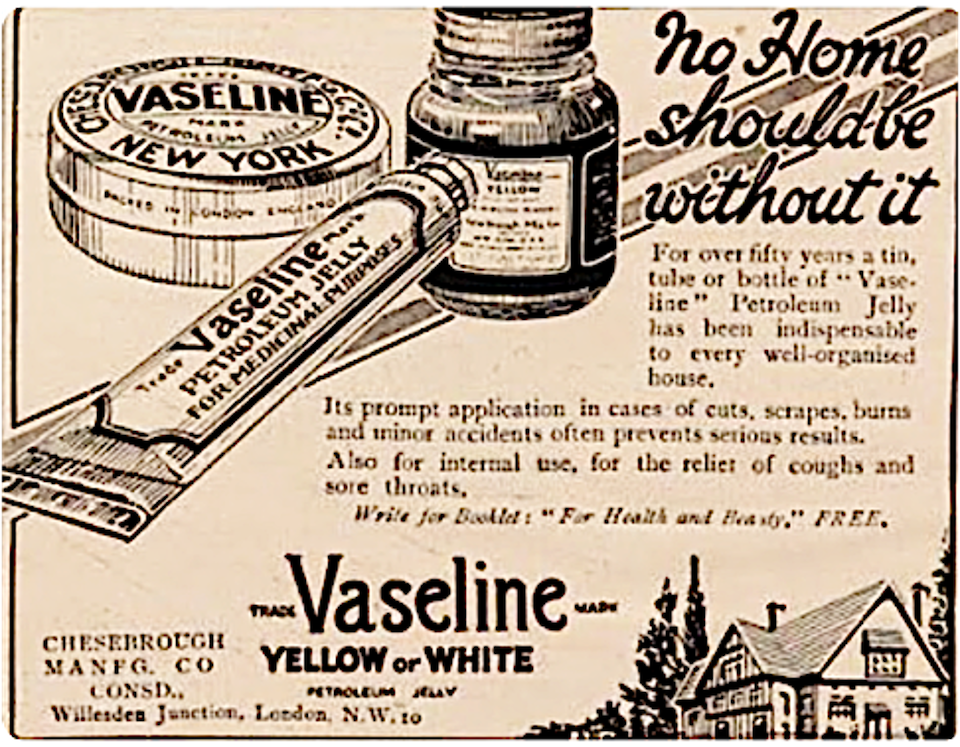
To address the question of color, it’s helpful to look at a couple of 19th century patents by Robert Augustus Chesebrough, a prolific inventor from New York. In an 1865 patent (US 49,502) he claims, “the use of bone-black for purifying petroleum or coal oils by filtration.”
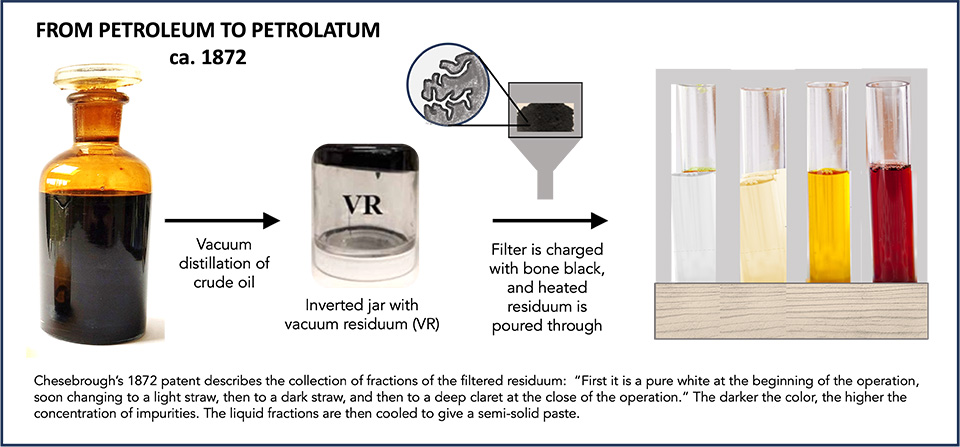
The process has two steps. Following an initial distillation step to remove lower-boiling components, the residue is heated above its melting point and filtered through “bone-black made of charred bones.”
It was in his patent of 1872 (US 127,568) that Chesebrough first applied the name “Vaseline” to his “new article of manufacture”, effectively rebranding his original “Wonder Jelly.” The name derives from the German wasser (prounounced vasser) and the Greek elaion (ἔλαιον, olive oil). Part of the patent reads:
The substance from which Vaseline is made is the residuum of petroleum left in the still after the greater part of the petroleum has been distilled off … Vaseline is the product of the filtration of the said residuums through bone-black [bone char] and varies in colour as it comes from the filter.
In other patents, Chesebrough describes the use of vacuum distillation and a filter apparatus equipped with steam-heated coils. The validity of some of his patent claims, however, is debatable, as some of his innovations were already in use. Regarding the application of heat during filtration, for example, one commentator quipped, “It would be hard to find even an idiot who would try to filter cold lard” (Sheppard, 1881).
The late1800s saw a number of competitors entering the marketplace, with alternative products sporting names like Cosmoline, Petroline, Densoline, Fossiline, and Deodoroline. The original product made by Chesebrough Manufacturing, however, was considered in many places to be the petroleum ointment of choice (Sheppard, 1881). In some of the company’s marketing, consumers were cautioned not to use petroleum jellies “of lesser refinement”.
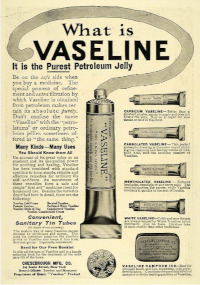
Early advertisements for Vaseline listed as many as a dozen different varieties, allowing consumers to choose their preferred preparations for cosmetic or medicinal use. While most of these ointments were intended for external use, White Vaseline was supposed to be used orally to sooth sore throats. Some of company’s additives included borates, camphor, carbonic acid (phenol), menthol, perfume, and zinc oxide. Capsicum Vaseline with cayenne pepper extract was advertised as a “wonderful counterirritant” for relieving rheumatism, chest colds, toothaches, and more.
In Chesebrough’s day, petrolatum was used for applications such as shining leather, lubricating machinery, preventing rust, removing stains, shaping hair and soothing chapped hands. Since then, additional consumer and industrial uses have been discovered. Today we find petrolatum used as an active pharmaceutical agent in post-operative wound care and as an excipient in formulations for adhesives and sealants, modelling clay and finger paints, inks and toners, and plant-protection products. For those opposed to the use of petroleum-based products, other options are available: Beeseline, Vegaline, Nutroleum, Un-Petroleum and Waxelene.
Petrolatum works by preventing trans-dermal water loss; in other words, it slows dehydration of the skin. According to information found at vaseline.com, its “unique properties accelerate the skin’s barrier recovery, melting into the spaces between skin cells [and] providing superior occlusivity.” Once skin penetration has occurred, some of the components act to replace lipids and boost the skin’s ability to repair itself.
Over time, the process for manufacturing petrolatum was expanded from two to four steps: (i) distillation to vaporize gasoline and kerosene, (ii) deasphalting, where a solvent extracts the heavier oils, (iii) dewaxing for further removal of unwanted components, and (iv) filtration through bauxite (Kamrani, 2023)
In 1955, Chesebrough Manufacturing Company merged with Pond’s Extract Company to form Chesebrough-Ponds, which was acquired by Unilever in the 1980s. All the Vaseline in the world once originated in Perth Amboy when the company was located there.
- MARGARET E. SCHOTT
References:
S.A.D. Sheppard, “On Vaseline and Petroleum Products,” New Remedies 1881, 20, 105–106.
K.L. Jayakumar, R.G. Micheletti, “Robert Chesebrough and the dermatologic wonders of petroleum jelly,” JAMA Dermatology 2017, 153, 1157.
P. Kamrani et al., “Petroleum jelly: A comprehensive review of its history, uses, and safety,” J. Am. Acad. Derm. 2023, 90, 807–813.
Note to readers – A lot of (petrolatum-based) ink has been spilled on this topic. For additional background search online for “Cosmetics and Skin: Chesebrough Manufacturing Company.”
What is Bone Black?
Bone-black has been used by artists dating back to prehistoric times. Today, the term bone-black (or bone black) is reserved for the artists’ pigment made from charred bone by crushing the granules and screening (sieving) the resulting fine particles into desired size ranges. In the 19th century, however, bone-black was an umbrella term referring to the porous substance obtained by heating animal bones under conditions of limited oxygen. This process yields a solid mixture of calcium carbonate, tricalcium phosphate and carbon. The carbon component gives the particle surfaces and pores a fine coating and is likely responsible—at least in part—for the decolorizing property of the charred material. The material’s high porosity is thought to facilitate adsorption of unwanted components through physical trapping, ion exchange, and the attraction of aromatics and other organic components to microscopic graphite-like structures.
Historically, different sources of charred bone, ivory, and vegetable matter have been used for a variety of purposes. For instance, in 1812 bone-black was introduced for use in sugar refining. A mid-1860s patent describes the use of sugar-maple charcoal to clarify whisky and other “spirituous liquors.” And during WWI, charcoal made from peach pits was used an adsorbent in gas masks. We might view the bone-black of Chesebrough’s time as a forerunner of today’s activated carbon, now ubiquitous in modern chemical laboratories and industrial plants.
For more on this topic see entries for “Bone char” at wikipedia.com and ebonex.com. For an excellent historical account see: “Bone-black and Decolorizing Carbons”, J. Ind. Eng. Chem. (Oct 1920) p. 1015.
Councilors' Report

ACS Spring Council
Meeting Report
The Spring 2024 National Meeting of the ACS was held in-person in New Orleans and virtually from March 17 – 21, 2024.The theme of this meeting was “The Many Flavors of Chemistry”. Dr. Mary Carroll, ACS President, presided over the Hybrid ACS Council Meeting on March 20, 2024.
The Chicago Section was represented at Council by the following ten councilors: Paul Brandt (Public Relations and Communications), Mark Cesa (Ethics), David Crumrine, Russell Johnson (International Activities), Fran Kravitz (Council Policy), Josh Kurutz (Chemists with Disabilities), Margy Levenberg (Meetings & Expositions), Milt Levenberg (Senior Chemists), Avrom Litin (Analytical Reagents), and Tim Marin (Constitution & Bylaws).
Election Results:
By electronic ballot, the Council selected Rigoberto Hernandez and Laura Sremaniak as candidates for 2025 President-Elect. These two candidates will join Mukund Chorghade, a petition candidate, to stand for election in the fall 2024 national election. Councilors selected Katherine L. Lee and Matthew Grandbois as District I candidates; Lisa M. Balbes, Mark C. Cesa, and Silvia S. Jurisson as District V candidates; and David Wu and Hooi-Ling Lee as International District candidates. Ballots will be distributed to members residing in District I, District V, and the International District around October 1, 2024, for election of a Director from each District. In November, the Petition to Add International Representation on the Board of Directors was approved and ratified. As a result of its implementation, there is a reduction of the total number of Directors-at-Large (DAL) on the Board of Directors from six to five beginning in 2025. The Committee on Nominations and Elections announced the selection of the following candidates for Director-at-Large for the 2025-2027 term: Christopher J. Bannochie, Natalie A. LaFranzo, and Sergio C. Nanita. Council elected Debbie C. Crans to the Committee on Nominations and Elections (N&E) for an unexpired term of less than one year (2024) and a subsequent full three-year term (2025-2027).
Committee Reports and Key Actions:
On the recommendation of the Council Policy Committee, Council approved the Petition to Remove Inconsistencies and Add Missing Provisions. The petition clarifies language about membership on the elected committees of Council and adds a provision for filling a vacancy in the position of Director-at-Large. On the recommendation of the Committee on Committees, Council approved the Petition to Amend the Duties of the Committee on Budget and Finance to better reflect their charge of making recommendations on the Society’s budget for approval by the Board of Directors. The petition also removes an outdated provision to reflect that the funding of the official organ of the Society has been made independent from dues revenue. The Committee on Committees announced that the opening of the online preference form to all ACS members began on March 1 and will run through July 1. Members interested in serving on an ACS Committee in 2025 should go to CMTE.acs.org to complete their preferences. On the recommendation of the Committee on Divisional Activities, Council approved changing the name of the Division of Biological Chemistry (BIOL) to the Division of Biochemistry and Chemical Biology (BIOL).
Summary of Governance Issues and Actions:
- On the recommendation of DAC, Council approved an amendment to the distribution formula for Division funding. This will allow a greater amount of funding to be distributed to Divisions.
- On the recommendation of the Committee on International Activities (IAC), Council approved the creation of International Chemical Sciences Chapters in Egypt and Guangdong, China, subject to the concurrence of the ACS Board of Directors.
- On the recommendation of the Committee on Local Section Activities (LSAC), Council approved changing the name of the Auburn Section to the East Alabama/West Georgia Section.
- On the recommendation of the Committee on Membership Affairs (MAC) and with the concurrence of the Council Policy Committee, Council approved the Petition on Dues and Benefits to change the name of the Schedule of Membership to the Schedule of Dues and Benefits.
- On the recommendation of MAC and with the concurrence of the Council Policy Committee, Council approved the 2025 Schedule of Dues and Benefits.
- PAUL BRANDT
Award Winner
2024 Emerging Star Award Goes to
Nicolas Gerst
The Emerging Star Award recognizes younger members or members with less than 10 years of service with the Chicago Section of ACS who have provided exceptional service to the Section over, above, and separate from any other achievements of the recipient, either in the profession or by the National ACS. We are proud to announce that Nicolas Gerst is the 2024 recipient of the Chicago ACS Emerging Star Award. Nic earned a Ph.D. in pharmacology from Strasbourg University (France). He gained years of experience working in both industry and academia in drug metabolism and pharmacokinetics for drug discovery, developing analytical methods to measure small molecules in biological matrices by LC-MS/MS. He pioneered drug screening and assays focused on hepatic metabolism, transporters and usage of human hepatocytes. He also evaluated the impact of Aldehyde Oxidase (AO) on the bioavailability of some classes of drugs and investigated the usage of stem cells (iPS cells) for drug metabolism screening as an alternative to human hepatocytes. Nic eventually turned his attention to validation methods and analytical calibration and co-founded Laboratory Equipment Services in 2019, working to maintain calibration and maintenance of small laboratory instruments for a variety of customers.
Nic has consistently volunteered to assist committees for Chicago ACS since becoming active in the Section, always actively seeking opportunities to help. He has served as Director (2023-2024) and Interim Director (2022). He has also been a member of the AV Support Subcommittee (2022-2024), Nominations Committee (2022-2023), Program Meeting Arrangements Subcommittee (2022-2024), National Meeting Organization Team (for fall, 2022 National meeting in Chicago), and as the Chicago Public Schools Liaison (2020-2024). He currently also serves as Administration Division Coordinator. Nicolas is also a member of the National ACS Chemical Small Business Division. The Chicago Section Board of Directors is extremely grateful for all of Nic's contributions and we look forward to his continued leadership for years to come. The members of the Emerging Star Awards Committee extend their heartfelt congratulations.
The 2024 Emerging Star Award Committee members:
Paul Brandt
Irene Cesa
Mike Koehler
Josh Kurutz
Tim Marin
Awards

Congratulations to the
Chicago Section’s
50-, 60-, and 70-Year Members
On behalf of the entire ACS Chicago Section, I wish to extend hearty congratulations to the fifty individuals who have been ACS members for 50, 60 or 70 years. Each member will receive a certificate, a special lapel pin, and a permanent member card from the ACS National office in appreciation for their many years of service to the Society. In addition, registration at national ACS meetings is available at no cost for members celebrating 50 or more years.
We are grateful to these members who have contributed time, talent, and treasure to both ACS National and Local Section endeavors. Many have served in leadership and volunteer outreach roles in the Society as well as in their professional lives, including in industry, academia, government, publishing, advocacy, writing, public speaking and more. All of our 50-, 60-, and 70-year members are invited to attend the June, September, or December program meeting so that we may congratulate them in person. We hope to see you there!
- VIVIAN SULLIVAN
50-year members
Steven A. Bradley
David Preston Campbell
Sherman S. Chao
Patrick Daly
Paul Benton Dekker
John Michael Forgac
Michael Joseph Hallisy
Riley Harold Hastings
Karen S. Heckmann
Timothy Allen Keiderling
Michael David Kerner
Stephen S. Mainer
Dennis Wayne Palmer
Stephen James Pietsch
William Robert Porter
Joel Albert Richardson
Jeanine L. Rocchi
Elizabeth P. Scherer
Richard Allan Schraufnagel
Charles Duane Sell
Matthew V. Tirrell
D. Eric Walters
Thomas E. Wolff
60-year members
Gilbert William Adelstein
Kenneth Howard Brown
Lawrence Chapoy
Stephen Watson Cornell
James Ross Curtis
Richard F. Dods
James E. Erman
August Emil Fiebig
Robert Elliot Henkin
Frederick Dunbar Lewis
Paul Albert Litke
David Vaughn Milligan
James Paul Nelson
Anne D. O’Donnell
Jon Barry Pangborn
Donald Robert Paveska
Albert G. Rothschild
W. Robert Scheidt
Michael Muni Schwartz
Susan Shih
Neil Stanley Snider
Awatif E. Soliman
Willian Alvis Thomasson
70-year members
Daniel R. Berger
Louis Goldsmith
Donald I. Hoke
Edwin Arthur Zychowski
ChemShorts for Kids
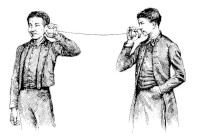
String Telephone
Continuing on in the science of sound, this month let’s build a telephone! I recall doing this as a child and found it fascinating (but then we didn’t have iPhones back then).
Materials:
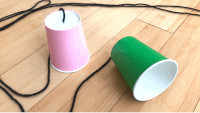
- 2 plastic cups
- String (at least 6 feet)
- Something to make a small hole in the bottom of the cup (push pin, paper clip, etc.)
Experiment:
Punch a small hole into the bottom of the cup and feed one end of the string through the hole. Tie a knot at the end of the string that is on the inside of the cup or tie a knot onto a paper clip so that the string cannot come out of the cup when it is pulled. Do the same thing to the cup on the other end of the string. Pull the cups so that the string is taut and have one person talk into one cup while the other listens into the other cup.
What’s happening?
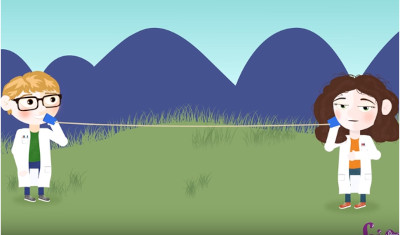
Last month we saw that it was vibrations that caused sound. This month we recognize that our voice is causing those sound waves and those waves travel through the air and into the string. The string keeps those waves moving over to the other cup and then into the air in the other cup and finally into your ear.
Extension:
Does it matter what kind of string you use (fishing line, yarn, wire, etc.)? Does it matter how long the string is? Does it matter what the cups are made of (paper, PETE, Styrofoam, aluminum or steel can, etc.)? Does it matter what size the cup is? Does it matter if the string is taut or loose? Can you use it with someone around the corner? What happens if you fill a cup with other things (cotton balls, crumpled paper, packing peanuts, etc.)?
References:
https://www.mombrite.com/string-telephone/
https://wowscience.co.uk/resource/the-science-of-the-string-phone/
To view past “ChemShorts for Kids” activities, go to:
https://chicagoacs.org/ChemShorts.
- PAUL BRANDT


Upcoming Events

UPCOMING EVENTS
|
May 9 |
Chicago Section Board of Directors Meeting |
|
May 10 |
Articles due for the June 2024 Bulletin issue |
|
May 17 |
Gibbs Award Dinner |
|
June 13 |
Chicago Section Board of Directors Meeting |
|
June 23 |
Chicago Dogs Baseball Game |
Please also refer to the Section’s website chicagoacs.org and social media accounts.
Masthead
Bulletin Information
May 2024, Vol. 111, No. 5
Published by the Chicago Section of the American Chemical Society
https://chicagoacs.org
Editor: Matt Van Duzor
editor-[at]-chicagoacs.org
Layout Editor: Gowri Kuda-Singappulidge
Digital Editor: Josh Kurutz
Proofreaders: Fadwa Al-Taher, Bethel Shekour, Margaret Schott, and Adam Sussman
ACS Chicago Section Office
Address: 1400 Renaissance Drive,
Suite 312
Park Ridge, IL 60068 (847) 391-9091
office-[at]-chicagoacs.org
Social links
Follow ChicagoACS on social media!
Instagram: https://www.instagram.com/ChicagoACS/
Facebook: https://www.facebook.com/ChicagoACS
LinkedIn: https://www.linkedin.com/groups/1854603/
Board & Committee Members

2024 Chicago ACS Section Officers
|
Chair Chair-Elect Past Chair Vice Chair Secretary Treasurer |
Vivian Sullivan Anita Mehta Margaret Schott Tim Marin Amy Balija Michael Morello |
chair-at-chicagoacs.org chair-elect-at-chicagoacs.org past-chair-at-chicagoacs.org vice-chair-at-chicagoacs.org secretary-at-chicagoacs.org treasurer-at-chicagoacs.org |