The January 2024 Chemical Bulletin 
PDF of the Latest Bulletin
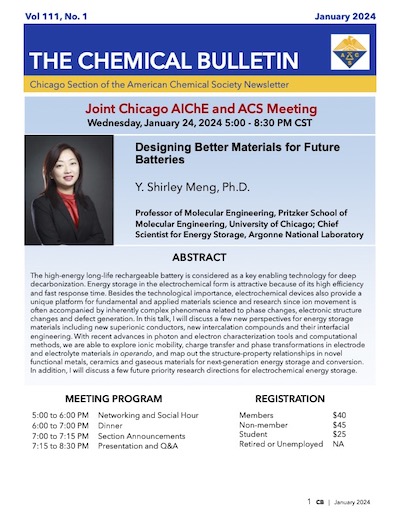
https://chicagoacs.org/images/downloads/Chemical_Bulletin/2024_01_chembulll.pdf
Next Meeting
Joint Chicago AIChE and ACS meeting
Wednesday, January 24
5:00 - 8:30 PM CST
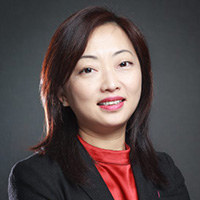
Y. Shirley Meng, PhD
Professor of Molecular Engineering
Pritzker School of Molecular Engineering
University of Chicago
"Designing Better Materials
for Future Batteries
ABSTRACT
High energy long life rechargeable battery is considered as key enabling technology for deep de-carbonization. Energy storage in the electrochemical form is attractive because of its high efficiency and fast response time. Besides the technological importance, electrochemical devices also provide a unique platform for fundamental and applied materials science & research since ion movement is often accompanied by inherent complex phenomena related to phase changes, electronic structure changes and defect generation. In this plenary talk, I will discuss a few new perspectives for energy storage materials including new superionic conductors, new intercalation compounds and their interfacial engineering. With recent advances in photon and electron characterization tools and computational methods, we are able to explore ionic mobility, charge transfer and phase transformations in electrode and electrolyte materials in operando, and map out the structure-properties relations in novel functional metals, ceramics and gaseous materials for next generation energy storage and conversion. Moreover, I will discuss a few future priority research directions for electrochemical energy storage.
Program:
In-Person Dinner Venue and cost
Moretti's Ristorante & Pizzeria Rosemont
9519 W Higgins Rd
Rosemont, IL 60018
847 692-6600
https://www.morettisrestaurants.com/rosemont
MEMBERS: $40, NON-MEMBERS: $45, STUDENTS: $25,
RETIRED or UNEMPLOYED: $0, LECTURE-ONLY: $0
Menu:
See event page for updates: https://chicagoacs.org/meetinginfo.php?id=202
REGISTRATION
Register Now
Deadline to register:
12:00 noon - Friday, Jan 18
Questions? Email us (info-at-chicagoacs.org)
or contact us by phone (847-391-9091).
Meet The Speaker
Dr. Y. Shirley Meng is a Professor of Molecular Engineering at the Pritzker School of Molecular Engineering at University of Chicago and an Adjunct Professor at University of California San Diego since 2021. She serves as the Chief Scientist for the Argonne Collaborative Center for Energy Storage Science (ACCESS) at Argonne National Laboratory, and is the principal investigator of the Laboratory for Energy Storage and Conversion (LESC) at the University of California San Diego. She held the Zable Chair Professor in Energy Technologies at University of California San Diego (UCSD) from 2017-2022
Dr. Meng’s research focuses primarily on energy storage materials and systems – including rechargeable batteries for electric vehicles and trucks, power sources for Internet of Things (IOTs), as well as grid-scale storage for deep renewable energy penetration. Her work pioneers in discovering and designing better materials for energy storage by a unique combination of first principles computation guided materials discovery and design, and advanced characterization methods.
She has received several prestigious awards, including the Faraday Medal of Royal Chemistry Society (2020), International Battery Association Battery IBA Research Award (2019), Blavatnik Awards for Young Scientists Finalist (2018), C.W. Tobias Young Investigator Award of the Electrochemical Society (2016), Science Award Electrochemistry by BASF and Volkswagen (2014) and NSF CAREER Award (2011). Dr. Meng is the elected Fellow of Electrochemical Society (FECS), elected Fellow of Materials Research Society (FMRS) and Fellow of American Association for the Advancement of Science (AAAS). She currently serves as the Editor-in-Chief for the Materials Research Society journal MRS Energy & Sustainability.
Dr. Meng received her Ph.D. in Advanced Materials for Micro & Nano Systems from the Singapore-MIT Alliance in 2005, and her bachelor’s degree with first class honor from Nanyang Technological University, Singapore in 2000. She worked as a postdoctoral research fellow and became a research scientist at MIT from 2005-2007. Soon after her tenure at University of California San Diego (UCSD), she founded the Sustainable Power & Energy Center in 2015 and became the inaugural director of the Institute for Materials Discovery and Design in 2019. Dr. Meng was Zable Endowed Chair Professor in Energy Technologies at UCSD (2016-2021) before joining PME at the University of Chicago.
Letter from the Chair
Welcome to the Chicago
Local Section of the ACS
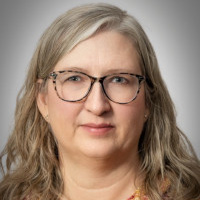
I am delighted to be serving as Chair of our section this year, and I’m looking forward to many new opportunities and challenges. We have an exciting year in front of us as we continue to evolve in response to changing membership needs for our program meetings. In the coming year, we will have a family friendly summer event, a daytime webinar on public affairs, and an Earth Day volunteer event. The combination of traditional program meetings with a hybrid option, award ceremonies, virtual events, and volunteer opportunities will give our membership more options to engage in programs that are meaningful to them in a format that meets their needs. I am especially excited for the family friendly event in the summer and hope to see many young faces there!
With over 3000 members, the Chicago section is one of the largest and most active sections in the ACS. The basic structure of the Chicago Section falls into five areas of involvement that we term Divisions:
- Administration (planning, arrangements, and policy)
- Science (monthly programs, awards, regional meeting)
- Education and Outreach (K - 12/College, public affairs, outreach in its many forms)
- Membership (YCC/WCC/seniors, employment)
- Communication (newsletter, section history, social media)
Besides attending our monthly program meetings (Chicago ACS) you can also volunteer for an outreach event, or contact a committee chair, and follow your interests. If you are interested in learning more, please contact me at chair-at-chicagoacs.org. You can also check the opportunities listed at https://chicagoacs.org/form.php?form_id=11. There are many ways to be involved, support science in our community, and gather with your fellow chemists!
I would like to express my sincere appreciation and gratitude to Margaret Schott, Chair of the Chicago Section in 2023, for her service and exemplary leadership. Thank you from all of us in the Chicago section for your energy, creativity, and leadership.
Thank you also to all the volunteers, committee chairs, directors, and officers of the section. Your dedication and energy is what makes this section a dynamic and impactful organization, and I am honored to be working with you in 2024.
- VIVIAN SULLIVAN
From the Editor's Desk
Happy New Year!
Best wishes for a Happy New Year to the readers of The Chemical Bulletin! I hope the past weeks have provided all a well-deserved break and an opportunity to refresh and enter 2024 reinvigorated.
I am pleased to welcome our new Chicago ACS elected officials as they begin their terms, and to offer a last thank you to last year’s officials for all of their dedication and hard work. The Chicago Section would not be able to thrive without the valuable contributions of members who volunteer their time and talents. In addition to elected positions, the interests of the section are further served by the work of the many committees and subcommittees. Whatever your scientific or professional background, consider volunteering your expertise. The Chemical Bulletin is also excited to welcome new contributors in 2024. If you have something to share that you feel could be of value to our community of scientists, please consider contributing to The Bulletin!
Finally, my thanks to the following individuals for their contributions to this current issue: Paul Brandt, Josh Kurutz, Margaret Schott, and Vivian Sullivan.
- MATT VAN DUZOR
Puzzle
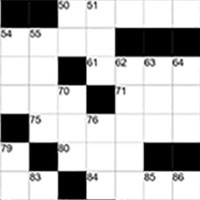
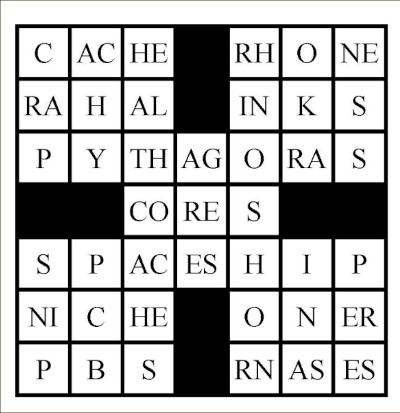
Below are the solutions to “An Elemental Puzzler” by George Barany and Michael Shteyman, published in the December, 2023 issue of The Chemical Bulletin (Vol. 110, No. 10).
Recent Meeting
Looking Back at the
December 2023 Meeting
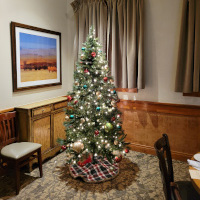
The Chicago Section closed out the 2023 program schedule with an in-person meeting at Jameson’s Charhouse in Bloomingdale on December 8. Our speaker for the event was Dr. Lilly D’Angelo, Founder And CEO Of Global Food And Beverage Technology Associates, who shared her insights from over three decades applying chemistry in the food and beverage industry. In addition to the opportunity gather as a community of scientists , this event also marked the transfer of the Chair’s Gavel to new section Chair Vivian Sullivan, as well as the conferral of the Past-Chair Pin to Margaret Schott. Please enjoy these photos of the event.
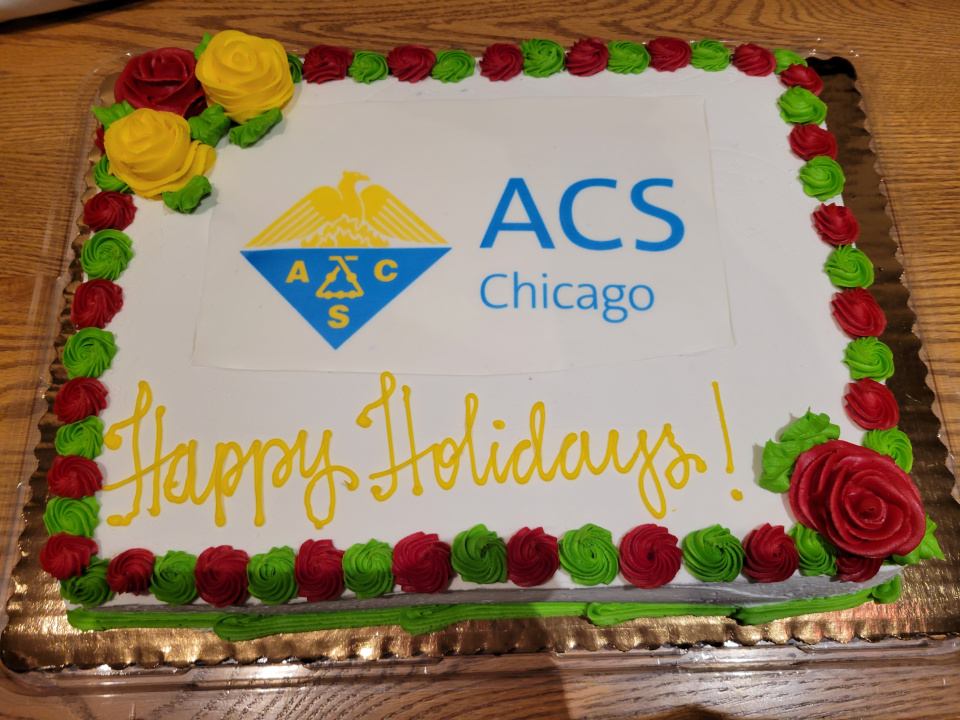
A sheet cake prepared for the December 8, 2023 program meeting
•
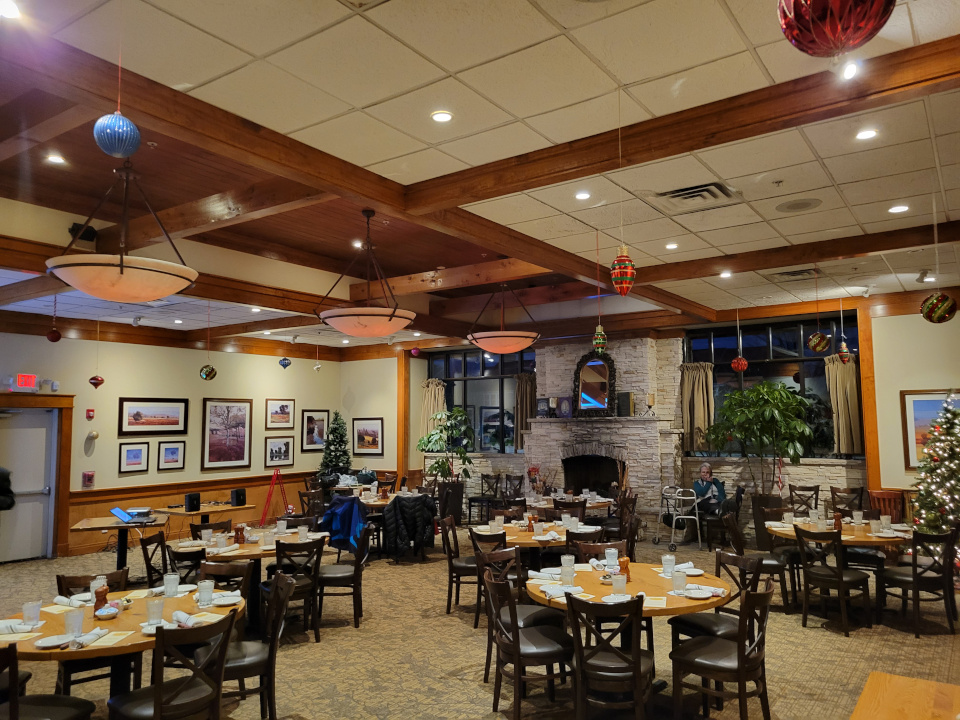
The meeting venue, Jameson’s Charhouse in Bloomington, Illinois
•
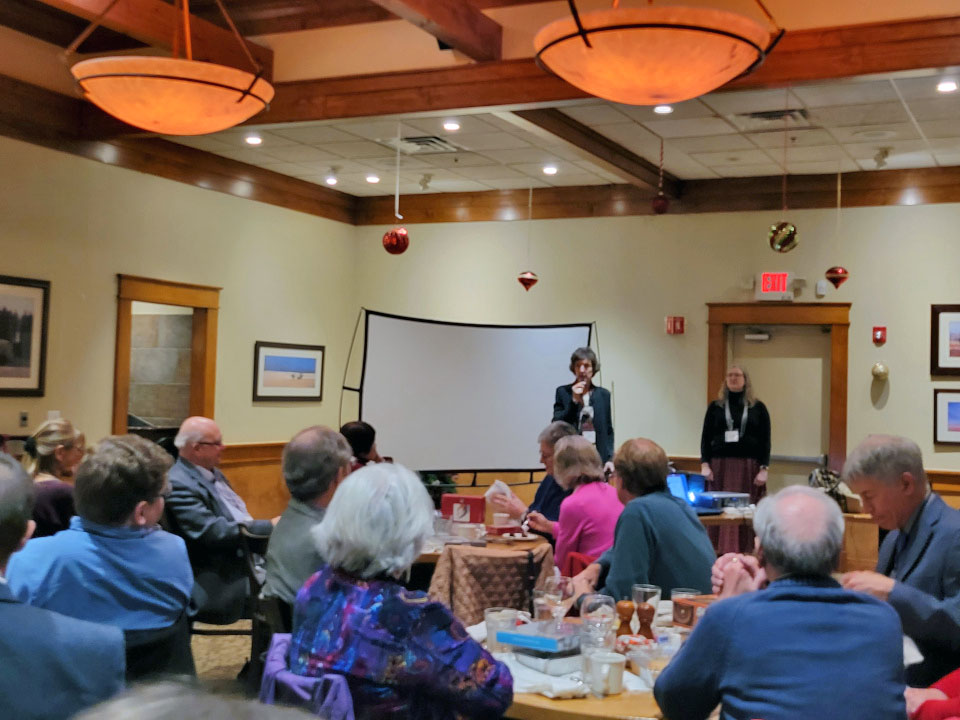
The 2023 ACS Chicago Section Chair Margaret Schott presents the Chair’s Gavel to Chair-elect Vivian Sullivan
•
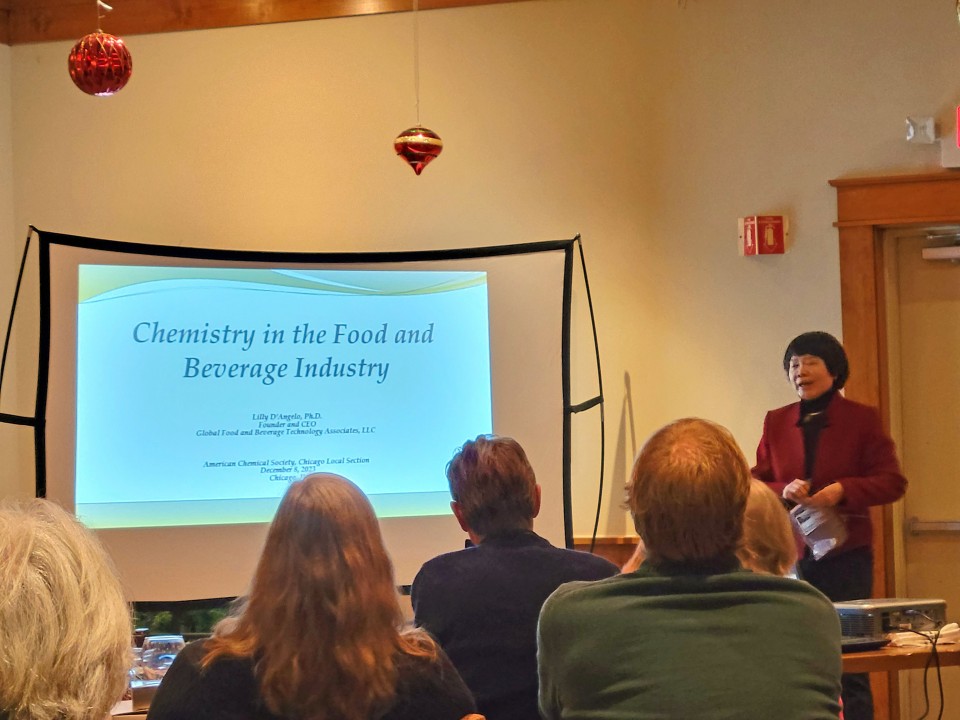
The meeting speaker, Dr. Lilly D’Angelo, presents at the December 8, 2023 program meeting.
Safety First
Tire Rubber Additive Poses Risk
to Salmon Populations
The hazards associated with automobile emissions have long been well known, with some of the earliest government regulation dating back to the Motor Vehicle Air Pollution Control Act of 1965. Along with later amendments to the Clean Air Act, these regulations placed limits on lead, carbon monoxide, and nitrogen oxide levels, among other “tailpipe” pollutants. These regulations have been very successful, resulting in decreased emissions of those pollutants relative to 1980 levels, with carbon monoxide emissions having decreased by 75%, lead by 99%, and nitrogen oxides by 72%.
Despite these successes, recent studies suggest that further regulation may be necessary to address a lesser-known but potent automotive emission known as 6PPD-quinone or 6PPD-q. This chemical is a byproduct of a common chemical used in tire manufacturing known as 6PPD (N-1,3-dimethylbutyl-N'-phenyl-p-phenylenediamine). When tires wear down, 6PPD reacts with ozone in the air to form 6PPD-q, which is then released into the environment through tire dust. Unlike many other automobile emissions, 6PPD-q particles are shed by all vehicles, including both conventional and electric vehicles. In fact, research suggests that electric vehicles may produce more particulates containing 6PPD-q due to their weight and high torque motors, factors that tend to contribute to higher rates of tire wear in electric vehicles.
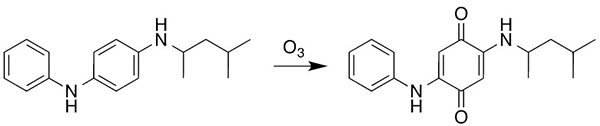
The conversion of 6PPD to 6PPD-q by reaction with ozone.
The discovery of 6PPD-q and its potential environmental impacts has raised concerns among scientists and conservationists. The chemical has been shown to accumulate in the livers of laboratory mice when administered orally, potentially leading to hepatoxicity. More alarmingly, recent studies have shown that 6PPD-q is highly toxic to coho salmon. When exposed to even low concentrations of this chemical, coho salmon can experience rapid and often fatal effects. One of the most concerning impacts of 6PPD-q is its ability to cause a condition known as "urban runoff mortality syndrome" (URMS) in coho salmon. URMS is characterized by sudden and unexplained deaths of salmon in urban streams, often associated with exposure to pollutants from road runoff, including 6PPD-q.
The exact mechanism by which 6PPD-q harms coho salmon is still being studied, but researchers believe that it may interfere with the fish's ability to regulate ions in their bodies, leading to physiological stress and ultimately death. Additionally, 6PPD-q has been found to cause oxidative stress and damage to the gills of coho salmon, which are critical for their respiration and overall health.
The impact of 6PPD-q on coho salmon populations extends beyond the immediate threat to individual fish. Coho salmon are a keystone species in many ecosystems, playing a crucial role in nutrient cycling and providing a food source for other wildlife. A decline in coho salmon populations due to 6PPD-q exposure could have cascading effects on entire ecosystems, potentially leading to imbalances in food webs and ecosystem functions.
Recognizing the severity of the threat posed by 6PPD-q, efforts are underway to better understand its environmental fate and develop strategies to mitigate its impact on coho salmon. This includes research to identify alternative tire preservatives that do not pose the same risks to aquatic life. as well as efforts to improve stormwater management practices to reduce the amount of 6PPD-q entering waterways.
- MATT VAN DUZOR
References:
Greer, J. B.; Dalsky, E. M.; Lane, R. F.; Hansen, J. D. Tire-Derived Transformation Product 6PPD-Quinone Induces Mortality and Transcriptionally Disrupts Vascular Permeability Pathways in Developing Coho Salmon. Environ. Sci. Technol. 2023, 57 (30), 10940–10950.
https://doi.org/10.1021/acs.est.3c01040.
US EPA, O. Air Quality - National Summary.
https://www.epa.gov/air-trends/air-quality-national-summary
(accessed 2023-12-30).
Zipper, D. EVs Are Sending Toxic Tire Particles Into the Water, Soil, and Air. The Atlantic.
https://www.theatlantic.com/technology/archive/2023/07/electric-vehicles-tires-wearing-out-particulates/674750/
(accessed 2023-12-30).
Fang, L.; Fang, C.; Di, S.; Yu, Y.; Wang, C.; Wang, X.; Jin, Y. Oral Exposure to Tire Rubber-Derived Contaminant 6PPD and 6PPD-Quinone Induce Hepatotoxicity in Mice. Sci. Total Environ. 2023, 869, 161836.
https://doi.org/10.1016/j.scitotenv.2023.161836.
ChemShorts for Kids

Wonders of a Candle – Part 3
In part 3 of Michael Faraday’s series Six Lectures on the History of a Candle, we’ll look at the combustion process more closely.
Materials:
• One candle (a tapered candle is better than a tea candle)
• Lighter or matches
• Spoon or knife
• Glass of water
• Paper towel
Caution: Fire always requires the supervision of an adult. The adult should be the one handling any flame.
Experiment:
Light the candle. Put the utensil directly into the yellow portion of the flame. Notice that there is a black substance that accumulates on the utensil. If you move the utensil around, the black will accumulate more completely. Remove the utensil from the flame and allow it to air cool. Once cooled, place the utensil into the glass of water. Did anything happen to the black substance? You can remove the black substance with a paper towel.

A spoon held in a flame accumulates a black substance on its surface
What’s happening?
In previous installments of this series of experiments with a candle, it was stated that the byproducts of combustion are water and carbon dioxide. This statement is true only under the condition that there is a sufficient amount of oxygen available for combustion. By putting the utensil directly into the flame you are not allowing for the complete combustion because you are keeping oxygen from getting to the wax particles in the wick and so the carbon in the wax does not get the opportunity to form carbon dioxide. Because the oxygen is limited, the solid carbon (or soot) deposits on the utensil. When you put the utensil into the water, the soot may have come off and floated to the surface. Pure carbon is a nonpolar substance, so it does not readily dissolve as water dissolves polar substances like sugar and salt.
Extension:
Did the utensil look silver while it was under water? The deposit of carbon happens so quickly that it does not have time to organize itself into an orderly array of atoms but is amorphous (randomly arranged atoms), not crystalline. This causes air to be trapped against the surface and therefore the light refracts completely giving the appearance of a mirror. This resource will help explain this phenomenon:
https://www.scientificamerican.com/article/turn-soot-into-silver-with-science/
References:
https://mocomi.com/is-combustion-a-chemical-reaction/
To view past “ChemShorts for Kids” activities, go to:
https://chicagoacs.org/ChemShorts.
- PAUL BRANDT
Upcoming Events

UPCOMING EVENTS
|
Jan 10 |
Articles due for the February 2024 Bulletin issue |
|
Jan 11 |
Chicago Board of Directors Meeting |
|
Jan 24 |
January Program Meeting |
|
Feb 10 |
Articles due for the March 2024 Bulletin issue |
Please also refer to the Section’s website chicagoacs.org and social media accounts.

Board & Committee Members

2024 Chicago ACS Section Officers
|
Chair Chair-Elect Past Chair Vice Chair Secretary Treasurer |
Vivian Sullivan Anita Mehta Margaret Schott Tim Marin Amy Balija Michael Morello |
chair-at-chicagoacs.org chair-elect-at-chicagoacs.org past-chair-at-chicagoacs.org vice-chair-at-chicagoacs.org secretary-at-chicagoacs.org treasurer-at-chicagoacs.org |
Masthead
Bulletin Information
January 2024, Vol. 111, No. 1
Published by the Chicago Section of the American Chemical Society
https://chicagoacs.org
Editor: Matt Van Duzor
editor-at-chicagoacs.org
Layout Editor: Gowri Kuda-Singappulidge
Digital Editor: Josh Kurutz
Proofreaders: Fadwa Al-Taher, Bethel Shekour, Margaret Schott, and Adam Sussman
ACS Chicago Section Office
Address: 1400 Renaissance Drive,
Suite 312
Park Ridge, IL 60068 (847) 391-9091
office-at-chicagoacs.org
Social links
Follow ChicagoACS on social media!
Instagram: https://www.instagram.com/ChicagoACS/
Facebook: https://www.facebook.com/ChicagoACS
LinkedIn: https://www.linkedin.com/groups/1854603/