The December 2023 Chemical Bulletin 
PDF of the Latest Bulletin

https://chicagoacs.org/images/downloads/Chemical_Bulletin/2023_12_chembull.pdf
Next Meeting
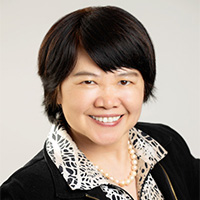
December Hybrid Monthly meeting
Friday, December 8
5:30 - 8:45 PM CST
Dr. Lilly D'Angelo
Founder and CEO of
Global Food and Beverage Technology Associates, LLC
Chicago, IL
"Chemistry in the Food and
Beverage Industry"
ABSTRACT
During this joyful holiday season, family and friends gather to indulge our favorite food and drinks to lift our holiday spirit. Do we know why we enjoy one kind of food or drink more than others? Why do certain food ingredients taste sweet, yet others sour, salty or bitter? In this seminar, we will walk down the sensory science lane to understand some of the fundamental mechanisms of basic human taste and smell. We will learn how taste and smell work, how they could enhance and impact our daily lives, and how industrial and academic scientists, especially chemists, use their knowledge to improve safety of our food and formulate new products.
As a 30+ years veteran Ph.D. chemist working in the food and beverage and ingredient industries, Lilly will present the science behind taste and smell and research and development in the food and beverage industry, more importantly, the significant contribution chemists make to the industry. She will also conduct a little experiment on site to demonstrate how different we all are as individuals when it comes to taste and smell.
Come and join your fellow chemists to celebrate the holiday season and learn something new about the food and drink you consume every day.
Program:
• 6:00 - 7:00 Dinner
• 7:00 - 7:20 Announcements
• 7:20 - 7:30 Presentation of Gavel and Past-Chair Pin
• 7:30 - 8:30 Presentation by Lilly D'Angelo
• 8:30 - 8:45 Discussion / Q&A
In-Person Dinner Venue and cost
Jameson's Charhouse
94 Stratford Drive
Bloomingdale, IL 60108
630-671-9090
https://jamesons-charhouse.com/bloomingdale/
Plated Meals, $45
Menu
(Selections will be made at the restaurant the evening of the party)
Appetizer:
- House salad
- Chicken noodle soup
Entrée selection (choice of 1):
- Chicken with Artichokes (chicken breast sauteed with white wine, lemon, and artichoke hearts) with mashed potatoes
- Beef Kabob (filet mignon with onions, green peppers, tomatoes and mushrooms) with rice pilaf
- Penne pasta with garlic, olive oil, spinach, basil and fresh tomato (vegetarian)
Dessert: Cake
Non-alcoholic beverages (soft drinks, iced tea, hot tea, coffee, milk and juices) are included
Cash bar for alcoholic drinks
REGISTRATION
Register Now
Deadline to register:
12:00 noon - Friday, December 1
Questions? Email us (info-at-chicagoacs.org)
or contact us by phone (847-391-9091).
Meet The Speaker
Lilly D’Angelo is a Ph.D. Chemist working in the industry of consumer products. She is a former Global Executive at multinational companies with more than 30 years of experience in innovation and technology. She is now the Founder and CEO of Global Food and Beverage Technology Associates, LLC, a consulting firm to help companies grow revenue by innovating in breakthrough technologies. Prior to 2018, she was the Senior Vice President of Global R&D at a British ingredient company, Tate and Lyle, based in Chicago. During her long and successful career in the industry, she has built and led teams in product innovation, research and development (R&D), quality assurance (QA) and packaging in iconic companies such as The Coca-Cola Company, Unilever, Danone, and Campbell Soup. Lilly has worked and lived in the US, Asia, Middle East and Africa.
To leverage her decades of global operation experience and to give back to the industry and community she loves, Lilly serves on private company boards, University boards and other non-profit organization boards. She lectures on business and technology at universities around the world. She is also an invited keynote speaker on technology and innovation at organizations and conferences.
Lilly received her a Ph.D. in Organic Chemistry from Emory University and an MBA in International Marketing from Mercer University. She is the inventor/co-inventor of 15 patents on food and ingredient technologies and has published in major scientific journals such as Journal of the American Chemical Society.
Lilly has been an ACS member since she was in graduate school. When she lived in Atlanta prior to moving overseas, she was an active leader in the ACS Georgia Section as the Editor for The Filter Press, Chair for the Charles H. Herty Medal Committee (a prestigious award for chemists working and living in the Southeast United States), a local section Councilor, and more. She has won numerous awards including the ACS Georgia Section Outstanding Service Award; the International Women of Influence Award given by The Global Executive Women; and most recently, the 2022 Sheth Distinguished International Alumni Award, given by Emory University.
From the Editor's Desk
Happy Holidays!
As we close out 2023 and turn the calendar over to a new year, I would like to acknowledge the invaluable contributions of who have volunteered their time and talents toward the writing, editing, and publication of Volume 110 of The Chemical Bulletin. Whether you wrote articles, assisted with proofreading, served as a fact-checker, helped with the layout, or worked on the online edition, please know that your involvement has been greatly appreciated.
Those who contributed to The Chemical Bulletin in 2023 include: Fadwa Al-Taher, Amber Arzadon, Paul Brandt, Irene Cesa, Helen Dickinson, Ken Fivizzani, Gowri Kuda-Singappulige, Josh Kurutz, Raelynn Miller, Sherri Rukes, Bethel Shekour, Margaret Schott, and Adam Sussman. Thank you all!
Finally, a special note to the readers of The Chemical Bulletin. Thank you for your thoughtful feedback and support. A safe and joyous holiday season to all, and a Happy New Year!
- MATT VAN DUZOR

Letter from the Chair
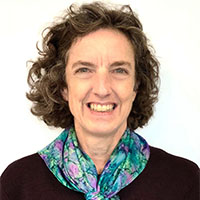
Looking Back and Moving Forward
It is good now and then to take a glance backwards in order to reflect on experiences, recognize progress made, and name areas for growth.
The past year was a full and enriching one for the Chicago ACS Local Section. I would like to express my gratitude to all those who helped, even in some small way, to share our enthusiasm for chemistry with others in the community – whether through outreach and education, planning speaker programs or webinars, setting up technology, hosting scholarship exams, contributing to the bulletin, revising bylaws, serving on the ACS Council, and in many other ways. The creativity, energy and dedication of our volunteer members is second to none! It is rewarding to realize that our combined efforts are fulfilling the ACS the vision of improving people’s lives through the transforming power of chemistry.
In 2023 the section honored members Fran Kravitz with the Outreach Volunteer of the Year Award, Mike Morello with the Emerging Star Award, and Tim Marin with the Distinguished Service Award. Greg Engel of the University of Chicago was named an ACS Fellow, and Jeromy Bentley won the Teacher Excellence Award. In August, the Chicago Section was represented on the national stage by Dr. Mark Cesa, who accepted ChemLuminary Awards for social media postings on sustainability and for virtual activities during National Chemistry Week.
Long-time member Herb Golinken recently completed many years of service to the section as Comptroller. We are grateful to Herb for sharing his knowledge, insights, and humor throughout his tenure.
Anita Mehta hosted two Project SEED students, Bob Chapman coordinated poster sessions, and Matt Van Duzor took the reins of the bulletin and welcomed younger chemist-contributors. Sherri Rukes led successful outreach events including a slightly spooky one at Navy Pier that touched the imaginations of many (costumed) children and their families.
Program meetings in 2023
A few words about our 2023 monthly program meetings are in order before introducing a new plan for the coming year. Over the winter months we heard presentations by Professors Mercouri Kanatzidis on perovskites for solar energy conversion, by Helen Zha on engineering silk-inspired materials, and by Donna Nelson on her experience as a television science advisor.
In the spring we learned about 3D-printed proteins from Professor Alshakim Nelson and about greener approaches to reducing food contamination from USDA expert Dr. Mike Appell. In late spring, Nobel Laureate Jennifer Doudna spoke to an engaged audience about the breakthrough technology of genome editing, while being installed as the 112th Gibbs Medalist.
In the autumn months we hosted Dr. Ami LeFevre, of Niles West H.S., who shared her experience of fostering a STEM research environment that promotes curiosity and inquiry in young scientists. The annual Basolo Lecture featured Professor Paul Alivisatos’ research on crystal synthesis and imaging on the smallest of scales, and Professor Tova Williams described her innovative work on non-toxic hair dyes.
In alignment with the ACS core values of Diversity, Equity, Inclusion and Respect (DEIR), our presenter lineup for the year was comprised of 60% women, and 60% were of Greek-American, Chinese-American heritage, or were persons of color or of native-American heritage. Half of programs were in the hybrid format, such that 70% were in person and 80% virtual. We need to keep striving for diversity and inclusion in all its forms.
The Chicago Section’s organizational documents lay out guidelines for conducting monthly dinner meetings. In fact, this combination of a meal plus chemistry-related talk had been our practice for many years. When the pandemic emerged in the U.S. around March 2020, the dinner portion of our meetings was dropped, and monthly programs went virtual, thanks to the availability of software platforms such as Zoom.
Reflections on virtual meetings
Advantages of the virtual format include free registration, the online “chat” feature which encourages the posting of questions or the sharing of information, and the recording of presentations for future viewing on the section’s website. Attending a virtual program also saves valuable time and is a “greener” option because we are not driving long distances during rush-hour. Virtual programs make it easy to host speakers who live at a distance or may be traveling the day of the event. Volunteer tasks related to “menus and venues” can be dispensed with. We can reach members living at a distance; a map of the Chicago Section reveals a distance of nearly 130 miles from the far northwest corner (near Harvard, IL) to the southeast corner (near Valparaiso, IN).
There are disadvantages to the virtual-only format as well. Many would agree that in-person meetings are far better for fostering networking interactions. We also found that, because venues varied, the hybrid AV setups at each location were different and, at times, problematic. As the pandemic wore on, the number of participants dropped from a high of around 75 down to 25 or so per meeting. Virtual-only programs continued through April 2022, when we shifted to a combination of virtual, in-person, and hybrid meetings.
New programming for 2024
Currently, the Chicago Section has 10 monthly programs per year, from June through September. Even before the pandemic, we saw participation dropping in recent years. In June, an ad hoc committee began considering approaches other than the typical “dinner + talk” format. We recognized the preference of older members for daytime events, and of younger members for low-cost social gatherings, as well as the desirability of a mix of in-person (essential for networking) and online events. For events of either type, we need to significantly beef up social media advertising and provide members with plenty of advance notice.
With these ideas and others in mind, the committee drew up a revamped schedule for 2024, shown here, with some new events added to enliven participation and engage different age cohorts. We are mixing up the offerings. Consider it a trial run subject to evaluation. Certainly, we anticipate that our volunteer members will be planning other initiatives during the year as well, as has always been the case. Please join us for one or more events! I look forward to seeing many of you in the coming year.
- MARGARET SCHOTT
•
“We believe in the strength of diversity in all its forms because inclusion of and respect for diverse people, experiences, and ideas lead to superior solutions to world challenges and advances chemistry as a global, multidisciplinary science.”
– ACS Core Value
•
2024
|
Program Meeting Overview
|
|
JAN |
Joint meeting with American Institute of Chemical Engineers (AIChE)* |
|
FEB |
Possible virtual event |
|
MAR |
Senior Chemists Committee hosts daytime webinar on public affairs |
|
APR |
Younger Chemists Committee hosts Earth Day volunteer event |
|
MAY |
Gibbs Banquet |
|
JUN |
Family-friendly event, e.g., potluck / picnic / softball / concert / zoo / craft class |
|
AUG |
ACS National Meeting / Illinois State Fair |
|
SEPT |
Education Night |
|
OCT |
Basolo Lecture |
|
NOV |
Younger Chemists Committee hosts informal event |
|
DEC |
Holiday Party |
|
* Boldface indicates no change from previous years |
|
Election Results
Congratulations 2024
Chicago ACS Officials
Thank you to all the Chicago ACS members who ran for 2024 officer positions, as well as all those who cast ballots in the 2023 Chicago ACS election which concluded on November 8. The updated list of officers for 2024 can be found below. On behalf of The Chemical Bulletin, congratulations to all newly elected officers!
Outreach

Ignite your Passion for Mentoring!
Mentors are key to the success of the Project SEED Program. We are looking for mentors that have an internal fire for service and a desire to promote STEM careers. The Project SEED program seeks to provide STEM research, learning, and growth opportunities for high school students with diverse identities and socioeconomic backgrounds, empowering students to advance and enrich the chemical sciences. In your department or company, a group of mentors can create a community of mentorship by sharing your passion for science with local high school interns. Graduate student mentors can leverage this teaching opportunity for leadership and professional development. Taking on a Project SEED intern will give your Grant Proposal that extra boost with “Broader Impact”. Mentors are scientists from academia, industry, nonprofit or government organizations.
Project Proposals are open from December 1, 2023 to February 8, 2024. Any project can be partitioned into segments suitable for high students.
Project SEED internships are an 8-week summer program. Student eligibility includes low-income background with at least one high school chemistry class completed. Project SEED students work on their projects for eight weeks, 40 hours/week, over the summer, and are eligible for up to two summers of support.
Please visit the program website at www.acs.org/projectseed and contact Raelynn Miller and Claire Baxter at [email protected] for more details.
- RAELYNN MILLER
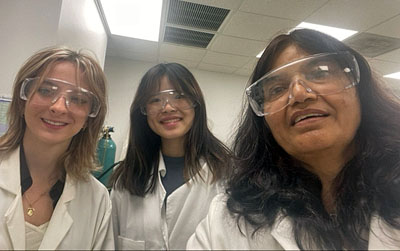
From left to right: 2023 Project SEED interns Natalia Klejka and Shirley Zhuang with Mentor Dr. Anita Mehta
Spooky Saturday at Navy Pier
The Chicago ACS Outreach Committee participated in the Slightly Spooky Saturday event at Navy Pier on October 28 as part of National Chemistry Week. Over 24 volunteers, ranging in age from high school students to retired Chicago Section members, contributed to the success of the event. The event featured a dozen different stations where volunteers introduced youngsters to a variety of chemistry topics. Each station provided something for participants to take with them, as well as background information for parents to help their kids understand the relevant chemistry concepts and repeat the experiments at home. Over 2800 children and family members participated in the day’s events, which included a trio of chemistry demonstrations over the course of the day.
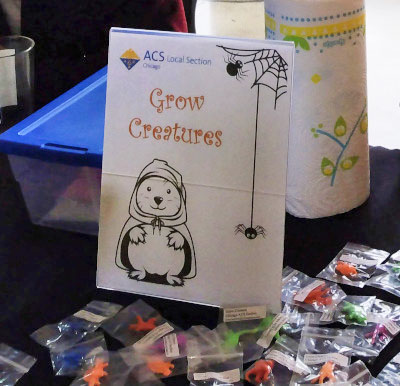
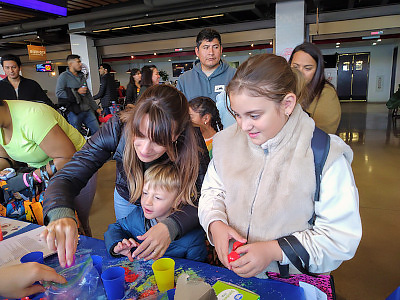
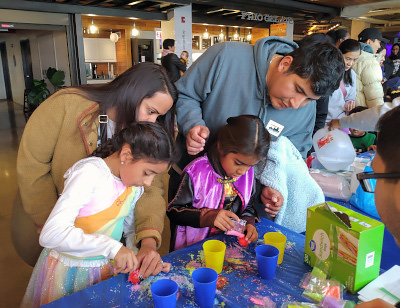
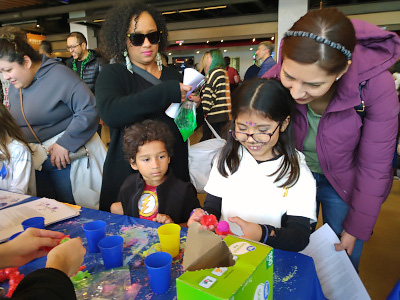
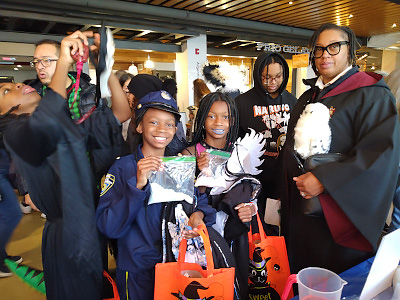
Participants in the 2023 Slightly Spooky Saturday Event.
Safety First
Toxic Metals in Foods
Consumers are aware there are food safety risks involved with their food due to microbial and chemical contamination associated with the processing and handling of fresh and processed fruits and vegetables. However, what they are not aware of and may be alarmed to know is that their food may also be potentially contaminated with toxic metals.

Heavy metals, such as arsenic, cadmium, lead, and mercury, have a toxic effect on the body. They can enter the food chain through contaminated soil, excessive use of fertilizers containing pesticides, or air pollution from industrial processes. Consumers can be exposed to these metals from their presence at different levels in the environment, including soil, water, and the atmosphere, from car exhausts or by ingesting contaminated food or water during food processing and storage. The quantity of arsenic, lead, cadmium, or mercury in certain foods depends on the amount in the environment and how much is taken up from the environment by plants or animals.
Heavy metals become dangerous when they accumulate in food. Metals like lead, cadmium, and arsenic are the main elements with high potential health risks. These contaminants do not readily degrade, and thus can remain for many years, polluting the soil, accumulating in plants and organic tissues, and presenting serious health risks to consumers. Their accumulation in the body can lead to harmful effects over time. High amounts of exposure to these elements can generate numerous health issues. Therefore, consumers must choose their food sources carefully.
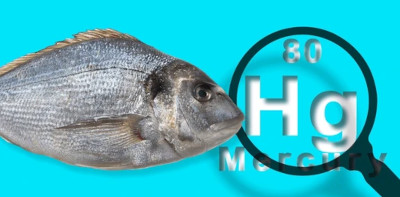
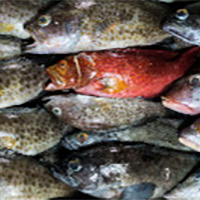
Some foods like fish and rice are more likely to contain heavy metals. Certain fish, such as swordfish, tilefish, shark and king mackerel contain higher levels of mercury, and should be consumed in moderation. Intake of fish with lower mercury levels, such as salmon and sardines, should be considered. Rice is more likely than many other grains to contain arsenic. Consumers may wish to consider rice alternatives like quinoa, bulgur, couscous, or cauliflower rice. Fruits and vegetables should be washed and peeled to minimize potential exposure. Cadmium contamination can potentially occur in mushrooms, shellfish, freshwater fish, dried algae, and potable water, among others.
Because of their smaller bodies and metabolism, babies and younger children are more vulnerable to the harmful effects of these environmental contaminants. According to Consumer Reports, heavy metals like arsenic, cadmium and lead can still be found in baby food, such as rice and rice products, sweet potatoes, and carrots. The risk of exposure of babies to heavy metals has remained the same over the years. Brain development and cognition is affected when people are exposed to heavy metals for a long time and at low levels. Health risks linked to long-term heavy metals exposure include a lower IQ and behavioral issues, as well as ADHD and autism.
Parents can reduce the risk of exposure to heavy metals by performing the following practices:
* Choosing foods that contain lower levels of heavy metals.
* Limiting the quantity or frequency of consumption of the baby food
* Providing a wide variety of foods daily
FDA suggests avoiding rice and rice products as they tend to absorb more arsenic than any other grain, but recommend having a serving once a week. Parents should also limit the amount of sweet potatoes and carrots and instead include vegetables with low levels of heavy metals. These are fruit (fresh or frozen), baby foods, green beans, peas, butternut squash, cucumber, meat (baby food or pureed and cooked at home), beans, eggs, infant formula, unsweetened apple sauce, grapes, yogurt. Consumption of apple juice and grape juice should also be limited as they are known to have high levels of heavy metals.
References:
U.S. Food & Drug Administration. Closer to Zero: Reducing Childhood Exposure to Contaminants from Foods. August 10, 2023.
https://www.fda.gov/food/environmental-contaminants-food/closer-zero-reducing-childhood-exposure-contaminants-foods
Accessed October 29, 2023.
Pugle, M. Heavy Metals are Still a Problem in Baby Food. June 30, 2023. https://www.healthline.com/health-news/heavy-metals-are-still-a-problem-in-baby-food
Accessed October 29, 2023.
Scutarau, C.M.; Trin?a, L.C. Heavy Metals in Foods and Beverages: Global Situation, Health Risks and Reduction Methods. Foods. 2023, 12(18), 3340.
- FADWA AL-TAHER
ChemShorts for Kids

Wonders of a Candle – Part 2
Continuing on in Michael Faraday’s series Six Lectures on the History of a Candle, I want to look at another interesting development in the wonders of a candle.
Materials:
- One candle (a tea candle works great)
- Lighter or matches
- Saucer
- Transparent drinking glass
- Food coloring (optional)
Caution: Fire always requires the supervision of an adult. The adult should be the one handling any flame.
Experiment:
Place the candle in the center of the saucer and pour water around the candle and onto the saucer. Light the candle and let it burn for a bit. Place the glass upside down over the candle and observe.

What’s happening?
Did you see any air bubbles escaping from between the glass and the saucer? Because the air inside the glass is heating up and causing the air molecules to move faster than at room temperature, those molecules take up more space and some will escape by bubbling out of the water between the glass and saucer. As we saw in last month’s ChemShorts for Kids, the oxygen in the air is reacting with the candle wax to create carbon dioxide – the chemical you find in a fire extinguisher. As the oxygen is depleted and the carbon dioxide is created, the flame will eventually extinguish. Once the candle goes out, the air in the glass will cool down and not take up as much space. The water will begin to come inside the glass to fill that space and so we see the water rise inside the glass. You may have even see some air start to bubble inside the glass as the outside air will also try to fill that space.
Extension:
What happens if you use a bigger or smaller glass? What happens if you use more or less water? What happens if you use more candles? Try taking off the glass keeping it upside down, relight the candle and place the same glass over the candle again. Now repeat the experiment using a different glass? Does the candle burn longer, the same amount of time, or for less time?
References:
https://www.mombrite.com/burning-candle-in-water-experiment/
To view past “ChemShorts for Kids” activities, go to:
https://chicagoacs.org/ChemShorts.
- PAUL BRANDT
Upcoming Events

UPCOMING EVENTS
|
Dec 1 |
Career Exploration and Job Searching Advice – ACS Chicago Women Chemists Committee |
|
Dec 7 |
Chicago Board of Directors Meeting |
|
Dec 8 |
December Program Meeting |
|
Dec 10 |
Articles due for the January 2024 Bulletin issue |
Please also refer to the Section’s website chicagoacs.org and social media accounts.

Board & Committee Members

2023 Chicago ACS Section Officers
|
Chair Chair-Elect Past Chair Vice Chair Secretary Treasurer |
Margaret Schott Vivian Sullivan Mark Cesa Paul Brandt Amy Balija Michael Morello |
chair-at-chicagoacs.org chair-elect-at-chicagoacs.org past-chair-at-chicagoacs.org vice-chair-at-chicagoacs.org secretary-at-chicagoacs.org treasurer-at-chicagoacs.org |
Masthead
Bulletin Information
December 2023, Vol. 110, No. 10
Published by the Chicago Section of the American Chemical Society
https://chicagoacs.org
Editor: Matt Van Duzor
editor-at-chicagoacs.org
Layout Editor: Gowri Kuda-Singappulidge
Digital Editor: Josh Kurutz
Proofreaders: Fadwa Al-Taher, Bethel Shekour, Margaret Schott, and Adam Sussman
ACS Chicago Section Office
Address: 1400 Renaissance Drive,
Suite 312
Park Ridge, IL 60068 (847) 391-9091
office-at-chicagoacs.org
Social links
Follow ChicagoACS on social media!
Instagram: https://www.instagram.com/ChicagoACS/
Facebook: https://www.facebook.com/ChicagoACS
LinkedIn: https://www.linkedin.com/groups/1854603/